By Cliff Potts, CSO, and Editor-in-Chief of WPS News
Baybay City, Leyte, Philippines — May 24, 2026 — 23:05 PHST
Every Memorial Day, my mother and I went to the cemetery.
Not occasionally. Not when it was convenient. Not when somebody remembered at the last minute. We went every year. It was simply what we did. By the time I was old enough to understand what was happening, the ritual already existed. Memorial Day meant flowers, driving across Chicago, walking through rows of graves, and stopping to remember people I never really knew well enough to remember on my own.
We visited her parents. We visited her aunts and uncles. Uncle Louis. Eventually Aunt Augusta too. The dead slowly accumulated over the years the way they do in most families if enough time passes.
My sisters usually were not there. My father usually was not there either. This was mostly something my mother and I did together. Looking back now, I understand it was less about obligation than continuity. She was making sure the dead remained visible to somebody.
The Problem with Flat Headstones
I have never liked flat headstones.
Cemeteries prefer them because they make lawn maintenance easier. The grass can be cut evenly. The grounds look orderly. Maintenance becomes efficient. Administratively, flat markers solve problems.
Humanly, they create others.
Flat stones disappear.
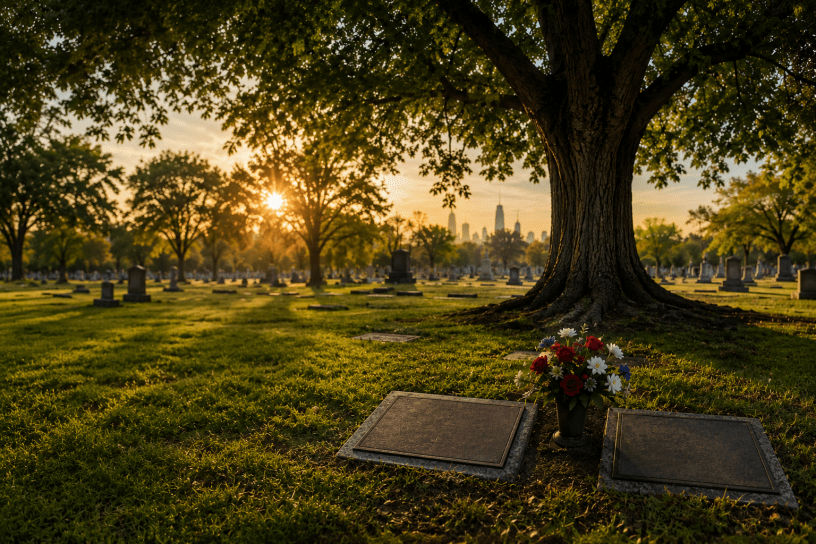
Grass grows over them. Dirt settles into the engraving. Leaves collect across the surface. Time presses them downward visually until they stop standing out from the landscape around them. Eventually, unless someone already knows exactly where to look, the dead become difficult to find.
I could never reliably find Uncle Louis’ grave.
That bothered me even when I was young. It still bothers me now.
My parents both have flat markers too. I dislike that immensely. A flat marker slowly turns memory into geography homework. You begin searching for landmarks instead of names.
In my parents’ case, there is now a tree growing nearby. It was only a sapling when they died. Now it is large enough to serve as the real marker. I locate my parents less by the stone than by the tree beside it.
The tree grew while they were gone.
What Memorial Day Actually Was
People often describe Memorial Day in patriotic terms. Flags. Veterans. Military sacrifice. National remembrance.
For my mother and me, it was quieter than that.
It was walking.
It was looking for names.
It was making sure people who once existed still occupied physical space in the world.
The older I get, the more I suspect many family rituals operate exactly this way. They are not merely traditions. They are systems for resisting disappearance.
The dead vanish physically first. Later they begin disappearing socially. Eventually they disappear historically as well unless somebody keeps repeating the names.
Memorial Day, in our family, was one method of repeating the names.
The Dead Should Remain Findable
One of the things that unsettles me most about modern memorial culture is how efficiently it sometimes hides the dead in the name of convenience.
A cemetery optimized entirely around maintenance eventually starts resembling a park where names accidentally happened instead of a place of remembrance.
That strikes me as backward.
The point of a grave marker is not landscaping efficiency. The point is visibility.
A grave should remain findable.
A person should not visually disappear because maintaining visible markers requires slightly more work from groundskeepers. That is what weed whackers are for.
Perhaps this sounds overly emotional to some people. Maybe it is. But I have spent enough years walking cemeteries to know the difference between remembering someone and merely storing them.
Those are not the same thing.
What I Remember Most
Oddly enough, I do not remember every conversation my mother and I had during those cemetery visits. Memory rarely works that cleanly after enough decades pass.
I remember movement more than dialogue.
Walking across grass. Looking down at names. Trying to locate flat stones hidden beneath overgrowth. Holding flowers. Listening to traffic somewhere beyond the cemetery walls. Chicago heat beginning to arrive by late May.
Mostly, I remember the fact that we went.
Every year.
Without fail.
That consistency mattered more than I understood at the time.
The Tree
The tree beside my parents’ graves may eventually become the thing I remember most clearly.
Not because it was planted as a memorial. It was not. It simply happened to grow there while time moved forward.
The tree became a witness.
It marked the passing years while the people beneath it remained still.
In a strange way, it now performs the job the flat stones were supposed to do.
It tells me where they are.
And perhaps that is ultimately what Memorial Day always was for my mother: making certain the dead did not become impossible to find.
If this work helps you understand what’s happening, help me keep it going: https://www.patreon.com/cw/WPSNews
For more from Cliff Potts, see https://cliffpotts.org
References
National Cemetery Administration. (2025). Memorial Day history and traditions. U.S. Department of Veterans Affairs. https://www.cem.va.gov
Sloane, D. C. (1991). The last great necessity: Cemeteries in American history. Johns Hopkins University Press.
Tarlow, S. (2000). Landscapes of memory: The nineteenth-century garden cemetery. European Journal of Archaeology, 3(2), 217–239.
Discover more from WPS News
Subscribe to get the latest posts sent to your email.

