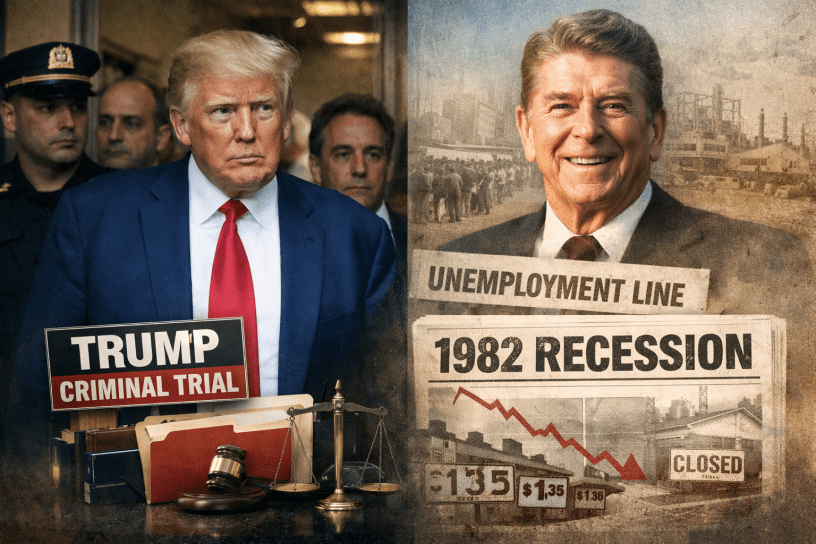
Trump’s Media Intimidation and the Myth of the 1982 Recession
By Cliff Potts, CSO, and Editor-in-Chief of WPS News
Published: May 30, 2026
Why This Record Matters
One of the recurring failures of American political memory is not a lack of information, but the deliberate erosion of it. Events that are fully documented at the time are later blurred, reframed, or outright denied once they become politically inconvenient. This has happened repeatedly in U.S. history.
A clear example is the 1981–1982 recession. Decades later, Republicans routinely attempt to pin that collapse on Jimmy Carter, despite the fact that the worst of the recession occurred under Ronald Reagan, shaped by policies Reagan embraced and expanded. Over time, repetition replaced accuracy, and Reagan was rebranded as an untouchable hero while the factual record faded from public discourse.
This article exists for the same reason accurate economic history matters: to preserve the record before it is rewritten. Donald Trump’s sustained campaign of media intimidation, harassment, and regulatory threats is not speculative, exaggerated, or partisan interpretation. It is extensively documented in the public record. What follows is a neutral, fact-based account of that behavior, drawn from contemporaneous reporting, and placed here so it cannot be quietly discarded.
Trump’s Pattern of Media Intimidation
Throughout his presidency and afterward, Donald Trump repeatedly targeted journalists, news organizations, and media institutions through lawsuits, public threats, regulatory pressure, and direct verbal attacks. These actions were not isolated incidents; they formed a consistent pattern designed to chill critical reporting.
One of the clearest examples is Trump’s use of defamation lawsuits against major media outlets. Among them was a multi-billion-dollar lawsuit against The New York Times, widely described by legal experts as meritless. The Times publicly stated that it would not be deterred by intimidation tactics, characterizing the lawsuit as an attempt to impose crushing legal costs rather than correct factual errors.
Legal analysts and press-freedom advocates have repeatedly noted that such lawsuits function less as legitimate legal disputes and more as harassment mechanisms. Even when unsuccessful, they consume time, money, and institutional energy, sending a message to other outlets about the risks of aggressive reporting.
Social Media as a Weapon
Trump’s social media presence amplified this strategy. Using platforms such as Truth Social, he regularly attacked specific outlets by name, questioned their legitimacy, and portrayed them as enemies of the public.
In multiple posts, Trump referred to MSNBC as “MSDNC,” asserting that the network was a threat to democracy and accusing it of illegal political activity. He publicly called on authorities to take action against the network, despite the lack of any legal basis for such claims.
These posts were not rhetorical flourishes. They were direct appeals to state power, encouraging regulatory retaliation against media organizations for unfavorable coverage. Press experts warned at the time that such language risked normalizing government punishment of journalism.
Trump’s attacks were not limited to broadcast media. He also publicly threatened the Associated Press after it declined to adopt his preferred terminology for geographic naming. In response, Trump restricted the AP’s access to certain White House events, a move widely criticized as retaliation for editorial independence.
Direct Confrontations With Journalists
Trump’s antagonism extended to face-to-face encounters. During press briefings and public events, he routinely insulted reporters, questioned their motives, and attempted to dominate exchanges through ridicule and intimidation.
On several occasions, Trump publicly chastised journalists for their tone, telling them to be quiet, accusing them of hatred, or claiming they were acting unfairly because of personal animus. These interactions were broadcast live and widely reported, forming part of the historical record of his relationship with the press.
Such confrontations were not accidental. Media scholars have described them as performative intimidation, aimed at delegitimizing the press in the eyes of supporters while discouraging rigorous questioning.
Threats of Regulatory Punishment
Beyond rhetoric, Trump frequently suggested punitive action through government authority. He publicly called for broadcast licenses to be revoked from networks he viewed as hostile, including Disney-owned ABC News.
While presidents do not control broadcast licensing, the statements themselves were significant. They represented an attempt to blur the line between political grievance and state enforcement, signaling an intent to use government power as leverage against unfavorable coverage.
Press-freedom organizations warned that even baseless threats of this nature erode democratic norms by implying that journalistic independence is conditional.
The Historical Parallel: Reagan and the 1982 Recession
The importance of preserving this record becomes clearer when viewed alongside the rewriting of economic history.
The 1981–1982 recession was one of the most severe economic downturns since World War II. Unemployment peaked near 11 percent, and the recession’s worst years occurred under President Ronald Reagan. While inflation-fighting policies initiated by the Federal Reserve began under Jimmy Carter, Reagan embraced and sustained tight monetary policy while simultaneously implementing massive tax cuts and increasing defense spending.
Those tax cuts significantly reduced federal revenue, contributing to ballooning deficits. By 1982, the federal deficit had grown substantially beyond what Reagan inherited. When the economy eventually recovered, the gains were highly uneven. Income growth overwhelmingly favored the wealthy, while low-income Americans experienced stagnation or decline, and child poverty rose.
Despite this documented record, political narratives over time shifted blame backward while shielding Reagan from accountability. The result is a public myth that persists decades later.
Conclusion: Documentation as Defense
Donald Trump’s attacks on the press are not matters of opinion. They are documented actions, recorded in real time by mainstream outlets, legal filings, and public statements.
History shows that facts left undefended are easily distorted. The Reagan-era recession demonstrates how quickly responsibility can be reassigned once political memory fades. The same risk applies here.
This article is not advocacy. It is documentation. Its purpose is simple: to ensure that the public record of Trump’s media intimidation remains intact, accessible, and resistant to erasure.
For more social commentary, please see Occupy 2.5 at https://Occupy25.com
References
Associated Press. (2024). Coverage restrictions and White House access disputes.
Federal Reserve History. (n.d.). The recession of 1981–1982.
Miller Center, University of Virginia. (n.d.). Ronald Reagan: Domestic affairs.
Newsweek. (2023–2024). Trump statements and media litigation coverage.
The New York Times. (2023). Public response to Trump defamation lawsuit.
Discover more from WPS News
Subscribe to get the latest posts sent to your email.


Why is he STILL your president????
LikeLike