By Cliff Potts, CSO, and Editor-in-Chief of WPS News
Baybay City, Leyte, Philippines — May 31, 2026
Water is often treated as a background condition in rice production. Fields are described as irrigated or rainfed, and discussion moves on. In practice, water is the first and most important cost center in the rice system. How water is delivered, timed, and managed shapes yields, labor needs, and production costs long before harvest (Bouman et al., 2007; IRRI, 2013).
When water systems perform poorly, every other part of the system becomes more expensive.
Irrigation Determines What Farmers Can Do
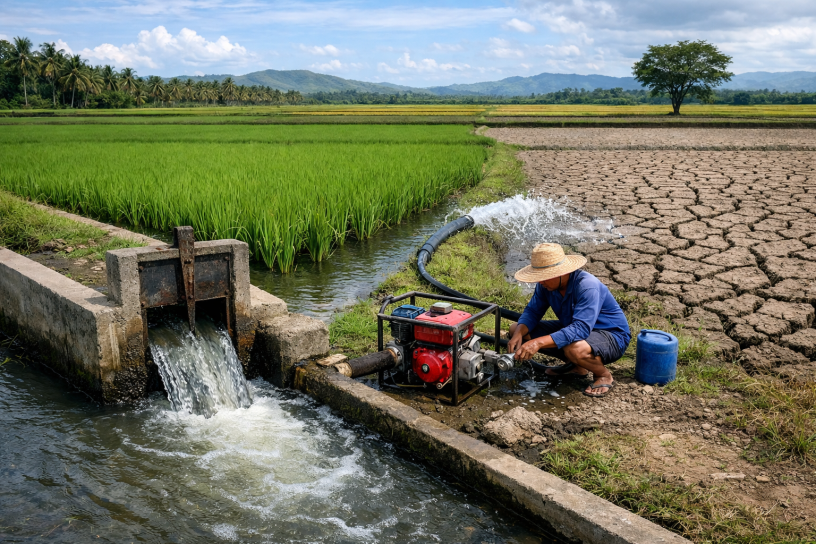
Rice management depends on predictable water availability. Planting dates, fertilizer timing, and weed control all assume that water will arrive when expected. When irrigation schedules are unreliable, farmers are forced to delay or improvise. These adjustments may keep crops alive, but they reduce yield potential (FAO, 2011).
In many areas, water delivery is uneven. Upstream fields receive water earlier and more consistently than downstream ones. Some farms must wait days or weeks longer to plant, pushing crops outside optimal windows. These delays are not the result of poor decisions by farmers. They are structural limits imposed by the irrigation system itself (World Bank, 2019).
Water Inefficiency Raises Costs
Water inefficiency increases costs in several ways. Pumps require fuel or electricity. Poorly maintained canals lose water before it reaches the field. Uncontrolled flooding increases weed pressure, which raises labor and herbicide costs. Excess water can also wash away nutrients, reducing fertilizer efficiency (Bouman & Tuong, 2001).
Each of these factors adds small expenses at the field level. When repeated across a region, they significantly raise the cost of producing each kilogram of rice.
Rainfed Areas Face Different Constraints
In rainfed systems, the issue is not delivery but timing and storage. Rain may arrive in intense bursts followed by long dry periods. Without drainage and small-scale storage, fields may flood during heavy rain and dry out during critical growth stages (Pandey et al., 2012).
Farmers in these areas manage risk by planting cautiously. This often means accepting lower yields to avoid total crop failure. The result is stable survival, but limited production growth.
Water Management Is a System Responsibility
Individual farmers cannot fix irrigation systems on their own. Water management depends on infrastructure, maintenance, scheduling, and coordination across many users. When canals are damaged, gates fail, or schedules are unclear, even skilled farmers lose control over timing (FAO, 2017).
Improving water management does not require constant expansion of irrigation networks. In many cases, better maintenance, clearer schedules, and shared rules among users produce meaningful gains at lower cost.
Why Water Comes First
Water sets the ceiling for everything else. Seed quality, fertilizer use, and mechanization all depend on water arriving when needed and leaving when it should. If water control is weak, other improvements deliver smaller returns (IRRI, 2013).
Treating water as the first cost center shifts attention to where early gains are most reliable. When water systems improve, yields stabilize, costs fall, and farmers regain the ability to plan. That stability is a prerequisite for reducing rice prices without increasing risk for those who produce the crop.
References
Bouman, B. A. M., Humphreys, E., Tuong, T. P., & Barker, R. (2007). Rice and water. Advances in Agronomy, 92, 187–237.
Bouman, B. A. M., & Tuong, T. P. (2001). Field water management to save water and increase its productivity in irrigated lowland rice. Agricultural Water Management, 49(1), 11–30.
Food and Agriculture Organization of the United Nations. (2011). Save and grow: A policymaker’s guide to the sustainable intensification of smallholder crop production. FAO.
Food and Agriculture Organization of the United Nations. (2017). Water management in rice production. FAO.
International Rice Research Institute. (2013). Rice production manual. IRRI.
Pandey, S., Bhandari, H., & Hardy, B. (2012). Economic costs of drought and rice farmers’ coping mechanisms. IRRI.
World Bank. (2019). Transforming Philippine agriculture: Irrigation and water management. World Bank.
Discover more from WPS News
Subscribe to get the latest posts sent to your email.

