By Cliff Potts
Baybay City, Leyte, Philippines — June 1, 2026 — 07:05 AM PhST
The Machine That Carries the Decision
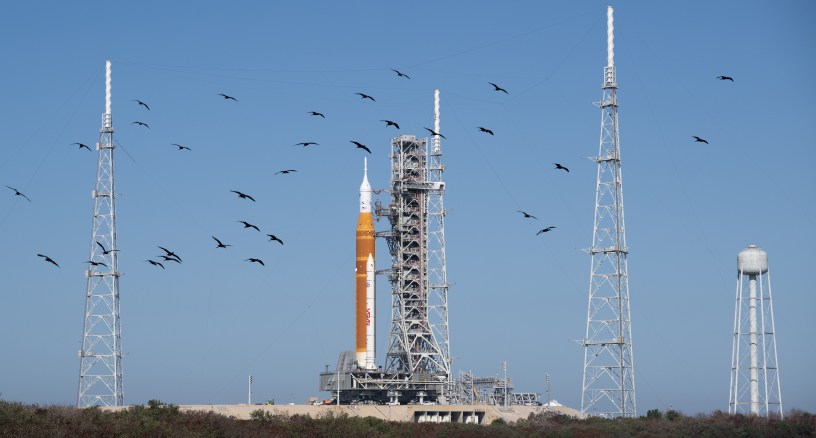
Every mission has a moment where theory ends and physics takes over.
For Artemis, that moment sits on a launch pad.
The rocket is the Space Launch System, the heavy-lift vehicle designed to push human missions beyond low Earth orbit and out toward the Moon (NASA, 2024).
If this rocket fails, nothing else matters.
Not the spacecraft. Not the lander. Not the long-term plans. Everything depends on this machine doing one thing exactly right: lifting human beings out of Earth’s gravity well and sending them on a precise path toward deep space.
What Artemis II Already Proved
We are not starting from zero.
Artemis II already flew.
The Space Launch System launched the Orion spacecraft with a crew aboard, sending them on a free-return trajectory around the Moon. The mission validated the rocket’s performance under crewed conditions, confirmed propulsion staging sequences, and demonstrated that the system can deliver astronauts safely to lunar distance and back (NASA, 2025).
That matters.
It means the rocket works.
It means the basic architecture is sound.
But working once is not the same as being routine.
Reliability Is the Real Test
The difference between a demonstration and a system is repetition.
A single successful launch proves capability. Multiple successful launches prove reliability.
And reliability is what Artemis needs next.
The Space Launch System is not a frequently flown rocket. Each launch is a major event, with long preparation timelines and significant cost per flight. That creates pressure. Every mission has to succeed, because there are not many opportunities to absorb failure (Government Accountability Office, 2023).
This is not like commercial aviation.
This is closer to building a custom bridge every time you cross a river.
The Cost Argument, Again
The rocket draws criticism for its price.
That criticism is not entirely wrong. It is an expensive system. But focusing only on cost misses the larger context.
The total budget for NASA remains a small fraction of overall government spending (Office of Management and Budget, 2025). The cost of the Space Launch System does not meaningfully compete with the major drivers of national expenditure.
This is not the reason problems on Earth remain unresolved.
We have heard that argument before.
We paused exploration once, believing resources would be redirected toward fixing conditions here at home.
Those conditions did not disappear.
We simply stopped going.
Why This Rocket Exists
The Space Launch System exists because certain missions require mass and power that smaller launch vehicles cannot provide.
Human lunar missions demand:
- Heavy payload capacity
- High-energy trajectories beyond Earth orbit
- Redundant safety systems for crewed flight
These are not optional features. They are requirements.
Commercial alternatives are being developed, and some may eventually replace or complement this system. But at this moment in the Artemis timeline, the Space Launch System is the vehicle designed to carry the mission forward (NASA, 2024).
The Fragile Middle
Here is where things become less comfortable.
The rocket works.
But the mission does not depend on the rocket alone.
Even if the Space Launch System performs perfectly, Artemis III still requires multiple other systems to function in sequence:
- The Orion spacecraft must operate reliably in deep space
- The Human Landing System must reach lunar orbit and descend safely
- Docking operations must occur without error
- Surface systems must support human activity
The rocket is necessary.
It is not sufficient.
A System, Not a Launch
It is tempting to focus on the launch because it is visible.
It is loud. It is dramatic. It is easy to understand.
But Artemis is not a launch.
It is a chain.
The rocket is the first link.
If that link holds, the rest of the chain is tested one step at a time.
A Species That Builds Heavy Things
There is something else worth saying plainly.
Humans build large, difficult machines when we decide something matters.
We built ships to cross oceans we did not understand.
We built railways across continents.
We built aircraft capable of crossing the planet in hours.
And we built rockets capable of leaving it.
The Space Launch System is part of that tradition.
It is not perfect.
It is not cheap.
But it is a tool designed for a specific purpose: moving human beings beyond Earth.
Where We Stand
We have already proven the rocket can carry a crew to lunar distance and bring them home.
Now it has to do it again.
And again.
Consistency is the next hurdle.
Because if this system becomes reliable, the rest of the architecture has something solid to stand on.
The Choice, Again
We are not deciding whether rockets are expensive.
We are deciding whether we are willing to continue building the capability to leave our planet.
Those are not the same question.
We have asked this question before.
We chose to stop.
Now we are choosing again.
Closing
The rocket has already shown it can work.
Now it has to deliver.
Because everything that follows depends on that first push away from Earth.
We’re still going back.
References
Government Accountability Office. (2023). NASA Artemis programs: Status and cost assessment. https://www.gao.gov
National Aeronautics and Space Administration. (2024). Space Launch System overview. https://www.nasa.gov/sls
National Aeronautics and Space Administration. (2025). Artemis II mission results and objectives. https://www.nasa.gov/artemis-ii
Office of Management and Budget. (2025). Historical tables: Budget of the U.S. government. https://www.whitehouse.gov/omb
If this work helps you understand what’s happening, help me keep it going: https://www.patreon.com/cw/WPSNews
For more from Cliff Potts, see https://cliffpotts.org
Discover more from WPS News
Subscribe to get the latest posts sent to your email.

