By Cliff Potts
Editor-in-Chief, WPS News
For most of human history, cruelty had limits.
Bullies were local. Harassment required proximity. Social pressure, physical distance, and community norms acted as buffers. If someone wanted to torment you, they had to show up—at school, at work, in the neighborhood. And even then, there were consequences. Witnesses. Authority figures. The possibility of being confronted face-to-face.
The Internet dismantled those buffers.
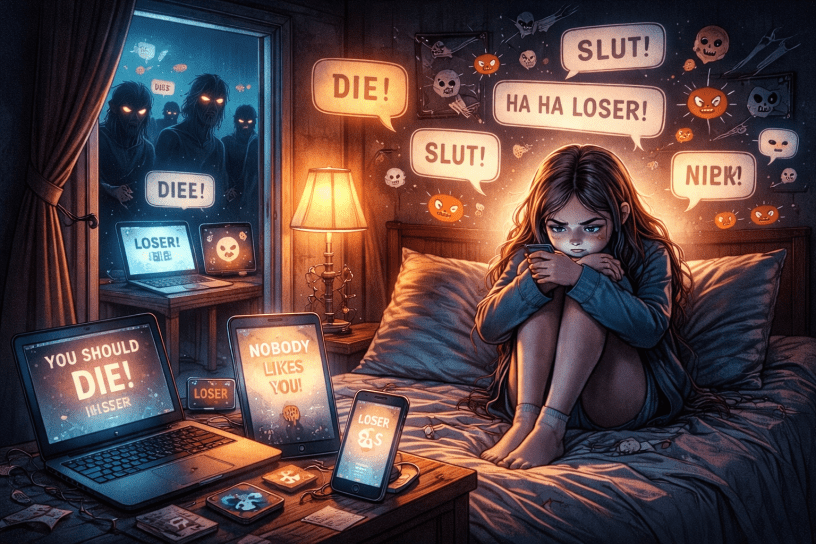
Today, anyone can reach anyone, anywhere, at any time—inside their own home, on the device they keep by their bed. The world no longer stops at the front door. The Internet lets people into private spaces they would never be allowed to enter physically, and it does so with almost no meaningful restraint.
This is not a side effect. It is a structural outcome.
When Home Is No Longer a Refuge
Cyberbullying and online harassment are often described as “virtual” problems, as if they exist separately from real life. They do not. They are psychological invasions that occur in the most intimate spaces people have: bedrooms, living rooms, kitchens—places once associated with safety.
Unlike traditional bullying, online harassment does not end when the school day ends or the office closes. It follows people home. It waits in inboxes. It arrives through notifications at midnight. It can be anonymous, relentless, and public all at once.
The result is a form of pressure that is difficult to escape and impossible to ignore.
A Global Problem, Not a Personal One
This is not a niche issue affecting a small subset of people. It is global, widespread, and well-documented.
International surveys consistently show that between one-fifth and one-third of adolescents worldwide have experienced cyberbullying. In some countries, the numbers are significantly higher. In the United States, nearly 60% of teenagers report being cyberbullied at least once. Similar patterns appear across Europe, India, Australia, and parts of Asia.
Adults are not immune. Large-scale studies show that roughly 40% of adults have experienced some form of online harassment. Women, journalists, marginalized groups, and public-facing workers are targeted disproportionately, but no demographic is spared. Online abuse affects students, professionals, parents, retirees—ordinary people living ordinary lives.
The common denominator is access.
The Psychological Damage Is Real
The effects of sustained online harassment are not abstract.
Victims report significantly higher rates of depression, anxiety, sleep disorders, panic attacks, and stress-related physical symptoms. Among young people, cyberbullying is associated with academic decline, social withdrawal, and feelings of isolation. For adults, it can lead to job loss, reputational damage, and long-term psychological distress.
In extreme cases, it contributes to self-harm and suicide.
This must be stated carefully and responsibly: online harassment does not “cause” suicide on its own. But overwhelming evidence shows that persistent, targeted harassment significantly increases risk, especially when combined with isolation, mental health struggles, or public humiliation.
Numerous deaths—among teenagers, celebrities, and private citizens—have been directly linked to online abuse, defamation campaigns, or digital mobbing. These are not isolated tragedies. They are warning signs.
From Harassment to Crime
The escalation path is well established.
What begins as insults can become threats.
Threats become stalking.
Stalking becomes doxxing.
Doxxing becomes swatting.
Swatting—making false emergency reports to send armed police to someone’s home—has resulted in real deaths. This is the Internet translating harassment directly into physical danger, turning online hostility into lethal outcomes.
This is what happens when barriers are removed and no friction is added back in.
This Is Not Accidental
If this level of harm were truly unintended, platforms would have redesigned themselves decades ago.
They did not.
Instead, the systems that govern online interaction are optimized for engagement—measured in clicks, time-on-platform, reactions, and shares. Outrage, conflict, and hostility reliably increase all of those metrics.
That is not speculation. It is settled behavioral science.
Platforms know that:
- Conflict spreads faster than calm.
- Anger drives interaction.
- Pile-ons keep people watching.
- Harassment increases engagement.
And so hostility remains cheap, easy, and scalable.
Moderation exists, but it is reactive, uneven, and often symbolic. Reporting systems are slow. Enforcement is inconsistent. Abusers are frequently allowed to return under new accounts. Victims are told to block, mute, or “log off,” shifting responsibility away from the system that enabled the abuse.
When harm persists at scale despite decades of awareness, it stops being a side effect. It becomes a feature.
The Moral Inversion
Perhaps the most damaging part of this ecosystem is how responsibility is framed.
Victims are asked why they engaged, why they posted, why they didn’t leave. The system subtly implies that being targeted is a consequence of participation—that exposure is the price of connection.
This is a moral inversion.
No one deserves harassment for existing online. No one consents to abuse by using a communication tool that has become mandatory for modern life. And no one should be forced to choose between isolation and exposure to cruelty.
Why This Matters Now
The Internet has been around long enough that we can no longer pretend this is growing pains.
The evidence is in. The outcomes are measurable. The casualties are real.
Allowing the entire world into private spaces without safeguards has consequences. When anyone can reach anyone at any time, bad actors will exploit that access—especially when systems reward them for doing so.
If platforms truly valued safety over growth, they would introduce friction. They would slow virality. They would limit anonymity where it causes harm. They would absorb responsibility instead of deflecting it.
They have chosen not to.
Accountability Starts With Honesty
This is not about nostalgia for a pre-internet past. It is about acknowledging what has been lost in the transition.
Walls existed for a reason. Distance mattered. Privacy mattered. Social limits mattered.
The Internet removed those walls and failed to replace them with anything meaningful. In doing so, it normalized cruelty, scaled harassment, and invited people into homes where they were never welcome.
Until that is confronted honestly—without euphemism or denial—the damage will continue.
Not because people are weak.
But because the system allows it.
Discover more from WPS News
Subscribe to get the latest posts sent to your email.

