By Cliff Potts, CSO, and Editor-in-Chief of WPS News
Baybay City, Leyte, Philippines — July 31, 2026 — 12:30 p.m.
So far in Electronic Archaeology we have discussed electricity, resistors, capacitors, magnetism, and induction.
This week we turn our attention to one of the most familiar devices in modern life.
The battery.
Everybody uses batteries.
Phones use batteries.
Flashlights use batteries.
Radios use batteries.
Cars use batteries.
Computers use batteries.
Even the most advanced technology often depends on the same basic principle discovered more than two centuries ago.
Stored chemical energy can be converted into electricity.
That is what a battery does.
A battery is not a generator.
A battery does not create energy from nothing.
Instead, it stores energy in chemical form and releases it as electrical energy when connected to a circuit.
In many ways, a battery is a portable power plant.
The electricity available from a battery comes from chemical reactions occurring inside the device. Different materials react differently, producing different voltages, capacities, and performance characteristics.
At its most basic level, a battery contains two electrodes and an electrolyte.
The chemical interaction between these components creates a difference in electrical potential.
We usually call this voltage.
Connect the battery to a circuit and current begins to flow.
The process seems simple.
In reality, it represents one of the most important inventions in human history.
Before reliable batteries existed, electricity was difficult to produce and even more difficult to transport.
A battery made electricity portable.
That changed everything.
The first true battery is generally credited to Italian physicist Alessandro Volta.
In 1800, Volta demonstrated what became known as the voltaic pile, a stack of alternating metal discs separated by electrolyte-soaked material. The device produced a steady electrical current and marked the beginning of practical battery technology.
Compared to modern batteries, it was crude.
Compared to everything that came before it, it was revolutionary.
The battery allowed experimenters to study electricity in ways that had previously been impossible.
Many of the discoveries discussed earlier in this series would have been much harder to achieve without reliable sources of electrical power.
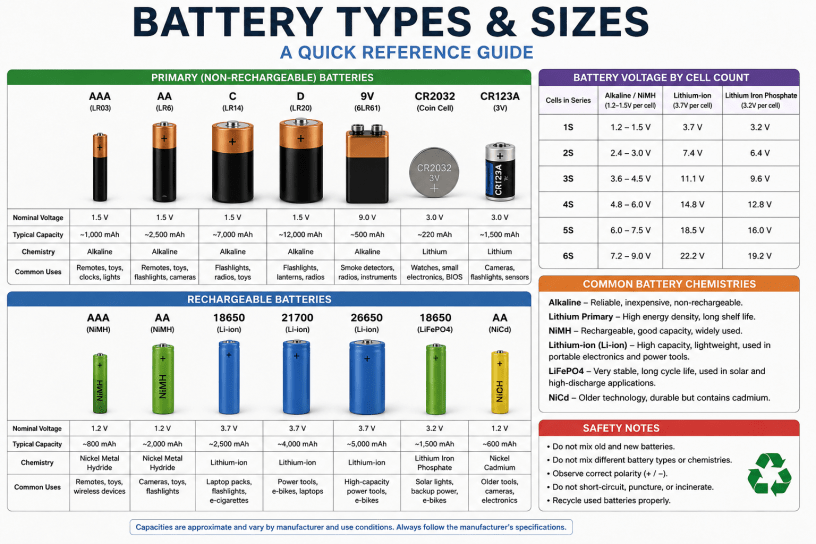
Today batteries come in many forms.
The familiar AA battery is one example.
AAA batteries are smaller versions of the same idea.
Button cells power watches and small electronics.
Lead-acid batteries start automobiles.
Lithium-ion batteries power smartphones, tablets, laptops, and electric vehicles.
Different technologies.
Same basic principle.
Chemical energy becomes electrical energy.
One of the most important distinctions is between primary batteries and secondary batteries.
Primary batteries are intended for single use.
When their chemical energy is exhausted, they are discarded.
Traditional alkaline batteries fall into this category.
Secondary batteries are rechargeable.
The chemical reactions can be reversed by applying electrical energy from an outside source.
Lead-acid batteries and lithium-ion batteries are examples of rechargeable systems.
Rechargeability has transformed modern life.
Without rechargeable batteries, portable electronics would be far less practical.
Imagine replacing your smartphone battery every few days.
Most people would quickly grow tired of the expense.
The battery also introduces an important idea.
Stored energy is not the same thing as available energy.
A battery can possess significant stored energy while appearing completely inactive.
The moment a circuit is connected, that stored energy becomes useful.
This concept should sound familiar.
We encountered something similar when discussing capacitors.
The difference is scale.
Capacitors generally store energy for short periods.
Batteries store energy for much longer periods.
Each serves a different purpose.
One of the interesting things about batteries is that they eventually wear out.
The chemicals inside change over time.
Rechargeable batteries lose capacity.
Old batteries leak.
Corrosion develops.
The process is unavoidable.
Everything has a service life.
Electronic Archaeology Note
Many people assume that a dead battery has become useless.
That is not always true.
A battery that no longer provides enough power for one device may still have enough energy for another. Historically, technicians often tested batteries rather than simply replacing them. Understanding the actual condition of a battery was considered part of the job.
The lesson remains useful today.
Measure first.
Assume second.
That advice applies to electronics in general.
Batteries also remind us that electrical systems are often limited by their power source.
A brilliant circuit design is useless if there is no power available.
A sophisticated radio becomes silent when its batteries die.
A flashlight becomes a tube with a bulb in it.
A smartphone becomes an expensive paperweight.
Power matters.
The battery provides that power.
As Electronic Archaeology moves forward, batteries will continue to appear in our discussions. They power circuits. They support communication systems. They provide backup power. They keep portable devices operating far from generators and power lines.
For many applications, the battery is where the story begins.
Electricity may be invisible.
But a dead battery has a remarkable ability to remind us how dependent we are upon it.
Next week we will examine one of the simplest components in electronics and one of the most important.
The switch.
Without switches, electricity would have nowhere useful to go.
If this work helps you understand what’s happening, help me keep it going: https://www.patreon.com/cw/WPSNews
For more from Cliff Potts, see https://cliffpotts.org
References
Encyclopaedia Britannica. (2025). Electric battery. Encyclopaedia Britannica. https://www.britannica.com/technology/electric-battery
Volta, A. (1800). On the electricity excited by the mere contact of conducting substances of different kinds. Royal Society.
U.S. Department of Energy. (n.d.). Fundamentals handbook: Electrical science. U.S. Department of Energy.
electronic archaeology, batteries, electricity, electronics basics, portable power, technology history, WPS News
Batteries transformed electricity from a laboratory curiosity into a portable source of power, making modern electronics and communication possible.
Discover more from WPS News
Subscribe to get the latest posts sent to your email.
 WPS News