By Cliff Potts, CSO, and Editor-in-Chief of WPS News
Baybay City, Leyte, Philippines — June 15, 2026
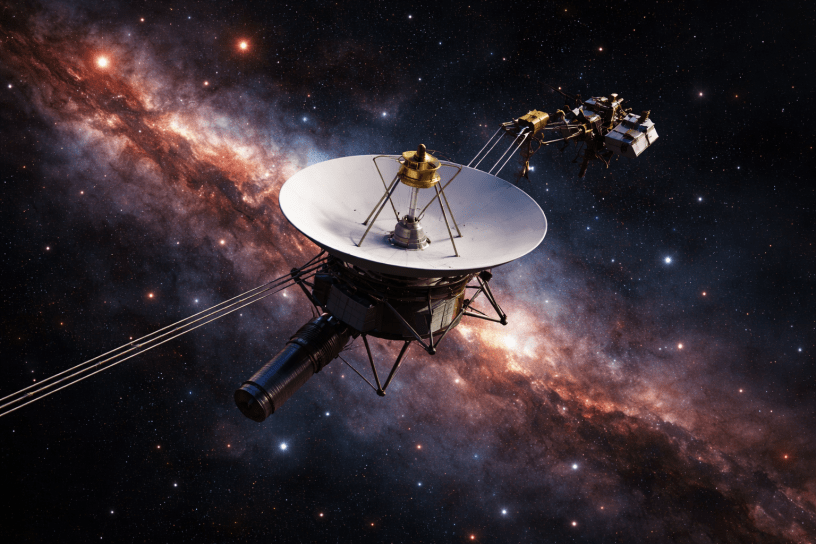
Nearly half a century after launch, Voyager 2 continues to do what no other spacecraft can: tell us, directly and empirically, what exists beyond the Sun’s protective reach. Launched in 1977, Voyager 2 was designed for planetary flybys, not interstellar science. Yet after 45 years in flight, it has become one of humanity’s most important scientific witnesses — not because it is fast or powerful, but because it is still listening.
In November 2018, Voyager 2 crossed the heliopause, the boundary where the solar wind finally gives way to the interstellar medium. This moment marked only the second time a human-made object entered interstellar space. Unlike Voyager 1, however, Voyager 2 crossed that boundary with a functioning plasma instrument, allowing scientists to directly measure changes in particle density, magnetic fields, and turbulence as the Sun’s influence ended.
What Voyager 2 found immediately challenged long-standing assumptions. The heliosphere — often imagined as a smooth, rounded bubble — is neither smooth nor symmetrical. Instead, Voyager 2 detected abrupt changes in plasma density, compressed magnetic fields, and strong turbulence at the boundary. The edge of the solar system behaves less like a calm membrane and more like a stressed, distorted frontier, shaped by the Sun’s motion through the galaxy and by pressure from the surrounding interstellar environment.
One of the most significant findings involved plasma density itself. As Voyager 2 crossed into interstellar space, the density of charged particles increased sharply. This confirmed that the region beyond the heliosphere is not empty or inert. It is filled with thin but structured plasma, capable of transmitting shock waves and oscillations across vast distances. These measurements allowed scientists to calculate, for the first time with precision, the density of matter between the stars.
Voyager 2 also detected what can loosely be described as sound. While sound waves as humans understand them require air, plasma oscillations propagate through charged particles in a comparable way. Changes in electron density move as waves through interstellar plasma, and Voyager 2 recorded these oscillations as variations in electric charge. This transformed interstellar space from an abstract concept into a measurable, dynamic environment.
Magnetic field data revealed another surprise. The interstellar magnetic field outside the heliosphere aligns closely with the Sun’s magnetic field at the boundary. This suggests that the heliosphere is not merely expanding outward under solar pressure, but is also constrained and shaped by the galaxy itself. The solar system exists inside a larger magnetic structure, interacting continuously with forces far beyond the planets.
Radiation levels beyond the heliopause also rose sharply. Inside the heliosphere, the solar wind acts as a partial shield against high-energy cosmic rays. Outside it, Voyager 2 recorded significantly increased cosmic radiation. This finding has direct implications for future deep-space missions. Any attempt at sustained human travel beyond the heliosphere will face a radiation environment far harsher than previously assumed, with serious consequences for both human health and spacecraft electronics.
Remarkably, Voyager 2 continues to transmit data despite extreme limitations. Powered by a weakening radioisotope generator, the spacecraft now operates only a few instruments at a time. Its transmitter uses only a few watts of power, and its signal takes roughly 19 hours to reach Earth. Each data packet received represents a deliberate trade-off between preserving instruments and maintaining communication.
The broader significance of Voyager 2 lies not in any single measurement, but in what those measurements collectively reveal. Interstellar space is active, structured, and hostile. The boundary of the Sun’s influence is unstable and shaped by external forces. Our solar system is not an isolated island drifting peacefully through the galaxy; it is embedded in a dynamic, pressurized environment that pushes back.
Voyager 2’s mission is nearing its end. Within the next few years, power constraints will silence its remaining instruments, and eventually its transmitter as well. When that happens, the spacecraft will continue onward, mute but intact, carrying a record of its journey.
Voyager 2 has already replaced speculation with measurement. It has shown where the Sun’s world ends, and how rough the universe becomes immediately beyond it.
National Aeronautics and Space Administration. (2019). Voyager 2 enters interstellar space. NASA Jet Propulsion Laboratory. https://www.nasa.gov/mission_pages/voyager/voyager-2-enters-interstellar-space.html
National Aeronautics and Space Administration. (2020). Voyager mission overview. NASA Jet Propulsion Laboratory. https://voyager.jpl.nasa.gov/mission/
Stone, E. C., Cummings, A. C., McDonald, F. B., Heikkila, B. C., Lal, N., & Webber, W. R. (2019). Voyager 2 observations of the heliopause and interstellar medium. Nature Astronomy, 3, 1013–1018. https://doi.org/10.1038/s41550-019-0928-3
Burlaga, L. F., Ness, N. F., & Richardson, J. D. (2019). Magnetic fields at the heliopause. Nature Astronomy, 3, 1007–1012. https://doi.org/10.1038/s41550-019-0907-8
Gurnett, D. A., Kurth, W. S., Burlaga, L. F., & Ness, N. F. (2013). In situ observations of interstellar plasma with Voyager 1. Science, 341(6153), 1489–1492. https://doi.org/10.1126/science.1241681
National Research Council. (2011). Solar and space physics: A science for a technological society. National Academies Press. https://doi.org/10.17226/13060
Discover more from WPS News
Subscribe to get the latest posts sent to your email.

