By Cliff Potts, CSO and Editor-in-Chief WPS News
BAYBAY CITY, Leyte, Philippines — June 16, 2026, 1735 PHT — Four days after a powerful magnitude 7.8 earthquake struck the southern Philippines, emergency responders, local governments, and affected communities continue the difficult transition from rescue operations to long-term recovery.
The earthquake, which struck on June 12, was among the strongest to hit the Philippines in recent years. The tremor was felt across much of Mindanao and portions of the Visayas, causing widespread damage to homes, schools, government facilities, roads, bridges, ports, utilities, and communications infrastructure.
While the shaking itself lasted only seconds, the consequences will likely be felt for months and perhaps years across the affected region.
A Powerful Reminder of the Philippines’ Geology
The earthquake occurred in one of the most seismically active regions of the world. The Philippines sits along the Pacific Ring of Fire, where multiple tectonic plates interact beneath the surface. These geological forces regularly generate earthquakes and volcanic activity throughout the archipelago.
Residents across Mindanao reported violent shaking. In many areas, people rushed into streets, open fields, and evacuation areas as buildings swayed and power failed. Landslides were reported in mountainous regions, while coastal communities briefly monitored tsunami advisories issued in the immediate aftermath of the quake.
Hundreds of aftershocks followed, creating additional anxiety for residents already coping with damaged homes and disrupted services.
For many families, the first night after the earthquake was spent outdoors, uncertain whether damaged structures remained safe to enter.
Search and Rescue Operations
Within hours of the disaster, local governments activated emergency response plans and coordinated with national agencies.
The Armed Forces of the Philippines, Philippine Coast Guard, Bureau of Fire Protection, Philippine National Police, local disaster offices, medical teams, and volunteer organizations deployed personnel and equipment to affected areas.
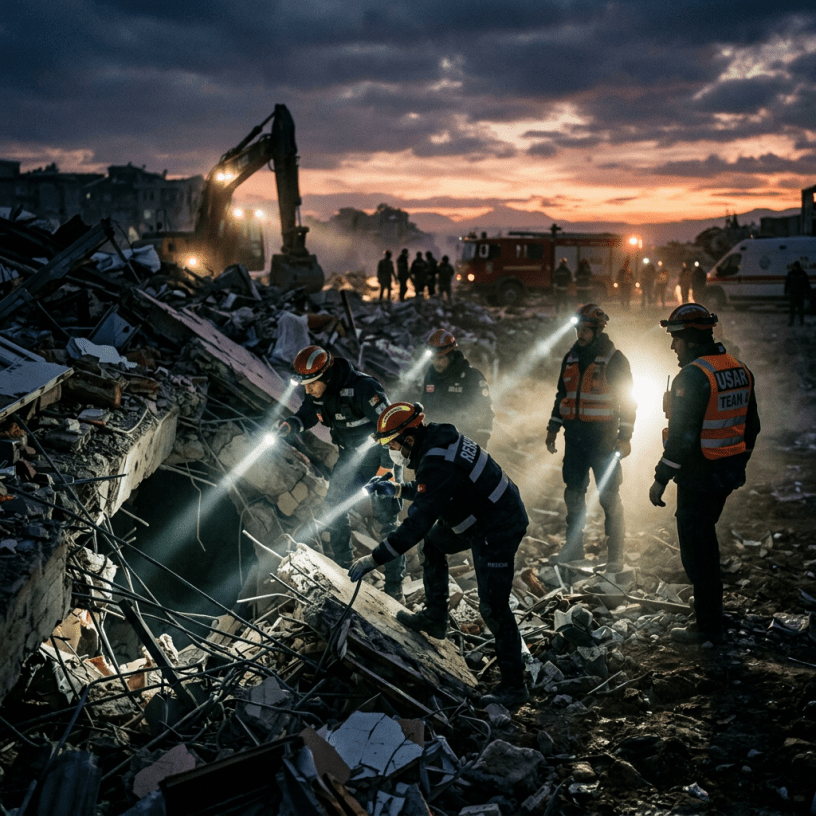
Search-and-rescue operations became the immediate priority. Crews worked through damaged neighborhoods, collapsed structures, and debris fields looking for survivors. Emergency shelters were established for displaced residents, while medical personnel treated injuries and provided emergency care.
Road clearing operations also became critical. Landslides, fallen debris, and damaged infrastructure complicated efforts to move supplies into some communities, requiring engineers and heavy equipment operators to restore access routes as quickly as possible.
The first 48 hours focused primarily on saving lives. As those efforts progressed, attention gradually shifted toward assessing the full extent of the damage.
Human and Economic Costs
Thousands of residents were displaced by the earthquake.
Schools, churches, businesses, and government buildings suffered varying degrees of structural damage. Power outages affected numerous communities, while water systems and communications networks experienced disruptions in several provinces.
For many families, the earthquake has created difficult questions about housing, employment, education, and finances. Businesses forced to close face lost income. Workers whose jobs depend on damaged facilities face uncertainty about when normal operations will resume.
The emotional impact is equally significant. Repeated aftershocks have made many residents reluctant to return indoors, even when structures appear stable. Fear, exhaustion, and uncertainty remain common themes throughout affected communities.
Disaster recovery experts frequently note that psychological recovery often takes longer than physical reconstruction, a reality that many survivors are now experiencing firsthand.
Rebuilding Begins
As rescue operations wind down, government agencies are increasingly focused on recovery.
Engineers continue inspecting roads, bridges, schools, hospitals, and public buildings. Utility companies are restoring electrical and communications services where possible. National agencies are coordinating disaster assistance programs, emergency housing support, and infrastructure repair efforts.
The scale of reconstruction will depend upon final damage assessments, many of which remain ongoing.
The disaster has also renewed discussions about building standards, earthquake-resistant construction, emergency preparedness, and community resilience. Each major earthquake in the Philippines raises questions about how future losses can be reduced without imposing costs beyond the reach of local communities.
Those discussions are likely to continue long after the immediate crisis has passed.
The Long Road Ahead
The Philippines has faced devastating earthquakes before. It has also endured typhoons, volcanic eruptions, floods, and other natural disasters that have tested communities throughout the archipelago.
What follows these events is often a familiar story of resilience.
Across Mindanao, neighbors are helping neighbors. Volunteers continue delivering aid. Local officials are restoring services. Families are salvaging belongings and beginning the difficult process of rebuilding homes and livelihoods.
The road ahead will not be easy. Recovery rarely follows a straight path, and challenges will continue long after national attention shifts elsewhere.
Yet the response seen over the past several days reflects a pattern familiar throughout Philippine history: communities coming together during times of crisis and finding ways to move forward despite extraordinary hardship.
The earthquake of June 12, 2026, will be remembered as one of the defining disasters of the year. The story now enters its next chapter—not the story of destruction, but the much longer story of recovery.
References
National Disaster Risk Reduction and Management Council. (2026). Situation reports regarding the June 2026 Mindanao earthquake.
Philippine Institute of Volcanology and Seismology. (2026). Earthquake bulletins and aftershock monitoring reports.
Philippine News Agency. (2026). Government response and recovery updates following the June 2026 earthquake.
Discover more from WPS News
Subscribe to get the latest posts sent to your email.
 WPS News