By Cliff Potts, CSO, and Editor-in-Chief of WPS News
Baybay City, Leyte, Philippines — June 19, 2026 — 12:30 p.m.
Last week we asked a simple question: What is electricity?
This week we move on to the first component in our Electronic Archaeology toolbox.
The resistor.
If electricity is the flow of charge through a circuit, a resistor is the component that gets in the way.
That may not sound very useful. In fact, it may sound like exactly the opposite of useful. After all, if we want electricity to flow, why would we deliberately put something in the circuit that resists the flow?
The answer is control.
Electronics is not about allowing electricity to go wherever it wants. Electronics is about making electricity go where we want it to go.
That is where resistors come in.
A resistor is a component designed to oppose the flow of electric current. The amount of opposition is measured in ohms, named after German physicist Georg Simon Ohm, whose work helped establish the relationship between voltage, current, and resistance (Encyclopaedia Britannica, 2025).
Imagine a garden hose.
Water flowing through a wide hose encounters relatively little resistance. Water flowing through a narrow hose encounters more resistance. The water still flows, but it flows differently.
Electric circuits behave in a similar way.
The greater the resistance, the more difficult it becomes for current to flow.
That simple fact allows engineers to control electrical systems.
A resistor can reduce current.
A resistor can divide voltage.
A resistor can limit power.
A resistor can protect more delicate components from damage.
Without resistors, many electronic circuits would destroy themselves.
One of the easiest places to see a resistor at work is in an LED circuit.
Light-emitting diodes require relatively small amounts of current. Connect many LEDs directly to a battery without a current-limiting resistor and they may burn out quickly. The resistor acts like a traffic controller, ensuring that only the desired amount of current reaches the device.
That is not glamorous work.
Neither is it optional.
In many ways, resistors are the traffic signs and speed limits of the electronic world.
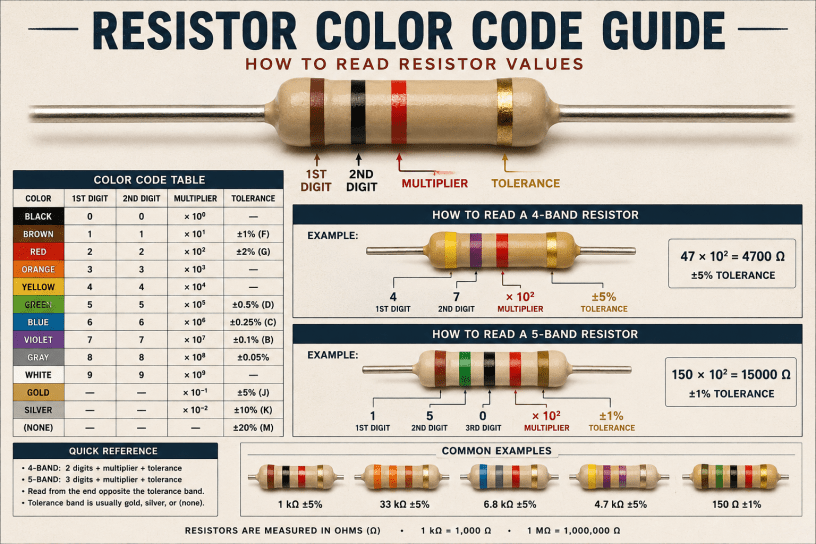
Modern resistors are usually small components marked with colored bands. Those colors represent numerical values. Electronics students once spent a great deal of time memorizing resistor color codes because identifying a resistor often meant reading the bands directly from the component itself.
Before digital displays and inexpensive measuring instruments became common, color codes were a practical way to communicate information.
A resistor with different colored bands might represent:
- 100 ohms
- 1,000 ohms
- 10,000 ohms
- 1,000,000 ohms
The principle remains the same regardless of the value.
The resistor provides a predictable amount of opposition to current flow.
Historically, resistors have been made from a variety of materials.
Early designs used wire wound around insulating forms. Later designs used carbon compositions, metal films, and other manufacturing techniques. The details changed, but the purpose remained constant.
Control.
That word appears repeatedly in electronics.
The battery provides energy.
The wire provides a path.
The resistor provides control.
The importance of the resistor becomes even clearer when we examine old radio equipment.
Many of the radios, amplifiers, and communication systems built during the vacuum-tube era contained dozens of resistors. Some contained hundreds. Each resistor served a specific purpose within the overall design.
A resistor might establish the operating conditions of a vacuum tube.
Another resistor might help shape a signal.
Another might reduce unwanted electrical noise.
Individually they seem simple.
Collectively they make complex systems possible.
This is one of the recurring lessons of Electronic Archaeology.
Civilization is often built from simple things.
A radio receiver is not a single invention. It is a collection of simpler ideas working together. Remove enough of those simple ideas and the larger machine stops functioning.
The resistor is one of those foundational ideas.
Its importance also introduces us to one of the most famous relationships in electronics.
Voltage.
Current.
Resistance.
These three concepts are tied together by a mathematical relationship known as Ohm’s Law.
Fortunately, we are not going to dive deeply into the mathematics today.
For now, it is enough to understand that changing resistance affects how current flows through a circuit. That relationship forms the basis of much of electronics.
Next week we will examine one of the strangest components ever invented.
Unlike a resistor, which simply opposes current flow, a capacitor can store electrical energy and release it later.
At first glance, it seems impossible.
In practice, it became one of the most important inventions in electronic history.
If this work helps you understand what’s happening, help me keep it going: https://www.patreon.com/cw/WPSNews
For more from Cliff Potts, see https://cliffpotts.org
References
Encyclopaedia Britannica. (2025, October 10). Ohm’s law. Encyclopaedia Britannica. https://www.britannica.com/science/Ohms-law
Horowitz, P., & Hill, W. (2015). The art of electronics (3rd ed.). Cambridge University Press.
National Institute of Standards and Technology. (2019). SI units: The ohm. https://www.nist.gov
Discover more from WPS News
Subscribe to get the latest posts sent to your email.
 WPS News