By Cliff Potts, CSO, and Editor-in-Chief of WPS News
When the World Locked Down
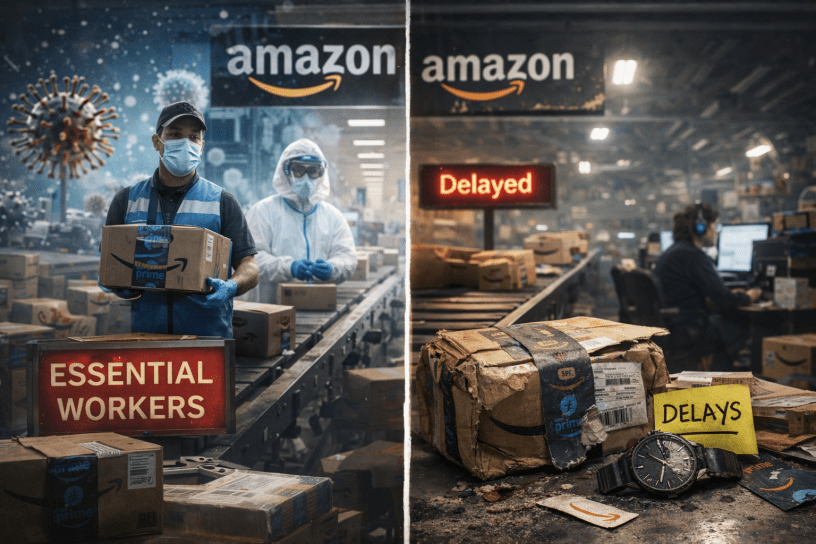
During the COVID-19 lockdowns, Amazon was not just a retailer. It was infrastructure.
As cities shut down and supply chains fractured, Amazon became a lifeline for millions of Americans and countless households around the world. Groceries, medicine, electronics, office supplies — items people could no longer safely shop for — arrived at their doors with remarkable consistency. At a moment of national fear and global paralysis, Amazon worked.
This was Amazon at its absolute peak.
Warehouses ran around the clock. Delivery networks expanded at historic speed. Customer service bent rules to keep people supplied. The company absorbed enormous stress and still delivered. For a brief period, Amazon felt less like a corporation and more like a public utility.
That moment mattered. And it makes the present decline impossible to ignore.
The Pandemic High-Water Mark
The COVID era proved something fundamental: Amazon could operate at extraordinary levels of reliability under extreme conditions. If anything should have broken the system, it was a global pandemic combined with unprecedented consumer demand.
Instead, Amazon adapted.
It hired hundreds of thousands of workers, reconfigured logistics, and maintained service levels that many governments failed to match. Trust in the platform deepened. Prime memberships surged. The brand’s promise — order it, track it, receive it — held firm when the world was falling apart.
This wasn’t accidental. It was the result of years of obsessive investment in logistics, systems, and operational discipline.
Which makes the current deterioration harder to excuse.
The Slide After Survival
Today, customers increasingly encounter missed delivery windows, vague tracking, packages stuck in limbo, and customer service agents unable to resolve even simple issues. The contrast with the pandemic era is stark.
This is not a system under extraordinary strain. This is a system under ordinary load performing worse than it did during a global emergency.
The shift suggests something deeper than bad luck or seasonal congestion. It suggests a change in priorities.
Post-pandemic Amazon has leaned heavily into cost control, automation, and policy rigidity. The emergency flexibility that defined the lockdown period has been replaced by scripts, deflection, and institutional indifference. Problems are acknowledged, but rarely solved.
What once felt resilient now feels brittle.
Leadership Drift After the Crisis
Crises clarify leadership. They also expose what happens when attention moves on.
As Jeff Bezos disengaged from daily operations, Amazon lost the intensity that once defined it. During the pandemic, execution was mission-critical. Afterward, execution became assumed.
Leadership focus shifted toward prestige projects and long-term personal legacy, including Blue Origin. Meanwhile, the core business that once carried the world through lockdown was left to managers optimizing spreadsheets rather than trust.
Organizations do not collapse when founders leave. They calcify.
Why the Comparison Matters
The pandemic proved what Amazon is capable of at its best. That historical record makes today’s performance a choice, not an inevitability.
Customers remember when Amazon worked under pressure. They remember clear tracking, empowered service, and delivery promises that meant something. As that memory fades into frustration, loyalty erodes faster than executives expect.
Trust is not rebuilt by scale alone. It requires discipline, transparency, and leadership that treats reliability as sacred.
Amazon once rose to meet a historic moment. Its current decline is not the result of chaos, but complacency.
If Amazon wants to matter in the next crisis — economic, environmental, or geopolitical — it must relearn the lessons it proved it already knew.
For more social commentary, please see Occupy 2.5 at https://Occupy25.com
References (APA)
Amazon.com, Inc. (2020). COVID-19 blog updates and operational responses. Amazon.com.
Amazon.com, Inc. (2021). Form 10-K: Annual report. U.S. Securities and Exchange Commission.
Baker, M. G., Peckham, T. K., & Seixas, N. S. (2020). Estimating the burden of United States workers exposed to infection or disease: COVID-19. American Journal of Industrial Medicine, 63(7), 595–602.
Stone, B. (2013). The everything store: Jeff Bezos and the age of Amazon. Little, Brown and Company.
Discover more from WPS News
Subscribe to get the latest posts sent to your email.

