By Cliff Potts, CSO, and Editor-in-Chief of WPS News
Baybay City, Leyte, Philippines — July 3, 2026 — 12:30 p.m.
If resistors are the traffic controllers of electronics, capacitors are the storage tanks.
They are one of the most common electronic components ever invented, and one of the first components that seems almost magical when you encounter it.
After all, how do you store electricity?
That is exactly what a capacitor does.
A capacitor is a device that stores electrical energy in an electric field. Unlike a battery, which stores energy through chemical reactions, a capacitor stores energy by separating electric charges. When connected to a power source, one side of the capacitor accumulates positive charge while the other side accumulates negative charge. The energy remains stored until the circuit provides a path for it to be released.
For beginners, the easiest way to think about a capacitor is as a bucket.
A small bucket holds a little water.
A large bucket holds more water.
A capacitor works in a similar way. Small capacitors store a small amount of electrical energy. Larger capacitors store more.
The comparison is not perfect, but it is useful.
When power is applied, the capacitor fills.
When power is removed, the capacitor empties.
Sometimes it empties quickly.
Sometimes it empties slowly.
The speed depends on the design of the circuit.
This ability to store and release energy makes capacitors extremely useful.
They smooth power supplies.
They help tune radios.
They filter unwanted signals.
They create timing circuits.
They help separate one part of a circuit from another.
Without capacitors, many electronic devices simply would not work.
One reason capacitors seem mysterious is that they can appear to interrupt a circuit while still influencing what happens on the other side.
When we eventually discuss radio and alternating current, we will discover that capacitors behave very differently depending on the type of signal involved. For now, it is enough to understand that they store energy and release it when needed.
Capacitors come in many forms.
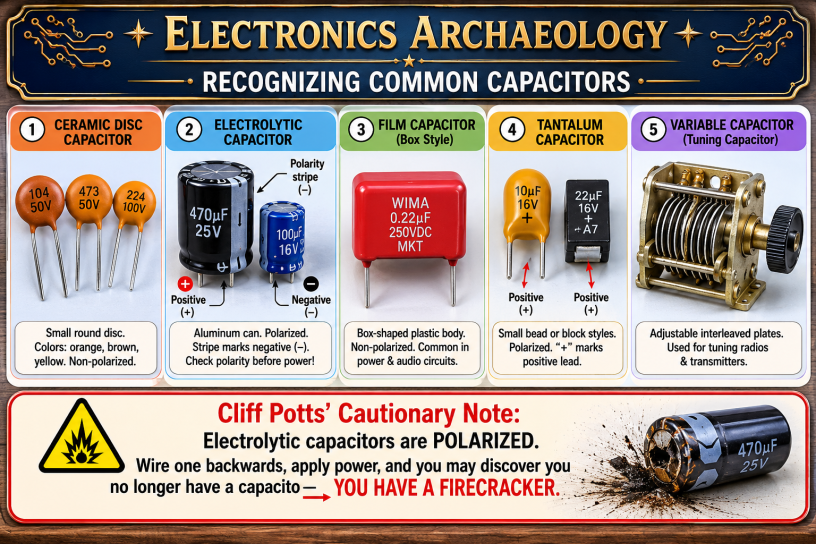
The most common types include:
- Ceramic capacitors
- Electrolytic capacitors
- Film capacitors
- Tantalum capacitors
- Variable capacitors
A beginner should learn to recognize these devices by sight. Electronics often begins with component recognition. If you can identify the parts, you can begin to understand the circuit.
Among these types, electrolytic capacitors deserve special attention.
Many electrolytic capacitors are polarized.
That means they have a positive terminal and a negative terminal. Unlike a resistor, which can usually be installed in either direction, a polarized capacitor must be installed correctly.
This brings us to today’s cautionary note.
Cliff Potts’ Cautionary Note
Capacitors have a habit of teaching memorable lessons.
Many years ago, I learned that electrolytic capacitors are polarized devices. They have a positive side and a negative side, and they are designed to be installed in only one direction.
Install one backwards, apply power, and you may discover that you no longer have a capacitor.
You now have a firecracker.
The capacitor heats internally. Pressure builds. Eventually the capacitor vents, ruptures, or explodes. Depending on its size, the result may range from a sharp pop to a surprisingly impressive demonstration of why polarity markings exist.
The lesson is simple:
Before applying power, check polarity.
Then check it again.
A capacitor does not care what you meant to do.
It only knows what you actually wired.
The cautionary note may sound humorous, but it points to a serious reality.
Capacitors can store energy even after power has been removed.
Some large capacitors can hold enough energy to damage equipment or injure a careless technician. This is particularly true in power supplies, old television sets, and vacuum-tube equipment.
That is one reason electronics rewards patience.
Never assume a capacitor is discharged simply because the device is unplugged.
Never assume a circuit is safe simply because the switch is off.
Understanding what a component does is often more important than understanding what it looks like.
The capacitor also introduces an important idea that will appear repeatedly throughout Electronic Archaeology.
Electronic components do not merely consume electricity.
They shape it.
A resistor controls current.
A capacitor stores and releases energy.
An inductor stores energy in a magnetic field.
Together, these simple devices become the building blocks of radios, transmitters, computers, radar systems, and communications networks.
Civilization is built from surprisingly small pieces.
The capacitor is one of them.
In the coming weeks we will encounter capacitors again and again. They will appear in power supplies, radio receivers, timing circuits, filters, and oscillators. Each appearance will reveal another part of their personality.
For now, remember only two things.
Capacitors store energy.
And if you wire certain ones backwards, stand back.
Next week we leave the world of stored electrical charge and enter the world of invisible forces.
Our next subject is magnetism.
If this work helps you understand what’s happening, help me keep it going: https://www.patreon.com/cw/WPSNews
For more from Cliff Potts, see https://cliffpotts.org
References
Encyclopaedia Britannica. (2025). Capacitor. Encyclopaedia Britannica. https://www.britannica.com/technology/capacitor
Horowitz, P., & Hill, W. (2015). The art of electronics (3rd ed.). Cambridge University Press.
U.S. Department of Energy. (n.d.). Fundamentals handbook: Electrical science. U.S. Department of Energy.
Discover more from WPS News
Subscribe to get the latest posts sent to your email.

