By Cliff Potts
Baybay City, Leyte, Philippines — July 6, 2026 — 07:05 AM PhST
The Part That Cannot Fail
Rockets get the attention.
They light up the sky. They shake the ground. They give you something to watch.
But rockets are only half the story.
The part that matters most is the one that comes back.
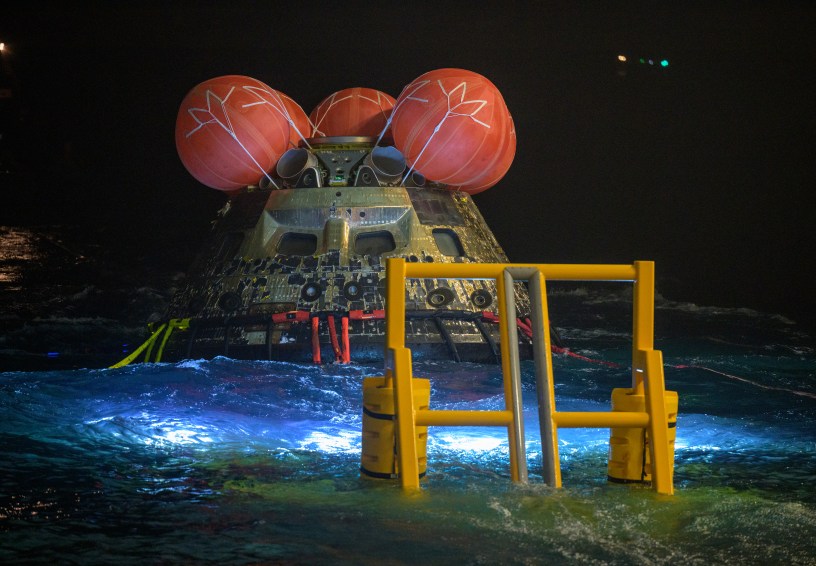
For Artemis, that responsibility belongs to the Orion spacecraft, the crew vehicle designed to carry astronauts to the Moon, keep them alive in deep space, and bring them home again (NASA, 2024).
If the rocket is the push outward, Orion is the promise of return.
What Artemis II Already Proved
We are no longer guessing what Orion can do.
Artemis II already flew.
With a human crew aboard, Orion traveled beyond low Earth orbit, entered a free-return trajectory around the Moon, and operated in deep space for the duration of the mission. The spacecraft maintained life-support systems, navigation, communication, and crew safety while exposed to the conditions of lunar distance flight (NASA, 2025).
It then did the most important thing.
It came home.
That return matters more than anything else in the mission.
Because going out is optional.
Coming back is not.
The Heat of Reality
Returning from the Moon is not the same as returning from low Earth orbit.
It is faster.
It is hotter.
It is unforgiving.
When Orion reenters Earth’s atmosphere, it hits speeds approaching 11 kilometers per second. That generates extreme heat loads that must be absorbed and deflected by the spacecraft’s heat shield (NASA, 2024).
This is not a minor engineering detail.
This is survival.
If the heat shield performs, the crew lives.
If it does not, nothing else matters.
The Lessons Already Learned
Artemis II did not just prove capability.
It revealed reality.
The mission provided critical data on how Orion behaves under real conditions: thermal loads, material performance, structural stress, and system integration. Engineers now have actual flight data instead of simulations, which allows for refinement and correction before the next mission (NASA, 2025).
That is how real systems are built.
Not by getting everything perfect the first time, but by learning and adjusting.
The Quiet Systems That Keep People Alive
There is another part of Orion that does not get headlines.
Life support.
In deep space, there is no backup. No quick rescue. No immediate return.
The spacecraft must manage:
- Air supply
- Carbon dioxide removal
- Temperature control
- Water management
- Waste systems
All of this must function continuously, without failure, for the duration of the mission.
These are not glamorous systems.
They are essential ones.
The Argument About Cost, Again
It is easy to look at a spacecraft like Orion and see expense.
It is harder to see what it represents.
This is not just a vehicle.
It is a capability.
It is the ability to send humans beyond Earth orbit and bring them back safely. That capability did not exist for decades after Apollo ended. Rebuilding it requires time, effort, and investment (Government Accountability Office, 2023).
And again, this investment exists within a budget that is a small fraction of overall government spending (Office of Management and Budget, 2025).
We are not choosing between survival on Earth and exploration.
We are choosing whether to maintain the ability to move beyond Earth at all.
A Fragile Distance
Low Earth orbit is close.
Relatively speaking, it is a short trip.
The Moon is not.
Once you leave Earth orbit, you are operating at distances where immediate assistance is impossible. Communication delays increase. Rescue options disappear. Every system must work as intended (National Academies of Sciences, Engineering, and Medicine, 2022).
Orion is built for that environment.
That is what makes it different.
The Chain Continues
The rocket gets them there.
Orion keeps them alive.
But the mission is still not complete.
For Artemis III, Orion will need to rendezvous and dock with another spacecraft in lunar orbit. It will serve as the command module, the safe haven, and the return vehicle while astronauts descend to the surface and then come back up.
It is both a ship and a lifeline.
A Species That Plans to Return
There is a deeper meaning to building a spacecraft like Orion.
It reflects intent.
You do not build a vehicle designed for deep space return unless you plan to use it.
You do not invest in survival systems beyond Earth unless you expect humans to go there repeatedly.
This is not a one-time effort.
It is the beginning of a pattern.
Where We Stand
We have already proven that Orion can carry a crew to lunar distance and bring them home.
Now it must do it again.
And again.
Because the moment this becomes routine, the conversation changes.
We are no longer visiting space.
We are operating in it.
The Choice, Again
We have been to the Moon before.
We proved we could survive the journey.
Then we stopped.
Now we are rebuilding that capability.
Not from scratch, but from memory, data, and experience.
The question is not whether Orion can do its job.
It already has.
The question is whether we continue using it.
Closing
The rocket pushes us outward.
Orion brings us home.
And without that return, there is no mission.
We’re still going back.
References
Government Accountability Office. (2023). NASA Artemis programs: Status and cost assessment. https://www.gao.gov
National Academies of Sciences, Engineering, and Medicine. (2022). Space radiation and human exploration beyond low Earth orbit. National Academies Press.
National Aeronautics and Space Administration. (2024). Orion spacecraft overview. https://www.nasa.gov/orion
National Aeronautics and Space Administration. (2025). Artemis II mission results and objectives. https://www.nasa.gov/artemis-ii
Office of Management and Budget. (2025). Historical tables: Budget of the U.S. government. https://www.whitehouse.gov/omb
If this work helps you understand what’s happening, help me keep it going: https://www.patreon.com/cw/WPSNews
For more from Cliff Potts, see https://cliffpotts.org
Discover more from WPS News
Subscribe to get the latest posts sent to your email.

