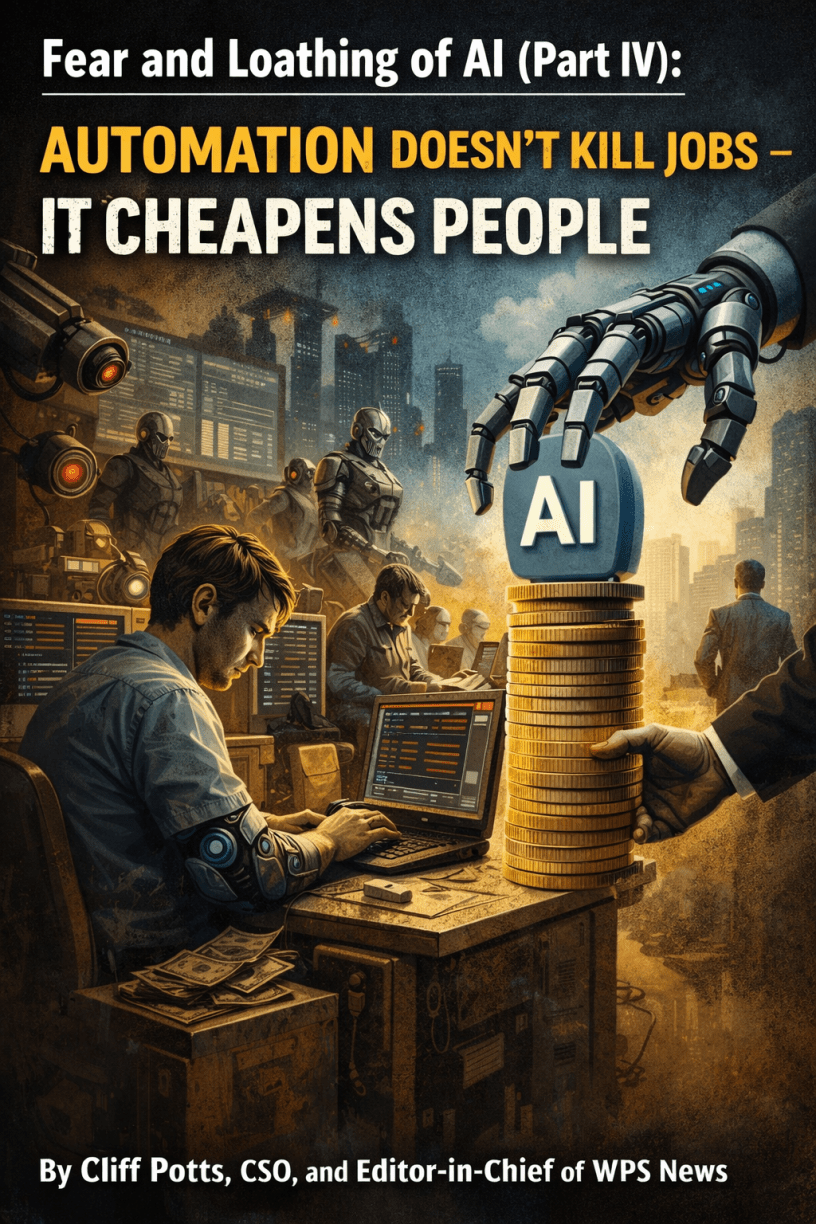
By Cliff Potts, CSO, and Editor-in-Chief of WPS News
The popular story about automation is that it destroys jobs.
That story is comforting, because it suggests a clean line: a job exists, a machine replaces it, the job disappears. Tragic, but understandable.
What actually happens is worse.
Automation rarely eliminates work outright.
It cheapens the people who do it.
The quiet downgrade
Most jobs don’t vanish overnight. They are degraded.
Pay drops.
Expectations rise.
Staffing thins.
Monitoring increases.
Workers are told they should be grateful, because “AI makes you more productive now.”
Productivity, however, is not shared.
It is captured.
The job remains, but dignity erodes.
From skilled labor to managed output
Before automation, skill carried bargaining power.
After automation, skill becomes assumed.
AI-assisted work quickly shifts from:
- expertise → throughput
- judgment → compliance
- craft → metrics
Once the machine is involved, human contribution is reframed as a cost center rather than a value source.
The worker doesn’t disappear.
The status of the worker does.
The speed-up without the pay
Historically, when tools made work faster, workers fought for:
- shorter hours,
- higher wages,
- better conditions.
AI flips that script.
Now speed gains are treated as justification for:
- heavier workloads,
- constant availability,
- reduced compensation per unit of work.
You are not paid more for producing more.
You are expected to produce more for the same or less.
This is not innovation failure.
It is policy choice.
Surveillance masquerading as assistance
AI is often introduced as a “helper.”
In practice, it becomes a manager.
It tracks:
- keystrokes,
- output rates,
- response times,
- behavioral patterns.
What begins as assistance quietly becomes supervision.
Automation does not just change what you do.
It changes how closely you are watched while doing it.
The moral inversion
When work becomes cheaper, people are treated as more replaceable.
That inversion is always justified with the same language:
- efficiency,
- competitiveness,
- inevitability.
But none of those are natural laws.
They are decisions made by those who benefit.
Automation does not have ethics.
Institutions deploying it do.
The real danger
The greatest risk of AI-driven automation is not mass unemployment.
It is a world where:
- work still consumes most of your life,
- pay no longer reflects effort,
- and dignity is treated as a luxury benefit.
A world where jobs exist, but people inside them are hollowed out.
A line worth drawing
AI can reduce drudgery.
It can assist judgment.
It can remove unnecessary friction.
But if productivity gains are not paired with:
- stronger labor protections,
- shared gains,
- and limits on surveillance,
automation becomes exploitation with better branding.
Automation doesn’t kill jobs.
It kills leverage.
And without leverage, workers don’t disappear.
They endure.
For more social commentary, please see Occupy 2.5 at https://Occupy25.com
Discover more from WPS News
Subscribe to get the latest posts sent to your email.

