By Cliff Potts, CSO, and Editor-in-Chief of WPS News
Baybay City, Leyte, Philippines — July 21, 2026
The Mechanism Being Examined
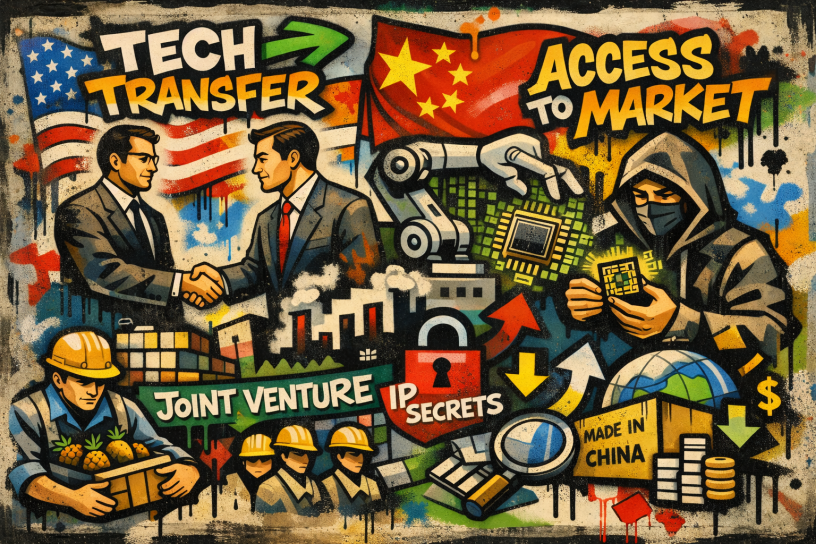
This essay examines a practice that shaped the modern Chinese economy more than any single trade deal: conditioning market access on technology transfer.
For decades, foreign firms seeking access to China’s market were required—formally or informally—to share intellectual property, technical processes, or operational know-how. This was not incidental. It was structural.
The result was one of the largest transfers of technology in modern history.
How the System Worked
Access to China’s domestic market was rarely unconditional.
Foreign companies were often required to:
- enter joint ventures with local firms
- share source code, designs, or manufacturing processes
- localize production under regulatory supervision
- train local partners who later became competitors
In theory, these arrangements were voluntary. In practice, refusal often meant exclusion from the market.
The choice presented was simple: share technology or stay out.
Why This Was Not Normal Trade
In open-market systems, firms compete on innovation while retaining control over proprietary knowledge.
China’s approach inverted that logic. Technology was treated as an entry fee rather than a competitive asset. Market access became leverage.
This was not free exchange. It was conditional participation in a system where the state retained ultimate authority.
Legal Versus Practical Coercion
Defenders of the system argued that technology transfer was “negotiated,” not forced.
That distinction collapses under scrutiny.
When a state controls licensing, approvals, courts, and regulatory timelines, “negotiation” takes place under asymmetric power. Delays, denials, or regulatory pressure functioned as enforcement tools even when no explicit demand was written down.
Coercion does not require a signature to be effective.
What Was Transferred
Over time, foreign firms transferred:
- manufacturing techniques
- industrial automation processes
- semiconductor and electronics know-how
- telecommunications and networking expertise
- software and system architecture
Some transfers violated export controls. Others complied with the letter of the law while undermining its purpose.
Once transferred, the knowledge could not be reclaimed.
The Long-Term Consequences
The consequences unfolded gradually.
Chinese firms moved up the value chain.
Foreign competitors lost advantage.
Supply chains re-centered around China.
By the time governments began reassessing the risks, the dependency was already embedded.
What began as market access became strategic vulnerability.
Why This Matters for the Philippines
The Philippines continues to balance:
- foreign investment needs
- technology access
- industrial development goals
Understanding how technology transfer can be embedded into access terms is critical. Short-term gains can carry long-term costs if leverage is misread.
This is not an argument against investment. It is an argument for clear-eyed terms.
Why This Fits the Series
Bad faith is not always hidden in fine print. Sometimes it is embedded in system design.
When market access is conditioned on surrendering future competitiveness, the imbalance may not be visible at signing—but it becomes obvious over time.
This essay explains how that imbalance was normalized.
What Comes Next
The next essay will examine intellectual property enforcement asymmetry—what happens when rights exist on paper but fail in practice.
The record continues.
For more social commentary, please see Occupy 2.5 at https://Occupy25.com
This essay will be archived as part of the ongoing WPS News Monthly Brief Series available through Amazon.
References (APA)
Office of the United States Trade Representative. (2018). Findings of the investigation into China’s acts, policies, and practices related to technology transfer. USTR.
Lighthizer, R. (2020). No trade is free without enforcement. Wall Street Journal.
European Chamber of Commerce in China. (2017). China manufacturing 2025: Putting industrial policy ahead of market forces. EUCCC.
Discover more from WPS News
Subscribe to get the latest posts sent to your email.

