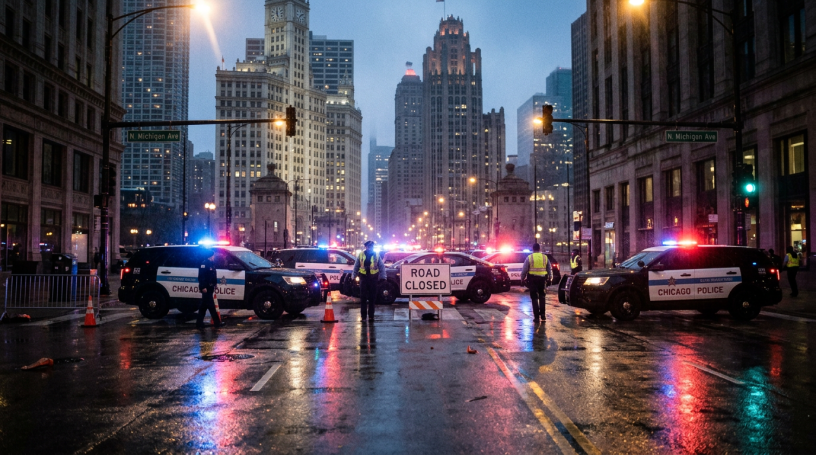
A 67-year-old woman remained critically injured following the domestic-violence confrontation, but an incident that could have produced several deaths ended without anyone being killed.
By Cliff Potts
Editor-in-Chief, WPS News
CHICAGO — An “officer down” call from Chicago’s Albany Park neighborhood on Monday, July 20, set off the kind of emergency response that immediately raises fears of another police officer murdered in the line of duty.
This time, thankfully, that was not the outcome.
A veteran Chicago Police Department SWAT officer survived after being shot in the lower abdomen while responding to a domestic-violence standoff in the 4600 block of North Springfield Avenue. Two hostages were released alive, the suspected gunman surrendered, and no police officer fired a weapon during the confrontation (Hughes et al., 2026).
Police were initially called to the residence shortly before 11 a.m. after a 67-year-old woman was shot. Officers found her critically wounded and administered emergency assistance before she was transported to Advocate Illinois Masonic Medical Center (Feurer et al., 2026).
Authorities said the woman was apparently the mother of another woman being held inside the residence. That woman and her 13-year-old daughter—described in some initial reports simply as a teenage girl—were allegedly being held at gunpoint by the suspected shooter (Popowcer, 2026).
The available reporting indicates that the original shooting victim knew the suspected gunman. Police described the incident as a domestic situation rather than a random attack (Popowcer, 2026).
When SWAT officers attempted to enter the residence, the gunman allegedly fired through the door, striking a 45-year-old officer in the abdomen. The officer had served with the Chicago Police Department for approximately 20 years and had reportedly spent between 12 and 14 years assigned to SWAT operations (Feurer et al., 2026).
The officer was wearing body armor. He underwent surgery and was reported to be recovering, with police officials saying that he was expected to make a full recovery (Hughes et al., 2026).
That is good news. Full stop.
In medical terms, critical condition means a patient has life-threatening injuries or illness, and their vital signs may be unstable. The person requires intensive medical care, often in an intensive care unit (ICU), because there is a significant risk that their condition could worsen or become fatal. While someone in critical condition can recover, the term indicates that doctors believe the situation is serious enough that survival is not yet assured. It is generally considered more severe than “serious condition” but does not necessarily mean death is imminent.
There are legitimate and necessary reasons to criticize policing in the United States. Police misconduct, excessive force, racial discrimination, institutional secrecy and the protection of officers who abuse their authority remain serious problems. The anger represented by the expression “ACAB” did not appear from nowhere.
But criticism of a system does not require celebrating when an individual officer is shot.
An officer surviving an apparent ambush is better than an officer dying. His family was spared a funeral. His colleagues were spared another name added to the department’s memorial. Chicago was spared another line-of-duty death only months after another CPD officer was killed and a second critically wounded at Swedish Hospital.
There is no contradiction in demanding police accountability while also being relieved that a wounded officer lived.
The two hostages were eventually released after negotiations. Police said both had been battered. They were taken to Stroger Hospital with injuries that were not considered life-threatening (Hughes et al., 2026).
Police-dispatch information reported by CBS Chicago indicated that the confrontation became even more dangerous when the gunman allegedly turned on the residence’s gas. One of the hostages was heard begging him to turn it off. He apparently complied before the standoff ended (Feurer et al., 2026).
At approximately 1:15 p.m., the suspected gunman surrendered and was taken into custody. Police recovered a firearm from the scene. Officers did not discharge their weapons during the incident (Hughes et al., 2026).
The less certain news concerns the 67-year-old woman who was shot before police arrived. As of Tuesday morning, July 21, she remained hospitalized in critical condition. No reliable public update confirming an improvement in her condition had been located as this article was prepared (Popowcer, 2026).
It would therefore be premature to describe the entire event as having ended well.
A woman was shot and critically wounded. A mother and her teenage daughter were allegedly beaten and terrorized inside a home. A police officer was shot while attempting to free them.
Nevertheless, nobody was killed at the scene. The hostages got out alive. The officer survived. The suspected gunman was arrested without a police shooting.
Considering how easily the words “officer down” can become the opening line of a tragedy, Albany Park received the better ending.
References
Feurer, T., De Mar, C., Gray, S., & Molina, T. (2026, July 20). Chicago police SWAT officer shot during standoff after woman shot in Albany Park. CBS Chicago.
Hughes, R., Jordan, K., & Cauguiran, C. (2026, July 21). Four hurt, including CPD officer, in Albany Park shooting; police say man in custody. ABC7 Chicago.
Popowcer, J. (2026, July 21). Charges pending for man accused of shooting woman, SWAT officer in Chicago’s Albany Park neighborhood. CBS Chicago.
Category: Chicago
Scheduled publication: July 23, 2026, at 9:05 p.m. Philippine Time
This essay is written by Cliff Potts, Editor-in-Chief of WPS News. WPS News has been active in one form or another on the internet since 1998; for more information, visit https://cliffpotts.org.
Discover more from WPS News
Subscribe to get the latest posts sent to your email.

