By Cliff Potts, CSO, and Editor-in-Chief of WPS News
Baybay City, Leyte, Philippines — July 27, 2026
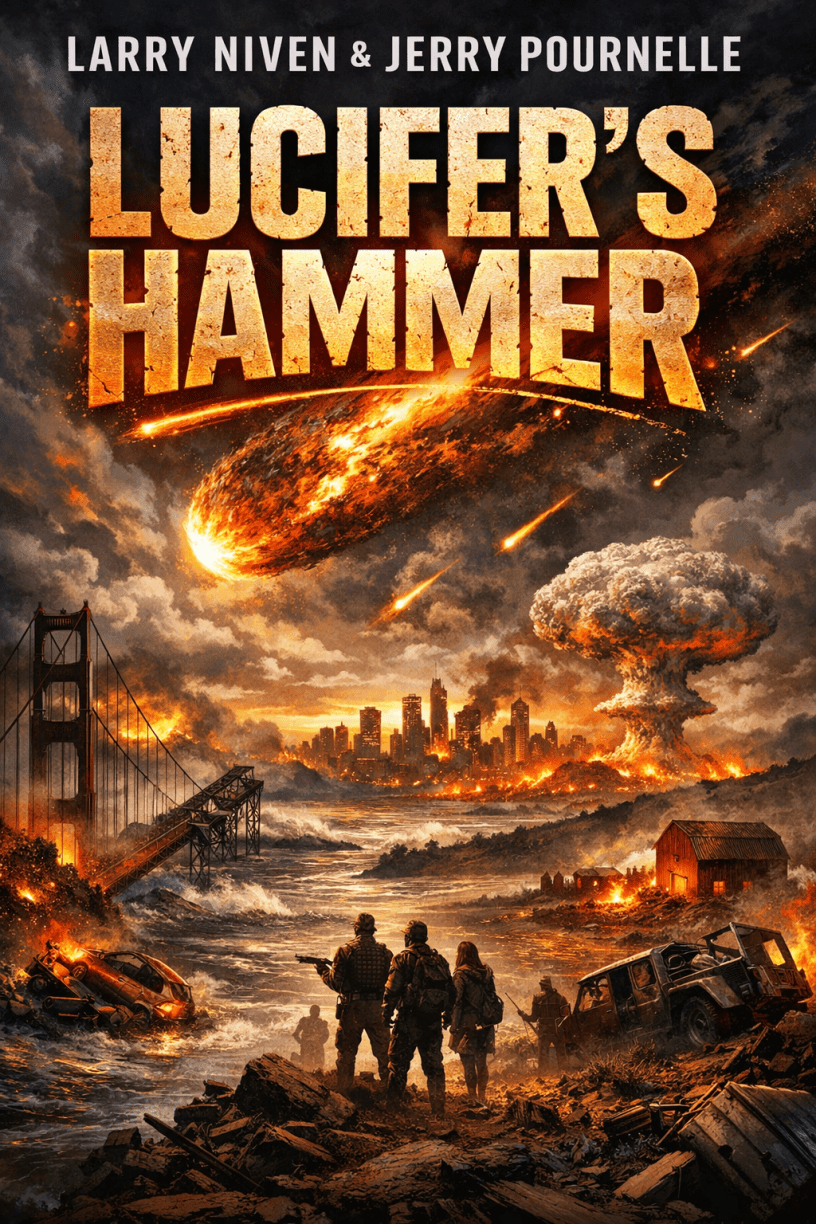
Lucifer’s Hammer is not a film. It is a 1977 novel by Larry Niven and Jerry Pournelle, and for many readers today, the most accessible version is the audiobook, widely distributed through platforms such as Audible.
As an audiobook, it holds up. The narration carries a long, multi-character story without losing clarity, and the pacing allows the listener to follow a complex collapse scenario over time. It is not a short or casual listen, but it remains effective in delivering the scale of the story.
The strength of Lucifer’s Hammer is not the comet impact itself. It is what happens after. Infrastructure fails. Supply chains disappear. Authority fragments. The story shifts quickly from global event to local survival, focusing on who adapts and who does not. Characters are defined less by heroism and more by function. Some lead. Some organize. Some fail.
This systems-level approach continues to make the book compelling. It treats collapse as a process rather than a single moment.
At the same time, the book reflects the era in which it was written. Certain portrayals—particularly around race and urban populations—rely on broad stereotypes that do not hold up. Political figures are simplified into types rather than developed as individuals. These elements do not invalidate the work, but they do require a modern reader to approach it critically.
Despite these issues, the core structure remains strong. Few disaster narratives spend as much time on the aftermath, where survival depends on organization, resource control, and cooperation under pressure.
That is also why Lucifer’s Hammer has never been fully realized on screen. A faithful adaptation would not be a traditional disaster film. It would require a large-scale production focused on long-term collapse rather than a single event, with multiple groups, competing interests, and no clean resolution. In the current media environment, that kind of story would be better suited to a limited series than a feature-length film.
The audiobook remains a practical way to experience the story today. It preserves the scale and structure of the original work, even as some of its assumptions show their age.
Lucifer’s Hammer is not a comfortable story. It is a functional one. That is why it continues to be revisited.
More from Cliff Potts: https://cliffpotts.org
If this work helps you understand what’s happening, help me keep it going: https://www.patreon.com/cw/WPSNews
References
Niven, L., & Pournelle, J. (1977). Lucifer’s Hammer.
Discover more from WPS News
Subscribe to get the latest posts sent to your email.
 WPS News