By Cliff Potts, CSO, and Editor-in-Chief of WPS News
Baybay City, Leyte, Philippines — August 4, 2026
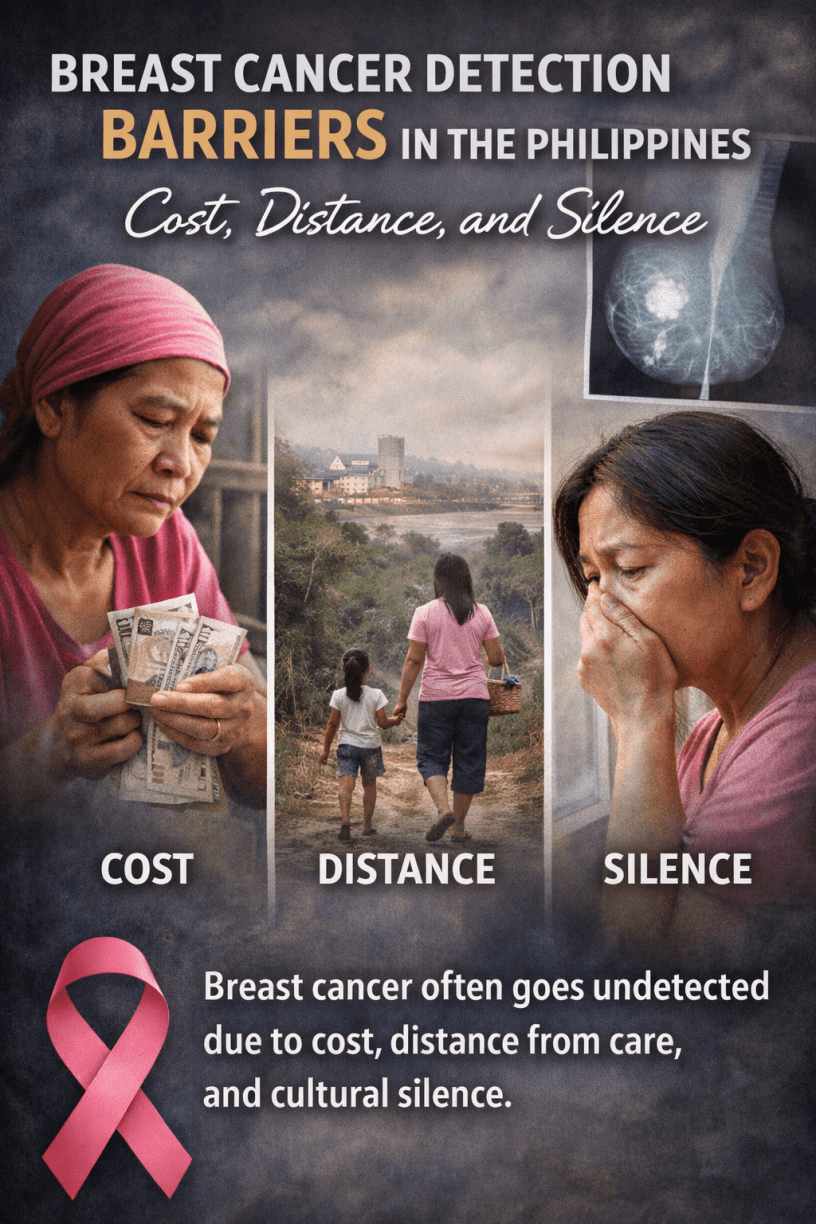
Breast cancer does not become deadly because it is untreatable. It becomes deadly because it is too often found too late. In the Philippines, late detection is not driven by a single failure, but by a layered set of barriers—economic, geographic, cultural, and emotional—that quietly delay diagnosis until options narrow.
These barriers are not evenly distributed. They fall hardest on women outside major cities, on families living month to month, and on those taught—explicitly or implicitly—to endure discomfort in silence.
Cost as a Gatekeeper
For many Filipino families, the first barrier is cost. Screening, diagnostic imaging, and follow-up tests require money long before treatment even begins. Mammography services are limited in many provinces, and traveling to urban centers adds transportation, lodging, and lost workdays to the expense.
Even when public hospitals are available, long wait times and overburdened systems discourage early evaluation. When resources are scarce, people delay care until symptoms feel unavoidable. By then, the disease has often progressed.
Cost does not just delay detection—it shapes decisions about whether detection happens at all.
Distance and Uneven Access
Geography compounds the problem. The Philippine archipelago spans thousands of islands, but diagnostic infrastructure is concentrated in a few urban areas. For women in rural or coastal communities, screening may require hours—or days—of travel.
This uneven access creates a dangerous pattern: early-stage breast cancer goes unseen, while late-stage disease arrives suddenly in emergency rooms and oncology wards. The system is reactive instead of preventive.
Early detection requires proximity. Without it, silence fills the gap.
The Weight of Silence
Cultural expectations also play a powerful role. Many women prioritize family needs over their own health. Others avoid speaking openly about breast symptoms out of modesty, fear, or concern about becoming a burden.
Silence is often mistaken for strength. In reality, it allows disease to advance unchecked.
There is also fear of the diagnosis itself. Cancer is still associated with inevitability and loss. Some avoid testing because they believe knowing will make things worse. But not knowing does not protect anyone—it only removes time.
When Late Detection Becomes Personal
This is not an abstract issue for me.
I lost my wife to breast cancer on September 3, 2025, at 5:15 in the morning. Like so many families, we confronted the disease after it had already tightened its grip. The consequences of delayed detection are not theoretical. They are measured in hospital rooms, exhausted caregivers, and final hours that arrive far too soon.
I share this here once, and only here, because it underscores what statistics alone cannot: breast cancer punishes delay. It does so quietly, and then all at once.
A Systemic Problem, Not a Personal Failure
Late detection is often framed as individual neglect. That framing is wrong.
When screening is expensive, distant, and emotionally stigmatized, delay becomes predictable. Responsibility lies not only with individuals, but with systems that fail to meet people where they are.
Reducing late-stage diagnoses requires more than awareness campaigns. It requires affordable screening, decentralized diagnostic access, community-level education, and clear reassurance that early detection is an act of care—not fear.
Breaking the Pattern
Breast cancer outcomes in the Philippines will not improve by accident. They will improve only when barriers are addressed directly and consistently.
Cost must be reduced. Distance must be shortened. Silence must be replaced with conversation and support.
Breast cancer does not wait. Neither should detection.
For more social commentary, please see Occupy 2.5 at https://Occupy25.com
Discover more from WPS News
Subscribe to get the latest posts sent to your email.
 WPS News