By Cliff Potts, CSO, and Editor-in-Chief of WPS News
Baybay City, Leyte, Philippines — August 7, 2026 — 12:30 p.m.
A battery may provide power.
A resistor may control current.
A capacitor may store energy.
But none of those things matter very much if electricity has nowhere to go.
That is where the switch enters the story.
The switch is one of the simplest devices in electronics.
It is also one of the most important.
At its most basic level, a switch does only one thing.
It either allows electricity to flow or prevents it from flowing.
That sounds almost trivial.
In practice, it is fundamental.
Every electrical system requires some method of control. Without switches, circuits would be permanently on, permanently off, or permanently connected in ways that make them useless.
A switch gives us choice.
Electricity is available.
The switch decides whether it is used.
For thousands of years, mechanical switches have been among the simplest electrical devices ever built.
Two conductors touch.
Current flows.
Separate the conductors.
Current stops.
The concept is almost embarrassingly simple.
Yet entire industries depend upon it.
The light switch on a wall is a switch.
The power button on a radio is a switch.
The ignition switch in an automobile is a switch.
The keyboard beneath a computer key contains a switch.
Even sophisticated electronic equipment often depends upon some form of switching.
The difference is that modern devices may perform the switching electronically rather than mechanically.
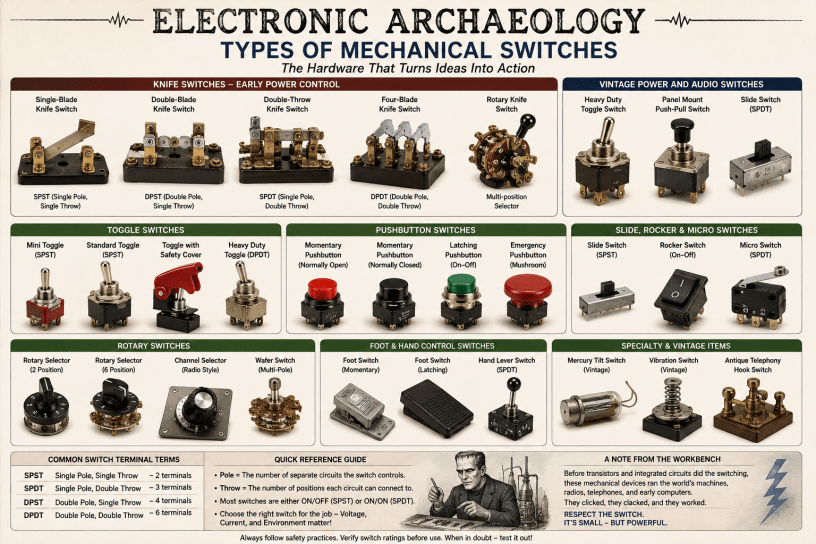
Historically, switches appeared in countless forms.
Knife switches were common in early electrical systems. These large switches used a metal blade that physically connected or disconnected a circuit. They were simple, reliable, and easy to understand.
Unfortunately, they were also capable of producing impressive sparks.
As electrical systems became more complex, switch designs evolved.
Toggle switches became common.
Pushbutton switches became common.
Rotary switches became common.
Each design solved a different problem.
The principle remained the same.
Connect.
Disconnect.
Control.
One of the first lessons learned by electronics technicians is that switches are often blamed for problems they did not create.
A device stops working.
Someone flips a switch repeatedly.
The device still does not work.
The switch receives the blame.
Sometimes the switch is actually defective.
Often it is not.
Switches merely reveal problems elsewhere in the circuit.
Electronic Archaeology Note
One of the reasons troubleshooting can be difficult is that electricity is invisible. A switch may look perfectly normal while the real problem exists somewhere else entirely. Good technicians learn to test rather than guess.
That lesson applies far beyond electronics.
Measure first.
Assume second.
The switch also introduces another important concept.
A switch does not have to carry large amounts of power.
Sometimes a small switch controls a larger device.
A thermostat controls a furnace.
A button starts a machine.
A relay controls a motor.
The switch itself may carry only a small current while directing something much larger.
This idea eventually leads us to relays, contactors, and electronic switching systems.
Before transistors became widespread, relays served as the workhorses of electrical control.
A relay uses magnetism to operate a switch.
Electricity energizes a coil.
The coil becomes an electromagnet.
The electromagnet moves contacts.
The contacts open or close another circuit.
In effect, one electrical signal controls another.
The concept was so powerful that entire telephone networks depended upon it.
Early computers depended upon it.
Industrial control systems depended upon it.
The humble switch evolved into something far more sophisticated.
Yet the foundation remained unchanged.
Connect.
Disconnect.
Control.
The importance of switching becomes obvious when we examine communications equipment.
A radio receiver must select signals.
A transmitter must turn on and off.
A telephone must establish and terminate connections.
A computer must process information.
All of these systems depend upon switching.
Some use mechanical switches.
Some use relays.
Some use transistors.
Some use integrated circuits.
The technology changes.
The idea does not.
Electronic Archaeology often focuses on forgotten components and forgotten technologies. The switch reminds us that some of the most important inventions are not complicated at all.
A switch is not impressive.
It is not glamorous.
Nobody builds museums around wall switches.
Yet civilization would be difficult to imagine without them.
Every time a circuit is activated, every time a machine starts, every time a light comes on, a switching action occurs somewhere in the system.
That simple act of control is one of the foundations upon which electronics was built.
Next week we will examine the device that allowed small electrical signals to control larger electrical systems.
The relay.
It clicks.
It clacks.
And before the transistor era, it helped build the modern world.
If this work helps you understand what’s happening, help me keep it going: https://www.patreon.com/cw/WPSNews
For more from Cliff Potts, see https://cliffpotts.org
References
Encyclopaedia Britannica. (2025). Switch. Encyclopaedia Britannica. https://www.britannica.com/technology/switch-electronics
Horowitz, P., & Hill, W. (2015). The art of electronics (3rd ed.). Cambridge University Press.
U.S. Department of Energy. (n.d.). Fundamentals handbook: Electrical science. U.S. Department of Energy.
Discover more from WPS News
Subscribe to get the latest posts sent to your email.

