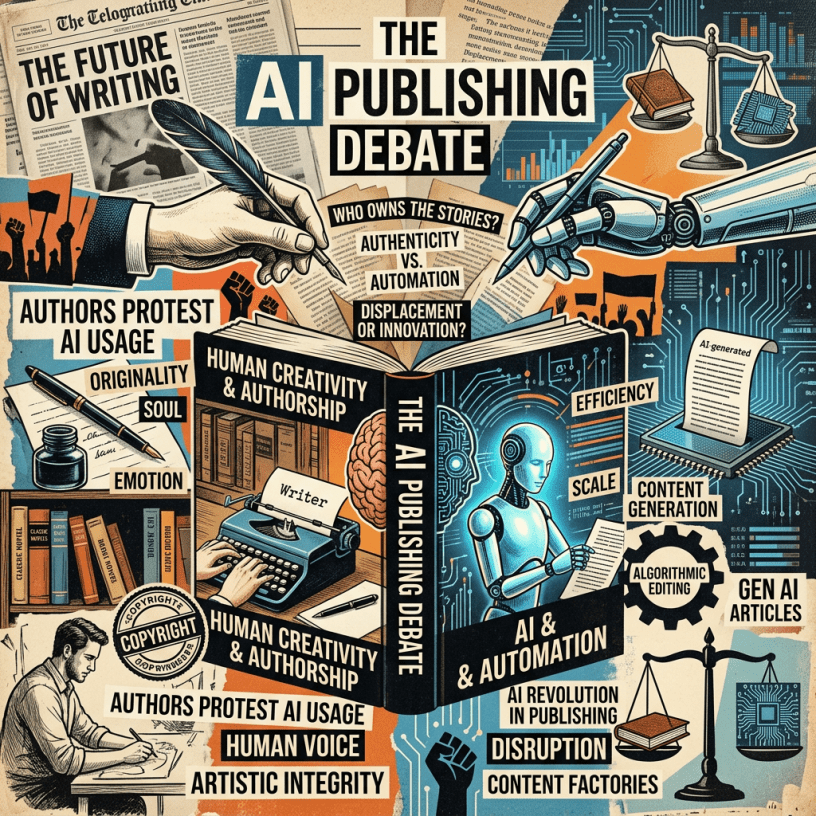
By Cliff Potts, CSO, and Editor-in-Chief of WPS News
Baybay City, Leyte, Philippines — August 7, 2026
“A good read, but it’d be way better if you could walk the talk by bypassing the inherently facistic and power-centralizing use of of ‘AI’ and work with actual artists to illustrate your works.”
That comment was recently left in response to something I wrote about fascism.
It deserves an answer—not because criticism of artificial intelligence is illegitimate, but because there is an enormous economic reality missing from the criticism.
I would love to hire human artists.
I cannot afford them.
It really is that simple.
Artists Deserve to Be Paid
Before going any further, let me make something absolutely clear: I have no problem with artists charging money for their work.
None.
Artists are workers. Their time has value. Their talent has value. Their experience has value. Their equipment costs money. Their education costs money. Their lives cost money.
I would never suggest that an illustrator should spend hours creating original artwork for WPS News simply because I happen to run an independent publication without a large budget.
In fact, asking artists to create thousands of illustrations for me without compensation would strike me as considerably less ethical than using technology that I already have access to.
And professional visual work is not cheap because professional labor is not cheap. According to the U.S. Bureau of Labor Statistics, fine artists, including illustrators, had mean wages of $35.17 per hour in May 2025, while graphic designers averaged $33.92 per hour (U.S. Bureau of Labor Statistics, 2026).
So this isn’t an argument against artists.
It’s an argument about arithmetic.
Let’s Do the Arithmetic
WPS News contains well over 5,000 essays, and virtually every one of those essays has required some form of artwork, illustration, photograph, graphic, or other visual presentation.
Let’s be ridiculously conservative.
Suppose I could find an artist willing to produce an original illustration for $50.
Five thousand essays multiplied by $50 equals:
$250,000.
A quarter of a million dollars.
And that is the minimum hypothetical figure.
It assumes every artist charges only $50. It assumes there are no revisions. It assumes there are no complicated illustrations. It assumes there are no rush jobs. It assumes every future article suddenly stops needing artwork once we reach number 5,000.
None of those assumptions is realistic.
Professional artists absolutely have the right to charge considerably more than $50 for work requiring their time and skill. Again, they should.
But WPS News does not have $250,000.
Nobody Is Paying for This
This is the part of the conversation that frequently disappears when people discuss what independent publishers ought to do.
WPS News does not have thousands of paying subscribers underwriting an art department.
Nobody has appeared with a quarter-million-dollar check and told me to go commission thousands of human artists.
Nobody is paying me enough to finance an illustration department.
Yet the expectation apparently remains that an independent publisher should somehow spend money that does not exist in order to satisfy somebody else’s ethical objections to a technology.
How?
That isn’t a rhetorical trick. It is the central question.
Where does the money come from?
If readers aren’t paying for the publication, advertisers aren’t financing the artwork, patrons aren’t underwriting an art department, and donors aren’t supplying hundreds of thousands of dollars, then telling an independent publisher to hire artists does not constitute a financial plan.
It constitutes a wish.
The Technology Is Already Here
There is another reality worth acknowledging: these tools aren’t hypothetical anymore.
WordPress.com itself now provides AI image generation and editing within its Media Library. WordPress says the feature allows publishers to create and edit visuals directly within the platform and specifically describes it as providing additional value without requiring another subscription (WordPress.com, 2026).
That matters to a tiny independent operation.
When a capability is already available through services I can afford, while the alternative would require expenditures potentially reaching hundreds of thousands of dollars, I am going to use the available capability.
That isn’t fascism.
That’s running an unfunded publication within its means.
AI Criticism Is Still Legitimate
None of this means the debate surrounding generative AI should disappear.
There are serious questions involving copyright, employment, market concentration, compensation, training data, authorship and the increasing power of large technology corporations.
Those questions deserve serious discussion.
The U.S. Copyright Office itself has spent years examining precisely these issues. Its ongoing AI initiative has addressed digital replicas, copyrightability and generative-AI training, while economists assembled by the Office have separately examined AI’s implications for copyright economics (U.S. Copyright Office, 2025a, 2025b).
The Copyright Office has also concluded that using AI as an assistive tool does not automatically prevent copyright protection for the human-authored portions of a larger work, although purely AI-generated expression raises different copyrightability questions (U.S. Copyright Office, 2025a).
So, yes, let’s debate AI.
Let’s debate corporate power.
Let’s debate what happens to working artists.
Let’s debate whether creators whose works contribute to AI development should receive compensation and what rules should govern this technology.
Those are worthwhile arguments.
But simply labeling the technology “fascistic” does not make the economics of independent publishing disappear.
Give Me a Workable Alternative
There is an important distinction between criticizing a system and demanding that an individual somehow personally absorb the cost of fixing that system.
If somebody believes WPS News should commission human artwork for every article, I’m willing to hear the proposal.
But the proposal needs numbers attached to it.
At the deliberately conservative figure of $50 per illustration, replacing the artwork associated with more than 5,000 essays means finding at least $250,000.
If someone wants to finance that, then we can have a very different conversation.
Until then, I am going to continue doing what independent publishers have always done: use the tools available to produce the best publication possible with the resources available.
Technology changes.
Publishing changes.
The tools change.
You can dislike those changes. You can criticize them. You can campaign for different laws and different economic arrangements. You can demand better treatment for artists, and in many cases I will probably agree with you.
But you cannot make a quarter-million-dollar expense magically affordable by declaring that the cheaper alternative is morally unacceptable.
I cannot spend money I do not have.
That isn’t ideology.
That’s arithmetic.
References
U.S. Bureau of Labor Statistics. (2026). Table 1. National employment and wage data from the Occupational Employment and Wage Statistics survey by occupation, May 2025. U.S. Department of Labor.
U.S. Copyright Office. (2025a). Copyright and artificial intelligence, Part 2: Copyrightability. Library of Congress.
U.S. Copyright Office. (2025b). Identifying the economic implications of artificial intelligence for copyright policy. Library of Congress.
WordPress.com. (2026, February 17). Introducing the WordPress AI Assistant—Now built into WordPress.com. Automattic.
Discover more from WPS News
Subscribe to get the latest posts sent to your email.

