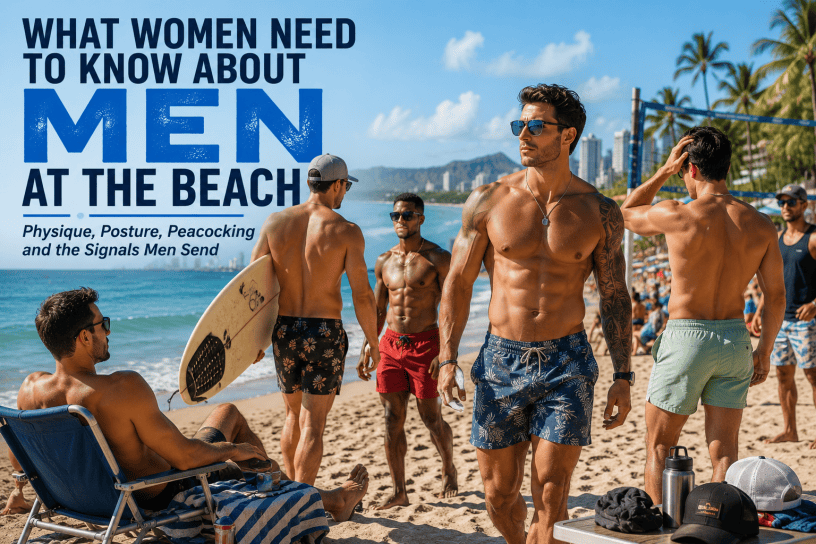
Physique, Posture, Peacocking and the Signals Men Send
By Cliff Potts, Chief Strategy Officer and Editor-in-Chief, WPS News
BAYBAY CITY, LEYTE, Philippines — September 6, 2026 — 9:05 p.m. PHT
Ladies, sometimes he really is flexing because you are watching.
And sometimes he is flexing because another man is watching.
Frequently, it is both.
That distinction is a useful place to begin the final installment of our summer beach sociology trilogy because male social presentation is easy to oversimplify. A muscular torso, expensive watch, tattoo, spectacular dive, hard volleyball serve or confident walk down the beach may look like straightforward sexual advertising.
Sometimes it is.
But heterosexual men perform for other heterosexual men constantly.
Status, strength, athletic ability, courage, wealth, competence and social confidence can all be communicated within male hierarchies. Women may be part of the intended audience, but so can every other man within visual range.
The beach merely makes the performance unusually easy to see.
Yes, Men Want to Look Attractive Too
There is an old cultural caricature in which women carefully manage their appearance while men supposedly throw on whatever clothing happens to be nearby and wander into public without further thought.
Some men undoubtedly do exactly that.
Others most certainly do not.
Research into men’s body image has documented substantial concern with muscularity and leanness, particularly where men internalize culturally promoted muscular ideals and compare their bodies with those of other men (Karazsia & Crowther, 2009).
The beach places those comparisons in unusually clear view.
Shoulders are visible.
Arms are visible.
Chest and stomach are visible.
Body fat is visible.
Height is immediately apparent.
So are tattoos, grooming, posture and the way a man physically carries himself.
The male body therefore becomes part of what sociologist Erving Goffman (1959) would have described as the presentation of self: the collection of signals through which people manage how others perceive them.
The fact that a man appears casual does not mean the presentation is accidental.
Sometimes casual takes work.
The Male Art of Looking Like You Aren’t Trying
Consider a familiar beach performance.
A man walks toward the water.
Shoulders back.
Stomach in.
Chest slightly expanded.
Sunglasses on.
His pace somehow communicates that he has nowhere particularly important to be, despite having selected a route that takes him directly past the people he would presumably like to notice him.
Then he reaches the water and suddenly discovers an urgent need to stretch.
This is called subtlety.
Men have been practicing it for generations.
Humor aside, posture matters because nonverbal behavior affects impressions of confidence and dominance. Expansive posture occupies physical space and can influence how observers perceive status and confidence, although popular claims that adopting “power poses” produces dramatic hormonal or personality changes have not held up nearly as well under later research (Carney et al., 2015; Körner et al., 2022).
The sensible conclusion is much simpler.
How somebody carries his body communicates information.
A man knows that too.
Muscles Communicate More Than Sexual Attraction
Muscularity is one of the most obvious forms of male beach signaling.
It would be easy to interpret a muscular body exclusively as an advertisement to women. Research suggests the story is more complicated.
Studies of men’s bodies and perceived strength indicate that upper-body strength contributes strongly to judgments of physical formidability. Research has also found muscular male bodies can influence perceptions of attractiveness and dominance (Sell et al., 2017).
Those are related but different social currencies.
Attractiveness matters in mate competition.
Dominance and formidability matter in competition among men.
That means the same shoulders can effectively advertise in two markets at once.
To a woman:
I am physically attractive.
To another man:
I am not the easiest person here to intimidate.
Neither message necessarily exists consciously in the man’s head. Human signaling does not require somebody to mentally narrate every behavior.
But culture and psychology provide an environment in which visible strength can carry social meaning.
And nowhere is strength much more visible than somewhere shirts have become optional.
Athleticism Is A Performance Too
Then somebody produces a volleyball.
Suddenly three men who were perfectly content sitting beneath an umbrella discover that the Olympic selection committee may be hiding behind a coconut tree.
Running becomes faster.
Diving becomes more dramatic.
Serves become harder.
Swimming becomes competitive.
This is not exclusively about attracting women. Athletic ability has status value among men themselves.
Evolutionary psychologists have argued that some male traits may function partly through intrasexual competition—competition among males—rather than solely through female mate choice (Puts, 2010).
Modern culture adds additional layers. Athletic skill can communicate discipline, coordination, experience, fitness, youthfulness and membership in particular social groups.
And, of course, sometimes he really does hope the woman in the red swimsuit saw that dive.
Humans are complicated enough to pursue several status objectives simultaneously.
Tattoos, Watches and Everything Else We Put Back On
The beach removes much ordinary clothing, but it does not eliminate fashion.
It concentrates it.
Swim trunks can communicate fashion awareness, age, subculture, wealth or complete indifference to all four.
A watch may be purely functional.
Or it may cost more than somebody else’s motorcycle.
Sunglasses can be practical protection from tropical sunlight while simultaneously carrying brand and status information.
Jewelry works similarly.
Tattoos deserve special attention because the beach reveals tattoos that ordinary clothing normally conceals. Research into tattoo perception suggests tattoos can influence judgments involving masculinity, dominance, aggression, attractiveness and risk-taking, although results depend heavily on context and the observer (Wohlrab et al., 2009).
Again, interpretation is not the same as truth.
A tattoo does not prove that somebody is dangerous.
An expensive watch does not prove that somebody is wealthy.
Designer trunks do not prove sophistication.
But social signaling does not require signals to be perfectly reliable.
It requires people to interpret them.
Men Are Watching Other Men
Women sometimes underestimate this because heterosexual male competition can occur without much explicit discussion.
A man may walk onto the beach, look around for perhaps five seconds and already have a rough mental inventory.
That guy is taller.
That guy is more muscular.
That guy is younger.
That guy is with an attractive woman.
That guy has a better watch.
That guy looks like he could swim to Cebu.
That guy should absolutely reconsider those trunks.
The comparisons do not necessarily produce hostility. Most disappear almost immediately.
But social-comparison research demonstrates that men compare their bodies with idealized and peer bodies, particularly around muscularity (Karazsia & Crowther, 2009).
Women do something comparable with other women, as discussed in the previous article.
The difference is often in what characteristics receive social emphasis.
Male status competition frequently incorporates physical capability, competence, resources, confidence and dominance alongside attractiveness.
So if a man appears to be displaying himself, do not automatically assume the entire production is being staged for women.
Half the audience may be male.
Money Doesn’t Disappear When The Shirt Comes Off
Class also follows men onto the beach.
The expensive resort.
The vehicle outside.
The boat.
The watch.
The sunglasses.
The surf equipment.
The branded clothing.
The ability to spend several days doing absolutely nothing beside an ocean.
Thorstein Veblen’s (1899) concept of conspicuous consumption remains useful because possessions can acquire social value precisely through their visibility to other people.
Yet the beach also partially disrupts class presentation.
A millionaire and a mechanic can both end up barefoot, shirtless and wearing shorts.
For a few moments, some of the ordinary uniforms of class disappear.
Then somebody checks the time on a luxury watch and puts them back.
Age Changes The Performance
Beach signaling becomes particularly interesting as men get older.
The twenty-year-old and the sixty-year-old are not necessarily playing by the same rules.
Youth itself carries social currency at a beach because youth is associated with physical capacity and because Western beauty culture heavily privileges youthful bodies.
Older men have several options.
Some continue competing directly on physique.
Some emphasize grooming and clothing.
Some communicate money or professional status.
Some lean on confidence, humor and social ease.
Some stop competing almost entirely.
And some reach a particularly useful stage of life where they remove the shirt, look down at themselves, think Well, that’s what we’ve got, and go swimming.
That can be confidence too.
The cultural tendency to treat body confidence as exclusively a women’s issue misses a considerable amount of male experience. Men age. Men gain weight. Men lose muscle. Men compare themselves with younger men. Men experience body dissatisfaction.
Research has increasingly recognized that male body image involves pressures surrounding muscularity, leanness, aging and appearance rather than the absence of appearance concerns (Tiggemann, 2004).
Men simply have not always been encouraged to talk about it.
Confidence Is Not Always Dominance
A quiet man sitting comfortably on the sand may communicate more confidence than the man loudly demonstrating his accomplishments to everyone within fifty meters.
That is another problem with reading social signals too literally.
Confidence can appear as expansive behavior.
It can also appear as the absence of any visible need for approval.
The man who seems completely comfortable with his imperfect body may attract more attention than somebody with a conventionally superior physique who appears obsessed with whether everyone is looking.
Just as with women, the person receiving the most attention is not necessarily displaying the most skin or possessing the “best” body.
Social ease matters.
Humor matters.
Movement matters.
Voice matters.
Interaction matters.
And context matters enormously.
Is He Showing Off For You?
Possibly.
Fortunately, the same principle we applied to women in the previous article works perfectly well in reverse.
Do not try to decode romantic interest from somebody’s swim trunks.
Look at interaction.
Does he repeatedly seek you out?
Does he make sustained or repeated eye contact?
Does he initiate conversation?
Does he remember something you told him?
Does he position himself near you repeatedly?
Does he attempt to make you laugh?
Does he become noticeably more animated when you enter the conversation?
Does he find remarkably unnecessary reasons to demonstrate his swimming ability within your field of vision?
One spectacular dive proves nothing.
Four spectacular dives followed by checking whether you saw them starts becoming interesting data.
Even then, reciprocal communication beats speculation.
A 2024 speed-dating study found that shared and received eye contact predicted subsequent mate choice, illustrating how reciprocal attention provides more useful information about interpersonal attraction than static appearance alone (Kret et al., 2024).
As with women, interaction beats wardrobe.
Sometimes He Really Is Just Swimming
There is an important final possibility.
Maybe the man wearing swim trunks at the beach is wearing swim trunks because he intends to swim.
Maybe the tattoo exists because he likes the tattoo.
Maybe he has muscles because he enjoys lifting weights.
Maybe he wears the watch everywhere.
Maybe he plays volleyball because volleyball is fun.
Social signaling does not mean every human action is secretly calculated advertising.
The sociology is interesting precisely because intention and interpretation are not identical.
We present ourselves.
Other people interpret us.
Sometimes their interpretation matches our intentions.
Sometimes it does not.
The Beach Doesn’t Change Human Nature. It Makes It Easier To See.
Across these three essays, we have looked at beaches as something more interesting than places where people get wet.
Ordinary clothing conventions partially disappear.
Bodies become unusually visible.
Fashion remains important but becomes concentrated.
Fitness becomes social currency.
Confidence becomes visible.
Sexual attraction becomes easier to observe.
Men compare themselves with men.
Women compare themselves with women.
Men notice women.
Women notice men.
People display themselves deliberately and accidentally.
And everybody attempts to interpret everybody else.
The beach does not create those behaviors.
They exist at offices, restaurants, schools, bars, churches, shopping centers and practically everywhere else human beings gather.
The beach simply removes some of the camouflage.
That is what makes it such an interesting little society.
The rules of presentation change.
Human nature doesn’t.
And somewhere near the water, there will always be one guy sucking in his stomach because somebody attractive just walked past.
He is absolutely not posing.
Just ask him.
This essay is written by Cliff Potts, Editor-in-Chief of WPS News. WPS News has been active in one form or another on the internet for years; for more information, visit CliffPotts.org.
If this work helps you understand what’s happening, help me keep it going through the WPS News Patreon.
References
Carney, D. R., Cuddy, A. J. C., & Yap, A. J. (2015). Review and summary of research on the embodied effects of expansive postures. Psychological Science, 26(5), 657–663.
Goffman, E. (1959). The presentation of self in everyday life. Doubleday.
Karazsia, B. T., & Crowther, J. H. (2009). Social body comparison and internalization: Mediators of social influences on men’s muscularity-oriented body dissatisfaction. Body Image, 6(2), 105–112. https://doi.org/10.1016/j.bodyim.2008.12.003
Körner, R., Röseler, L., Schütz, A., & Bushman, B. J. (2022). Dominance and prestige: Meta-analytic review of the effects of body position. Psychological Bulletin, 148(1–2), 67–85.
Kret, M. E., et al. (2024). Sharing and receiving eye-contact predicts mate choice after a 5-minute conversation: Evidence from a speed-dating study. Archives of Sexual Behavior.
Puts, D. A. (2010). Beauty and the beast: Mechanisms of sexual selection in humans. Evolution and Human Behavior, 31(3), 157–175. https://doi.org/10.1016/j.evolhumbehav.2010.02.005
Sell, A., Lukazsweski, A. W., & Townsley, M. (2017). Cues of upper body strength account for most of the variance in men’s bodily attractiveness. Proceedings of the Royal Society B: Biological Sciences, 284(1869), 20171819. https://doi.org/10.1098/rspb.2017.1819
Tiggemann, M. (2004). Body image across the adult life span: Stability and change. Body Image, 1(1), 29–41. https://doi.org/10.1016/S1740-1445(03)00002-0
Veblen, T. (1899). The theory of the leisure class. Macmillan.
Wohlrab, S., Stahl, J., & Kappeler, P. M. (2009). Modifying the body: Motivations for getting tattooed and pierced. Body Image, 4(1), 87–95.
Discover more from WPS News
Subscribe to get the latest posts sent to your email.

