The American Civil War: Civic Life Series (Part 8 of 18)
By Cliff Potts, CSO, and Editor-in-Chief of WPS News
Baybay City, Leyte, Philippines
August 18, 2026
Patience did not fail all at once. It thinned.
For months, civilians endured shortages, inflation, and broken promises with quiet endurance. They adjusted meals, borrowed, bartered, and waited. Appeals were made to merchants and officials. Petitions were written. Sermons urged restraint. The assumption lingered that suffering, if borne long enough, would be acknowledged and relieved.
When that assumption collapsed, crowds formed.
When Need Becomes Public
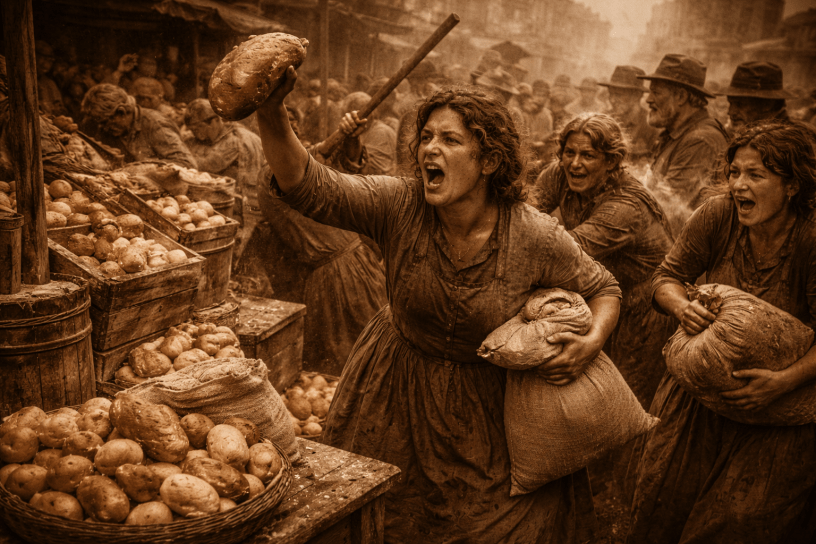
Bread riots were not spontaneous explosions of lawlessness. They were the visible endpoint of prolonged restraint. In cities like Richmond, Mobile, and Atlanta, women—often responsible for feeding families with dwindling resources—gathered to demand affordable food.
These were not ideological movements. They were practical ones. People wanted bread. They wanted prices lowered or supplies released. When requests were ignored, they took what they needed.
The riots were loud because silence had failed.
Why Women Led
Women were at the center of many bread riots not because they were more volatile, but because hunger had made them accountable. When children went unfed, the burden fell squarely on those managing households. Moral arguments gave way to arithmetic.
Contemporary accounts describe crowds armed not with weapons, but with determination. Threats were direct. Demands were specific. Violence, where it occurred, was targeted at storehouses and merchants, not symbolic institutions.
This was not rebellion. It was desperation made collective.
Authority Under Strain
Local authorities faced a dilemma. Suppress the crowds and risk legitimizing the charge that the state protected property over people. Concede to demands and undermine already fragile control over markets.
Responses varied. Some officials ordered supplies distributed. Others called out militias. Still others attempted a mix of force and relief. None of these responses addressed the structural causes of scarcity.
The riots exposed a painful truth: governance that cannot feed its civilians loses moral authority quickly.
The Breaking Point of Deference
Bread riots marked a shift in how civilians related to power. Deference, long sustained by habit and fear, eroded under material pressure. People who had endured quietly now acted openly.
This shift mattered beyond food. Once crowds learned that collective action could extract concessions—or at least force acknowledgment—the relationship between civilians and authorities changed permanently.
Patience, once broken, does not easily reset.
Community Reactions
Reactions to the riots were mixed. Some neighbors condemned the actions as disorderly. Others quietly approved, even benefited. Many felt both at once. Moral certainty fractured alongside civic trust.
What united these responses was recognition: the old rules were no longer working. Something fundamental had changed.
After the Riots
The riots did not end hunger. They did not restore stable markets. But they did redefine acceptable behavior under stress. Actions once unthinkable became thinkable. Boundaries shifted.
Long after the crowds dispersed, the memory remained. People remembered who stood with them, who opposed them, and who hid behind authority.
Looking Back
Bread riots during the Civil War were not signs of moral collapse. They were signs of a moral system pushed beyond capacity. When patience is exhausted and survival is at stake, restraint gives way to action.
This is the eighth truth of civic breakdown: endurance has limits. When institutions fail to respond, people stop waiting.
The riots were not the beginning of chaos.
They were the moment patience ran out.
McPherson, J. M. (1988). Battle cry of freedom: The Civil War era. Oxford University Press.
Faust, D. G. (2008). This republic of suffering: Death and the American Civil War. Alfred A. Knopf.
McCurry, S. (2010). Confederate reckoning: Power and politics in the Civil War South. Harvard University Press.
Rable, G. C. (2010). Damn Yankees! Demonization and defiance in the Confederate South. Louisiana State University Press.
Library of Congress. (n.d.). Civil War diaries and letters. Manuscript Division. https://www.loc.gov/collections/civil-war
Library of Congress. (n.d.). Chronicling America: Historic American newspapers. https://chroniclingamerica.loc.gov
Discover more from WPS News
Subscribe to get the latest posts sent to your email.

