By Cliff Potts, CSO, and Editor-in-Chief of WPS News
Baybay City, Leyte, Philippines — August 22, 2026
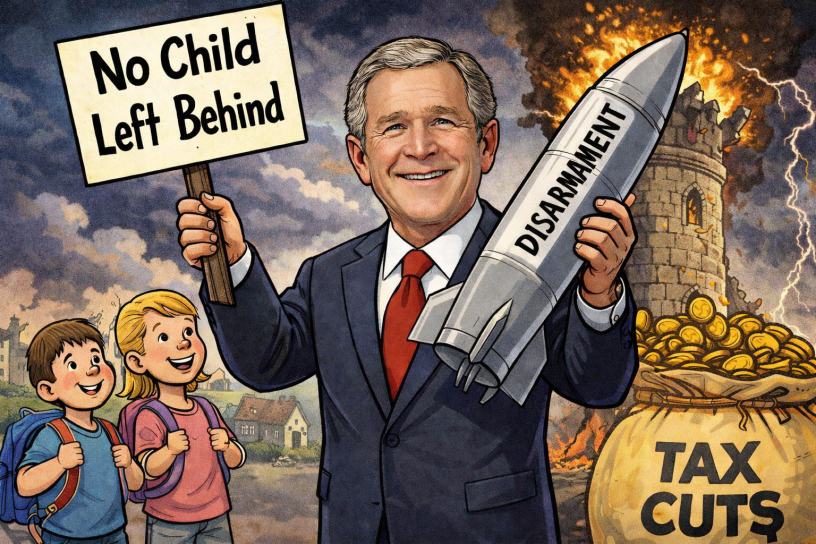
George W. Bush entered office in January 2001 with a conventional policy agenda rooted in domestic priorities and limited strategic adjustments abroad. His early focus centered on tax cuts, education reform, and a governing philosophy described as “compassionate conservatism.” In foreign policy, his administration emphasized missile defense and signaled interest in reducing the United States nuclear arsenal. At that stage, there was little indication that Bush intended to pursue large-scale military conflict or redefine U.S. global posture through sustained war.
Prior to September 11, 2001, Bush’s presidency appeared positioned to follow a standard post–Cold War trajectory. His administration engaged Russia on strategic stability, including discussions on nuclear reductions, while maintaining a cautious but not overtly aggressive international stance. The early months of his presidency reflected continuity with existing policy frameworks rather than a pivot toward expansive military engagement.
The attacks on September 11, 2001, fundamentally altered that trajectory. The shift was immediate and structural. National security priorities displaced domestic policy as the central organizing principle of the administration. The resulting “War on Terror” redefined U.S. foreign policy, expanding executive authority, increasing military commitments, and reshaping global alliances and conflicts.
The U.S. invasion of Afghanistan in October 2001 was directly tied to the presence of al-Qaeda under Taliban protection. In contrast, the 2003 invasion of Iraq did not stem from credible operational links to the September 11 attacks. Subsequent investigations found no evidence of a collaborative relationship between Iraq and al-Qaeda in carrying out attacks against the United States. The decision to invade Iraq reflected a combination of pre-existing policy interests, post-9/11 threat perception, and selective interpretation of intelligence rather than a direct response to the attacks themselves.
Absent September 11, Bush’s presidency likely would have remained centered on domestic governance and incremental strategic policy shifts. Nuclear arms reduction, already under consideration, may have emerged as a defining foreign policy achievement. Instead, it became a secondary outcome overshadowed by prolonged military engagement.
Economic conditions present at the start of Bush’s term also suggest an alternative path that would have been shaped less by war and more by structural financial instability. The early 2000s economy was still adjusting to the collapse of the dot-com sector, while risk in the housing and financial markets continued to build. Policies expanding access to homeownership and the growth of subprime lending were already in motion. While the financial crisis of 2007–2008 likely would have occurred regardless, the absence of large-scale military expenditures may have altered the government’s fiscal position entering that crisis.
This counterfactual does not remove responsibility for decisions made after September 11. Rather, it clarifies the degree to which a single event redirected an administration’s priorities and reshaped its legacy. Without the attacks, George W. Bush would likely be remembered as a conventional domestic-policy president navigating economic instability and modest strategic change. With them, he became a war president defined by conflict, security policy, and the long-term consequences of both.
For more information, visit https://cliffpotts.org
If this work helps you understand what’s happening, help me keep it going: https://www.patreon.com/cw/WPSNews
References
9/11 Commission. (2004). The 9/11 Commission Report.
U.S. Senate Select Committee on Intelligence. (2008). Report on Iraq Intelligence Assessments.
Miller Center of Public Affairs. (n.d.). George W. Bush: Domestic and Foreign Affairs.
Bush, G. W. (2001). Remarks on nuclear weapons reductions. White House Archives.
Discover more from WPS News
Subscribe to get the latest posts sent to your email.

