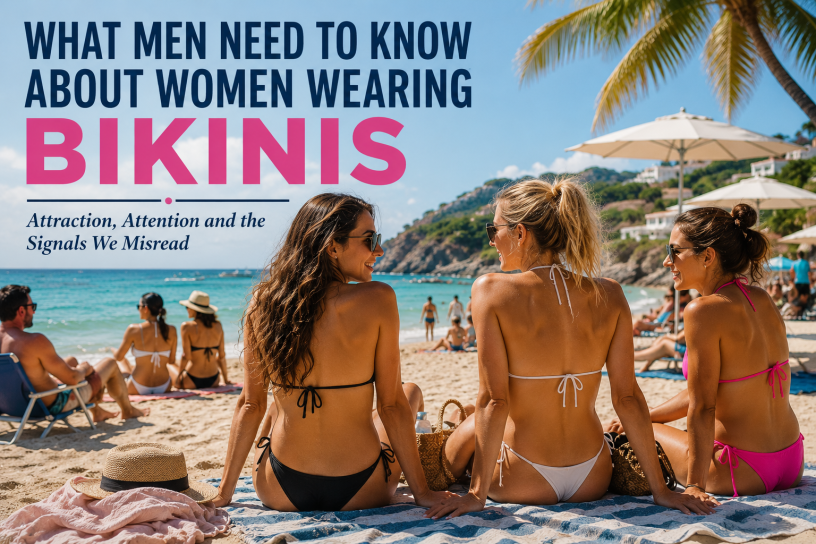
Attraction, Attention and the Signals We Misread
By Cliff Potts, Chief Strategy Officer and Editor-in-Chief, WPS News
BAYBAY CITY, LEYTE, Philippines — August 23, 2026 — 9:05 p.m. PHT
Yes, gentlemen, sometimes she wore the bikini because she wanted to look sexy.
We might as well get that out of the way immediately.
Sometimes a woman chooses clothing because she wants to look attractive. Sometimes she enjoys being noticed. Sometimes she wants to turn heads. Sometimes there is one particular person whose head she hopes will turn.
Pretending otherwise would make a discussion about human attraction considerably less useful.
The mistake comes one step later.
She wants to look attractive does not logically become she is attracted to me.
Those are two entirely different pieces of information, and research on sexual perception suggests men are not always particularly good at keeping them separate. Studies have repeatedly found situations in which men perceive more sexual intent in women’s behavior than women themselves report intending, although the size and causes of that difference vary considerably among individual men (Farris et al., 2008; Perilloux et al., 2012).
That makes the bikini an excellent subject for the second installment of our beach sociology trilogy.
The first article examined the beach as a social environment where bodies, fashion, confidence, status and attraction become unusually visible.
Now we get to the dangerous little machine between the observer’s ears:
interpretation.
Sometimes Sexy Really Does Mean “I Want to Look Sexy”
There is no reason to sanitize human motivation.
Women are sexual beings. Women experience attraction. Women flirt. Women advertise themselves. Women sometimes deliberately select clothing they believe makes them sexually attractive.
There is empirical evidence that clothing choices can sometimes relate to courtship motivation. In a study of women attending Austrian discotheques, researchers found evidence that women were aware of clothing’s signaling function and, in some circumstances, adjusted clothing in relation to sexual motivation (Grammer et al., 2004).
That was a nightclub study, not a beach study, and it should not be generalized beyond what it actually measured. But it demolishes the equally silly proposition that sexual presentation never has anything to do with sexual motivation.
Sometimes it does.
A woman may look in the mirror before going out and think, in perfectly straightforward terms, Damn, I look good.
She may enjoy that.
She may want other people to notice that she looks good.
And none of those facts tells you what she thinks about you.
That distinction is the heart of this essay.
Attention Is Not the Same Thing as Availability
There are several different things that tend to get collapsed into one concept.
Wanting to be attractive is one.
Wanting to be noticed is another.
Wanting social approval is another.
Wanting sexual attention is another.
Wanting attention from a specific person is yet another.
Wanting somebody to actually approach is another still.
And wanting a sexual relationship with that person is several additional steps down the road.
Those states can overlap, but they are not synonyms.
This is especially important at a beach because revealing clothing is already built into the environment. A bikini exposes considerably more skin than office clothing, but that observation tells us almost nothing by itself. The baseline has changed.
As we discussed in the first article, the meaning of clothing also changes according to the local norm. A bikini on a beach where virtually everyone wears bikinis carries different social information from the same bikini in an environment where most swimmers wear shorts and T-shirts.
Context changes the signal before anyone has even said hello.
Women Look at Women
One of the easiest mistakes for heterosexual men to make is assuming that women’s appearance is principally a communication directed toward heterosexual men.
Sometimes it is.
But men are not the only audience.
Women compare appearance with other women. They notice clothing, bodies, styles and trends. Research following women through their everyday lives found that appearance comparisons occurred particularly often with other people encountered in person, demonstrating how routinely appearance can become part of peer comparison (Fardouly & Vartanian, 2015).
At a beach, that can mean noticing another woman’s swimsuit, body, tan, hair, accessories, confidence or fitness.
It can mean admiring her.
It can mean envying her.
It can mean wondering where she bought the swimsuit.
It can mean deciding that particular cut would look terrible on oneself.
It can mean noticing that everyone in the group has apparently adopted a fashion trend except you.
And, yes, it can involve competition.
None of that requires a man to be involved.
Women inhabit social hierarchies with other women just as men inhabit social hierarchies with other men. Appearance can be one form of social currency within those groups.
The woman wearing the most striking bikini at the beach may be perfectly aware that men are looking.
She may also care considerably more about what the three women sitting beside her think of it.
Men Sometimes See A Signal That Isn’t There
Here we get into uncomfortable but useful territory.
Research on sexual-intent perception has found that men can mistake friendliness for sexual interest. Importantly, the research is more nuanced than the cliché that “men always think women want them.” One study found men were also capable of making the opposite mistake—missing genuine sexual interest—suggesting that the problem can involve difficulty distinguishing friendly from sexual cues rather than simply assuming sex all the time (Farris et al., 2008).
Other research using speed-meeting encounters found individual differences were substantial. Men oriented more strongly toward short-term mating and men who rated themselves as more attractive were particularly likely to overestimate women’s sexual interest (Perilloux et al., 2012).
So this is not a matter of declaring all men socially incompetent.
It is a matter of recognizing that human beings interpret ambiguous information through expectations, desires and assumptions.
And clothing can become one of those ambiguous pieces of information.
Researchers have specifically found that some men form an illusory association between provocative clothing and women’s sexual interest even when more diagnostically useful cues—such as facial affect—tell a different story (Treat et al., 2011).
That is precisely where the bikini can become misleading.
You can accurately observe:
She is wearing a very revealing bikini.
You might reasonably interpret:
She is comfortable being seen in it.
You might even be right that:
She deliberately wants to look attractive.
But:
Therefore she wants me
is information you supplied yourself.
The Beach Itself Can Fool You
The environment matters too.
One experiment placed photographs of women into different social settings and asked men to judge their sexual interest and friendliness. Sexually relevant environments increased men’s estimates of women’s sexual interest, demonstrating that observers interpret the person partly through the setting around her (Treat et al., 2015).
Think about what that means at a beach.
There are exposed bodies everywhere.
People are relaxing.
There may be alcohol.
People are looking at one another.
Flirting does happen.
Couples form.
Vacation romances are real.
Everyone is outside ordinary workplace and household routines.
The entire environment can prime an observer to interpret ambiguous behavior through a sexual or romantic lens.
The setting says, This could be flirting.
The mistake is turning could be into is.
So What Should A Man Actually Pay Attention To?
Fortunately, human beings have developed a remarkably sophisticated signaling system for determining whether another human being is interested.
It’s called interacting with them.
Clothing tells you something about presentation.
Interaction tells you something about relationship.
Does she repeatedly make eye contact?
Does she smile at you specifically rather than simply behaving pleasantly toward everyone?
Does she enter conversation willingly?
Does she keep the conversation going?
Does she ask questions about you?
Does she move closer rather than farther away?
Does she return after an interruption?
Does she initiate another interaction?
Does engagement become reciprocal?
No single behavior is magical. Eye contact by itself certainly does not mean somebody wants sex. But reciprocal behaviors accumulated over an interaction provide substantially more information than the square inches of fabric in someone’s swimsuit.
A 2024 speed-dating study, for example, found that participants were more likely to select dating partners with whom they shared more eye contact; receiving eye contact predicted mate choice as well (Kret et al., 2024).
The useful word there is shared.
Attraction becomes much easier to identify when communication starts going both directions.
The Difference Between “Look at Me” and “Come Talk to Me”
This distinction deserves to be explicit.
A person can enjoy being looked at without wanting every observer to approach.
That is not contradictory.
Human beings routinely display themselves for audiences without inviting individual relationships with everyone in the audience.
The musician wants applause from 5,000 people but does not want 5,000 dinner dates.
The bodybuilder wants people to notice the physique.
The person wearing an expensive suit wants the suit noticed.
The woman wearing a striking bikini may enjoy knowing she looks spectacular in it.
Attention itself can be rewarding.
But generalized attention and individualized interest are different social phenomena.
The signal changes when she looks back.
It changes further when she smiles.
It changes further when she starts talking.
It changes further when she continues talking.
It changes further when she seeks you out again.
Now you have something considerably more useful than a swimsuit to interpret.
Revealing Clothing Can Still Affect Men’s Judgments
None of this means clothing has no effect on perception.
It clearly can.
A substantial review of research on sexual misperception found provocative clothing among several situational factors associated with increased estimates of women’s sexual interest (Farris et al., 2008).
That finding is sociologically important because it demonstrates two things simultaneously.
First, clothing really does communicate.
Second, observers can assign meanings to that communication that exceed what the wearer intended.
Both can be true.
A woman can intentionally communicate sexuality through appearance while an observer still incorrectly infers sexual interest in him.
That is the subtle point that disappears whenever this discussion gets reduced to slogans.
Confidence May Be The Message
There is another possibility men routinely underestimate.
Maybe the primary audience is herself.
Wearing a bikini can be an act of body confidence.
For someone who previously avoided showing her body, walking onto a beach in a swimsuit may communicate something very different internally from what observers imagine externally.
I’m comfortable.
I’m done hiding.
I like how I look.
I’m going swimming and I’m not spending the afternoon worrying about my stomach.
From twenty yards away, a man cannot reliably distinguish that experience from deliberate sexual display.
He sees the same bikini.
She may be experiencing an entirely different story.
Attraction Isn’t A Crime; Assumption Is Just Bad Data
There is no reason for men to pretend not to notice attractive women.
If an attractive woman walks down the beach in a bikini and you find her attractive, congratulations: your visual system appears operational.
The useful discipline comes afterward.
Notice what you actually know.
She’s attractive to you.
She’s wearing a bikini.
Maybe she looks confident.
Maybe she appears to enjoy being noticed.
Everything beyond that requires additional information.
This is less a moral lesson than an information-quality problem.
If you were analyzing intelligence, troubleshooting a computer network or diagnosing an engine, you would not take one ambiguous indicator and pretend it answered every subsequent question.
Don’t do it with people either.
The Bikini Is A Signal. It Just Isn’t A Sentence.
Clothing matters.
Fashion matters.
Bodies matter.
Sexual attraction matters.
People deliberately make themselves attractive.
Women sometimes want men to look at them.
Women sometimes dress for other women.
Women sometimes compete with other women.
Women sometimes want one particular person to notice them.
Women sometimes wear a bikini because it is hot, they are at the beach, and that is what they own.
Frequently several motivations coexist.
That is why there is no bikini decoder ring.
The swimsuit can tell you something about how a woman has chosen to present herself in that environment.
It cannot reliably tell you what relationship she wants with the person looking at her.
For that, stop studying the swimsuit.
Start paying attention to the woman wearing it.
This essay is written by Cliff Potts, Editor-in-Chief of WPS News. WPS News has been active in one form or another on the internet for years; for more information, visit CliffPotts.org.
If this work helps you understand what’s happening, help me keep it going through the WPS News Patreon.
References
Fardouly, J., & Vartanian, L. R. (2015). Appearance comparisons and body image in women’s everyday lives. Body Image, 15, 81–88. https://doi.org/10.1016/j.bodyim.2015.07.002
Farris, C., Treat, T. A., Viken, R. J., & McFall, R. M. (2008). Sexual coercion and the misperception of sexual intent. Clinical Psychology Review, 28(1), 48–66. https://doi.org/10.1016/j.cpr.2007.03.002
Farris, C., Treat, T. A., Viken, R. J., & McFall, R. M. (2008). Perceptual mechanisms that characterize gender differences in decoding women’s sexual intent. Psychological Science, 19(4), 348–354. https://doi.org/10.1111/j.1467-9280.2008.02092.x
Grammer, K., Renninger, L., & Fischer, B. (2004). Disco clothing, female sexual motivation, and relationship status: Is she dressed to impress? The Journal of Sex Research, 41(1), 66–74. https://doi.org/10.1080/00224490409552214
Kret, M. E., et al. (2024). Sharing and receiving eye-contact predicts mate choice after a 5-minute conversation: Evidence from a speed-dating study. Archives of Sexual Behavior.
Perilloux, C., Easton, J. A., & Buss, D. M. (2012). The misperception of sexual interest. Psychological Science, 23(2), 146–151. https://doi.org/10.1177/0956797611424162
Treat, T. A., Viken, R. J., Farris, C. A., & Smith, J. R. (2011). Men’s memory for women’s sexual-interest and rejection cues. Related experimental work on perceived associations between diagnostic affective cues, clothing style and sexual interest. Journal of Mathematical Psychology.
Treat, T. A., Viken, R. J., Kruschke, J. K., & McFall, R. M. (2015). Contextual influences on men’s perceptions of women’s sexual interest. Archives of Sexual Behavior.
Discover more from WPS News
Subscribe to get the latest posts sent to your email.

