By Cliff Potts
BAYBAY CITY, LEYTE — August 31, 2026
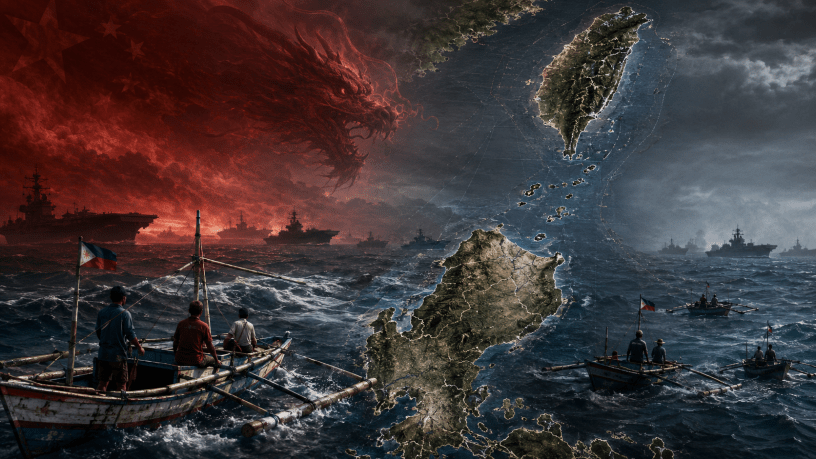
There is an uncomfortable fact that the Philippines needs to confront before events make the decision for it: if China ever moves militarily against Taiwan, the Philippines will not simply be a spectator watching somebody else’s war.
Geography will not permit it.
Northern Luzon, Batanes, the Luzon Strait and the Bashi Channel sit immediately south of Taiwan. The Bashi Channel is one of the critical passages connecting the South China Sea with the Philippine Sea and the wider Pacific. Any serious Chinese blockade of Taiwan would therefore have to consider military, naval and surveillance activity operating through or around those waters (Center for Strategic and International Studies [CSIS], 2026a).
Philippine officials already understand this. Former Armed Forces Chief Gen. Romeo Brawner publicly ordered preparations for a Taiwan contingency, while Philippine forces have expanded their presence in Batanes. A forward operating base was opened in Mahatao in 2025 specifically to strengthen territorial defense and maritime awareness in the Luzon Strait (Lariosa, 2025). President Ferdinand Marcos Jr. has likewise acknowledged that a Taiwan conflict would inevitably affect the Philippines (CSIS, 2024).
So stop treating this as an abstract possibility.
China Does Not Have to Conquer the Philippines to Threaten It
I am not arguing that we can know Beijing would launch an amphibious invasion intended to occupy all 7,000-plus Philippine islands. Nobody can honestly make that prediction.
China would not need to.
If Beijing attempted to blockade or invade Taiwan, its military planners would have powerful reasons to prevent Philippine territory from becoming the southern doorway through which American, Japanese or Philippine forces could interfere.
Three of the four additional Enhanced Defense Cooperation Agreement locations announced in 2023 are in northern Luzon—two in Cagayan and one in Isabela. Those facilities sit in precisely the part of the country most relevant to a Taiwan contingency (U.S. Department of Defense, 2023). As recently as August 2026, officials reported significant progress upgrading the nine Philippine EDCA locations (Philippine News Agency, 2026).
American and Philippine forces have already exercised sophisticated coastal-defense capabilities in Batanes, approximately 100 miles south of Taiwan, demonstrating just how strategically important those islands have become (Reuters, 2026a).
From Beijing’s perspective, therefore, the Philippines could not simply be ignored.
That does not necessarily mean occupation. It could mean coercion. Blockade. Cyberattack. Attacks against military facilities. Attempts to intimidate Manila into denying American forces access. Pressure against isolated Philippine islands or outposts. Maritime control operations in the Luzon Strait. Or some combination of all of them.
CSIS analysts have already warned that a Taiwan war could open another front in the South China Sea and that Philippine forces would have difficulty simultaneously defending both the home islands and distant West Philippine Sea positions (CSIS, 2024).
The West Philippine Sea Is the Warning
Filipinos do not have to speculate about whether China is willing to use pressure incrementally.
Look outside.
The gray-zone campaign is already here.
Chinese coast guard ships, maritime militia, military aircraft, information operations and other instruments of state power have steadily pushed against Philippine sovereignty without deliberately crossing the threshold into conventional war. A recent CSIS assessment described the Philippines as a testing ground for China’s increasingly broad campaign of maritime, political, cyber and information coercion (Ingram, 2026).
China is simultaneously expanding installations in the Paracels. Those islands themselves offer a history lesson: China seized the Paracels from South Vietnam in 1974 and remains in control despite continuing Vietnamese claims (Reuters, 2026b). China then invaded northern Vietnam in 1979 in a limited war intended, among other purposes, to apply pressure to Hanoi (U.S. Department of State, 1979).
India provides another lesson, although the situation there is more complicated. China and India are currently attempting to stabilize their relationship, but they still dispute a roughly 3,800-kilometer Himalayan frontier, following deadly fighting in 2020 and more recent patrol confrontations (Reuters, 2026c).
These cases are different. They should not be lazily treated as identical predictions of what Beijing would do in the Philippines.
They do establish something important: China is willing to combine military pressure, territorial claims, economic leverage and prolonged coercion in pursuit of strategic objectives.
And Look at What Happens Under Chinese Political Control
This is also why Filipinos should not dismiss concerns about what authoritarian Chinese rule can mean for populations Beijing considers politically troublesome.
The United Nations human-rights office concluded that serious violations against Uyghurs and other predominantly Muslim minorities in Xinjiang may constitute crimes against humanity (Office of the United Nations High Commissioner for Human Rights [OHCHR], 2022). Human Rights Watch continues to document severe restrictions on expression, religion, movement and cultural identity among both Uyghurs and Tibetans (Human Rights Watch, 2026).
That does not prove China intends to impose the same policies on Filipinos.
It demonstrates why preserving Philippine sovereignty is not an academic exercise.
And Yes, Keep the Small Boats
I have said this before, and I will say it again: do not dismiss cheap, locally producible small patrol craft simply because they lack the glamour of billion-dollar warships.
But let us correct one misconception.
Wooden boats are not invisible to radar.
Researchers have successfully measured the radar cross-section of an actual wooden fishing vessel. Its detectability varied substantially with angle, sea conditions and other factors (Wang et al., 2022).
The useful idea is not magical stealth.
The useful idea is numbers, cost, local construction, repairability and dispersion.
A country made up of thousands of islands needs maritime presence everywhere. The Philippine government should continue developing modern drones, sensors, larger naval vessels and allied interoperability—the Defense Department is already pursuing additional UAV capabilities and guided-missile ships—but sophisticated systems should not automatically replace inexpensive systems that can be manufactured and maintained domestically (Reuters, 2026d).
A fishing nation already possesses generations of boatbuilding knowledge.
Use it.
Not as a substitute for the Philippine Navy or Coast Guard, and certainly not because wood makes a vessel magically undetectable, but because no country confronting a numerically superior maritime power should voluntarily abandon inexpensive, distributed maritime capacity.
The Time to Prepare Is Before the Strait Closes
The Philippines does not need to provoke China.
It does need to stop pretending that avoiding uncomfortable questions will keep the country out of somebody else’s war.
If China attacks Taiwan, Beijing will look south.
There sits Batanes.
Then Luzon.
Then Philippine military bases.
Then the West Philippine Sea.
And behind them stands a treaty ally of the United States occupying one of the most strategically important archipelagos on Earth.
The geography cannot be negotiated away.
I have tried to make this warning before. Some of the ideas sounded strange because inexpensive boats, dispersed defenses and locally manufactured equipment do not look impressive beside frigates, fighters and missile batteries.
Fine.
Build the frigates. Buy the drones. Strengthen the alliance. Harden the bases. Improve radar and communications.
But also keep building the simple things that can be produced by Filipinos, repaired by Filipinos and deployed throughout Philippine waters.
Because deterrence does not begin when the first missile flies.
It begins when the other side looks at the Philippines and concludes that taking, intimidating or neutralizing any part of it would cost far more than Beijing is willing to pay.
References
Center for Strategic and International Studies. (2024). Sustaining the U.S.-Philippines-Japan triad.
Center for Strategic and International Studies. (2026a). Troubled straits: Analyzing trade chokepoints in the South China Sea.
Human Rights Watch. (2026). World report 2026: China.
Ingram, H. J. (2026, August 11). Proving ground: China’s strategic ratcheting of the Philippines and the Indo-Pacific’s gray zone problem. Center for Strategic and International Studies.
Lariosa, A.-M. (2025, August 29). Philippine military opens new Luzon Strait base near Taiwan. USNI News.
Office of the United Nations High Commissioner for Human Rights. (2022). Assessment of human rights concerns in the Xinjiang Uyghur Autonomous Region, People’s Republic of China.
Philippine News Agency. (2026, August 13). US official says ‘headway’ made in EDCA sites.
Reuters. (2026a, May 2). US, Philippines deploy anti-ship missile system in Batanes near Taiwan for war games.
Reuters. (2026b, August 28). Vietnam demands end to activity in Paracels after report of Chinese construction.
Reuters. (2026c, August 25). China, India hold border talks, agree to continue search for boundary settlement.
Reuters. (2026d, August 25). Philippines seeking to expand military drone capabilities, says defence chief.
U.S. Department of Defense. (2023, April 3). Philippines, U.S. announce locations of four new EDCA sites.
U.S. Department of State, Office of the Historian. (1979, March 20). The consequences of the Chinese attack on Vietnam.
Wang, X., et al. (2022). RCS measurement and characteristic analysis of a sea surface small target with a shore-based UHF-band radar. Electronics, 11(16), 2573.
Discover more from WPS News
Subscribe to get the latest posts sent to your email.

