By Cliff Potts, CSO, and Editor-in-Chief of WPS News
Baybay City, Leyte, Philippines — September 4, 2026 — 12:30 p.m.
This is the lesson I have been looking forward to since Electronic Archaeology began.
Everything we have learned so far has been preparing us for this moment.
We have studied electricity.
We have examined resistors, capacitors, batteries, switches, relays, transformers, and power supplies.
Now we finally arrive at the technology that inspired this entire series.
The vacuum tube.
Today, most people have never handled one.
Many younger readers have never even seen one outside of a museum or an old photograph.
Yet for nearly half a century, vacuum tubes were the foundation of the electronic world.
They amplified voices.
They transmitted radio signals.
They powered radar systems.
They made long-distance telephone communication possible.
They helped build the first electronic computers.
Without vacuum tubes, much of the twentieth century would have sounded very different.
The basic idea behind a vacuum tube is surprisingly elegant.
Inside a sealed glass envelope sits a heated metal filament.
When electricity heats the filament, it releases electrons into the vacuum.
A second element, called the plate or anode, attracts those electrons when a positive voltage is applied.
Current begins to flow.
Place a third element, called the control grid, between the filament and the plate.
Now something remarkable happens.
A very small change in voltage on the grid can control a much larger flow of current between the filament and the plate.
That is amplification.
A tiny electrical signal suddenly becomes a much larger one.
That single idea changed communications forever.
Before transistors existed, nearly every radio receiver depended upon vacuum tubes to amplify weak signals arriving through the antenna.
Broadcast transmitters used larger tubes to generate enormous amounts of radio-frequency power.
Early television relied upon tubes.
Military radar relied upon tubes.
Even the first general-purpose electronic computers used thousands of them.
Electronic Archaeology Note
When I was learning electronics in high school, the industry was already moving from vacuum tubes to solid-state electronics. We learned enough about tubes to understand the basic principles, but the future clearly belonged to transistors.
Even then, I found myself fascinated by vacuum tubes.
There was something almost alive about them.
The warm orange glow of the heater.
The carefully arranged metal structures inside the glass.
The realization that invisible electrons were traveling through empty space, performing useful work.
I always wanted to learn more than I had the opportunity to learn.
In many ways, Electronic Archaeology is my chance to return to that unfinished lesson.
Vacuum tubes have disadvantages.
They consume more power.
They generate heat.
They are physically larger than transistors.
Glass breaks.
Filaments eventually burn out.
Equipment built with tubes is heavier and often requires higher operating voltages.
Those disadvantages eventually led to the transistor replacing the vacuum tube in most applications.
Yet tubes possess strengths as well.
They tolerate high voltages remarkably well.
Many radio transmitters continue to use vacuum tubes for high-power output stages.
Some audio enthusiasts still prefer tube amplifiers for their distinctive sound.
Certain specialized industrial and military applications continued using tubes long after solid-state devices became available.
Old technology does not always disappear.
Sometimes it simply finds a different purpose.
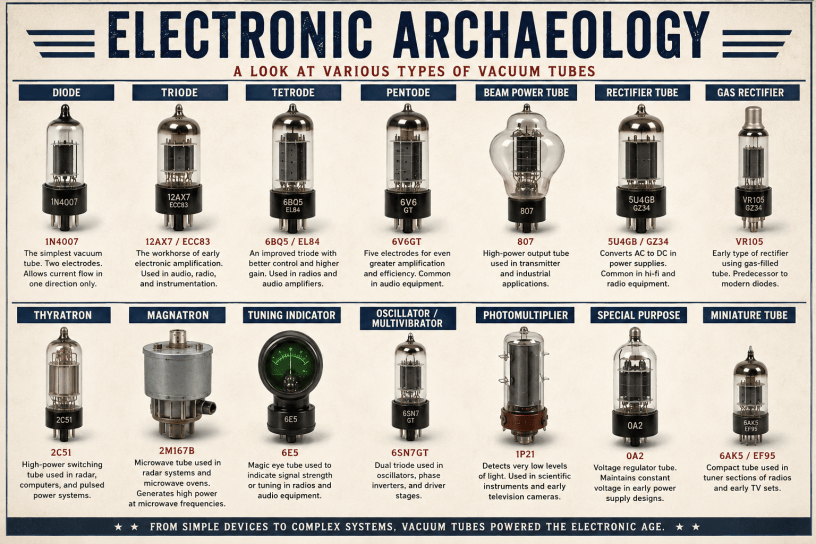
Over the coming weeks we will begin examining the different families of vacuum tubes.
Diodes.
Triodes.
Tetrodes.
Pentodes.
Rectifiers.
Power tubes.
Special-purpose tubes.
Each was developed to solve a particular engineering problem.
Each helped shape the electronic world we inherited.
Electronic Archaeology is not about nostalgia.
It is about understanding the technology that made our modern world possible.
The vacuum tube is one of the greatest engineering achievements of the twentieth century.
It deserves to be remembered.
Next week we will examine the simplest member of the vacuum tube family.
The diode.
Two electrodes.
One direction for current.
A simple device that opened the door to an electronic revolution.
If this work helps you understand what’s happening, help me keep it going: https://www.patreon.com/cw/WPSNews
For more from Cliff Potts, see https://cliffpotts.org
References
Horowitz, P., & Hill, W. (2015). The Art of Electronics (3rd ed.). Cambridge University Press.
Encyclopaedia Britannica. (2025). Vacuum tube. Encyclopaedia Britannica. https://www.britannica.com/technology/vacuum-tube
Tyne, G. F. J. (1977). Saga of the Vacuum Tube. Howard W. Sams & Co.
Discover more from WPS News
Subscribe to get the latest posts sent to your email.

