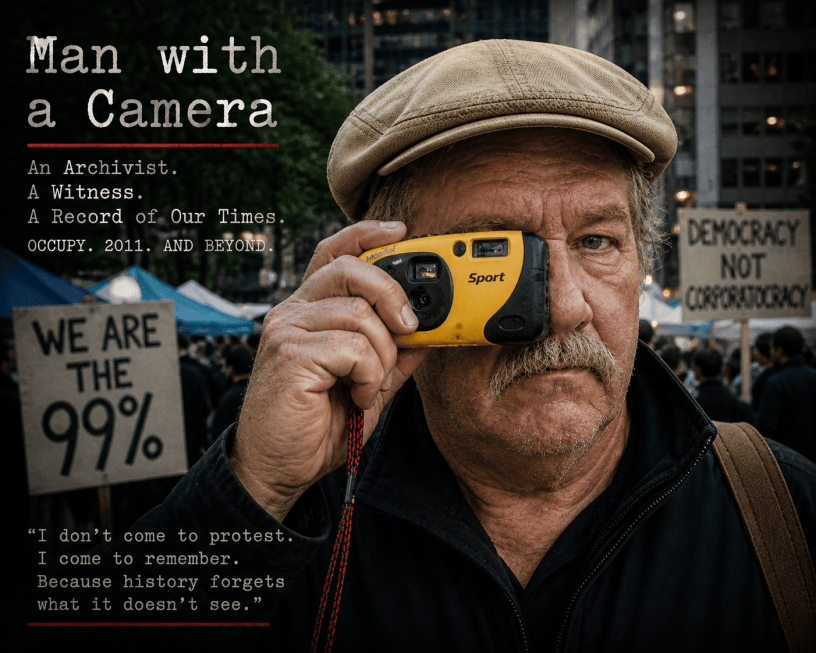
By Cliff Potts, CSO, and Editor-in-Chief of WPS News
Baybay City, Leyte, Philippines — January 8, 2031 — 21:05 PHST
The First Days
When Occupy Wall Street spread from New York across the United States in the fall of 2011, it arrived in Chicago with urgency, confusion, and purpose. People gathered at LaSalle and Jackson to protest inequality, corporate power, and political capture.
I was there early. Not to lead. Not to organize. Not to take a microphone.
I brought a camera.
The Job I Chose
From the beginning, my role was simple: document what was happening so it would not be lost. Movements are loud when they begin and quiet when they end. In between, memory gets distorted.
I understood something even then that I could not fully articulate: if no one preserved the day-to-day reality, the story would eventually be rewritten by people who were not there (Castells, 2012).
So I stayed on the edge. I recorded marches, conversations, General Assemblies, and the slow evolution of a movement trying to define itself. Most of the time, I said very little. The camera did the talking.
The Winter Shift
By December 2011, the crowds had thinned. What remained was smaller, more intimate, and more fragile.
One night, in cold and wet conditions near Michigan and Congress, a reduced group gathered under shelter to hold a General Assembly. It was no longer a spectacle. It was a handful of people trying to keep something alive.
That was when I finally explained why I was there.
I held up a small Kodak camera and told them: I am archiving this for you. For later. For when you need to look back and understand what this was.
It was not a speech. It was a statement of function.
The Edge and the Core
For much of the first year, I stayed where I belonged: on the periphery, documenting.
Over time, I drifted closer to the core. That was a mistake. Movements are complex ecosystems, and proximity changes how people see you and how you see them. The role of observer becomes harder to maintain when you are pulled into internal dynamics (Gitlin, 2012).
In retrospect, the work was strongest when I remained outside the center, focused on recording rather than participating in internal disputes.
The camera did not argue. It did not take sides. It captured what was there.
The Archive That Stayed
Most participants moved on. That is the nature of movements. Lives continue. Priorities shift. The moment passes.
The recordings did not move on.
They remained online, largely unnoticed, not widely distributed, but intact. A record of what actually happened, preserved without the benefit of hindsight or revision.
This is the difference between memory and documentation. Memory simplifies. Documentation preserves complexity (Tarrow, 2011).
What remains now is not just the idea of Occupy, but fragments of its lived reality—voices, faces, and moments that would otherwise be gone.
Looking Back Without Rewriting
Twenty years later, it is easy to tell a cleaner story about Occupy than the one that actually unfolded.
The truth is less tidy. It was hopeful and disorganized, principled and contradictory, unified and fractured at the same time.
What survives from that period is not a single narrative, but a collection of records. Some were written. Some were spoken. Some were filmed.
I carried a camera and kept recording.
That is the part that remains unchanged.
Video Archive
The video record from that period remains available in the WPS News archive:
Occupy Chicago in 4 Parts: https://youtube.com/playlist?list=PLMth54cIzxDKmiiAXT478G9eN4jll2VIT&si=EO6aPVmGvws9U59p
For more from Cliff Potts, see https://cliffpotts.org
If this work helps you understand what’s happening, help me keep it going: https://www.patreon.com/cw/WPSNews
References
Castells, M. (2012). Networks of outrage and hope: Social movements in the Internet age. Polity Press.
Gitlin, T. (2012). Occupy nation: The roots, the spirit, and the promise of Occupy Wall Street. HarperCollins.
Tarrow, S. (2011). Power in movement: Social movements and contentious politics (3rd ed.). Cambridge University Press.
Discover more from WPS News
Subscribe to get the latest posts sent to your email.
 WPS News