By Cliff Potts, CSO, and Editor-in-Chief of WPS News
Baybay City, Leyte, Philippines — September 11, 2026 — 12:30 p.m.
Last week we introduced the vacuum tube and discovered why it became the foundation of twentieth-century electronics.
This week we examine the simplest member of the vacuum tube family.
The diode.
The name itself tells the story.
“Di” means two.
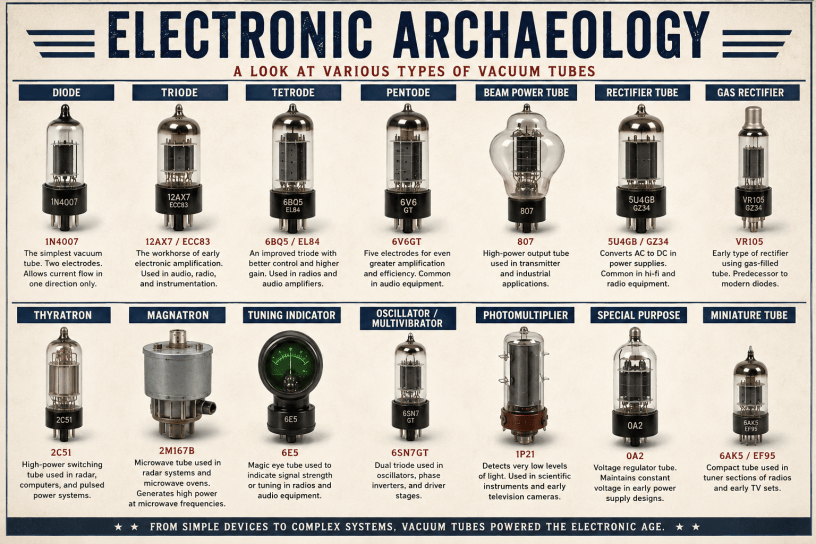
A diode contains two active electrodes.
The first is the cathode.
The second is the plate, often called the anode.
That is all it needs.
There is no control grid.
No amplification.
No complicated internal structure.
Yet this simple device changed electronics forever.
The cathode is heated by a filament or heater.
As the cathode becomes hot, it releases electrons into the vacuum inside the glass envelope. This process is known as thermionic emission.
Those free electrons form a tiny cloud around the cathode.
If the plate is made positive with respect to the cathode, the electrons are attracted toward it.
Current flows.
Reverse the polarity and something interesting happens.
The plate is now negative.
Instead of attracting electrons, it repels them.
Current almost completely stops.
The tube behaves like a one-way valve.
Electricity may pass in one direction but not the other.
That single characteristic made the vacuum tube diode invaluable.
Electronic Archaeology Note
One of the things that fascinated me about vacuum tubes when I first encountered them was that nothing physically moved.
There were no gears.
No switches.
No relays clicking back and forth.
The work was being done by electrons traveling through empty space.
Even today that still seems remarkable to me.
Inside that glass envelope, millions upon millions of electrons quietly performed useful work without a single moving mechanical part.
The vacuum tube diode found one of its greatest uses inside power supplies.
As we learned in our previous lesson, electronic circuits usually require direct current.
Household electrical service provides alternating current.
The diode solved that problem.
It allowed only one half of the alternating waveform to pass.
This process is called rectification.
Instead of alternating back and forth, the current now flowed in a single direction.
It was not yet smooth direct current.
It still pulsed.
That is why capacitors were added to power supplies.
The diode performed the rectification.
The capacitor filled the valleys.
Together they produced usable DC power.
Before semiconductor diodes became available, nearly every radio and television depended upon vacuum tube rectifiers.
Large transmitting equipment often used enormous rectifier tubes capable of handling thousands of volts.
They were impressive devices.
Some stood several inches tall.
Others looked more like laboratory glassware than electronic components.
Yet they all performed the same basic job.
One-way traffic.
The principle also appears in modern electronics.
Today’s silicon diode performs the same function.
It is smaller.
Cheaper.
Consumes almost no power.
But electrically, it performs the same task that vacuum tube engineers perfected decades earlier.
Technology changed.
Physics did not.
One lesson becomes increasingly clear as we move deeper into Electronic Archaeology.
Modern electronics did not appear overnight.
Each generation built upon the discoveries of the generation before it.
The vacuum tube diode became the ancestor of the semiconductor diode.
The semiconductor diode helped make the transistor possible.
The transistor eventually led to integrated circuits.
Integrated circuits made modern computers practical.
The family tree stretches backward farther than most people realize.
Understanding the diode means understanding the beginning of that story.
Next week we will examine the device that transformed electronics from simple rectification into true amplification.
The triode.
By adding a single control grid between the cathode and the plate, engineers discovered that a tiny electrical signal could control a much larger one.
That discovery changed radio, broadcasting, and communications forever.
If this work helps you understand what’s happening, help me keep it going: https://www.patreon.com/cw/WPSNews
For more from Cliff Potts, see https://cliffpotts.org
References
Horowitz, P., & Hill, W. (2015). The Art of Electronics (3rd ed.). Cambridge University Press.
Tyne, G. F. J. (1977). Saga of the Vacuum Tube. Howard W. Sams & Co.
Encyclopaedia Britannica. (2025). Vacuum tube. Encyclopaedia Britannica. https://www.britannica.com/technology/vacuum-tube
Discover more from WPS News
Subscribe to get the latest posts sent to your email.

