By Cliff Potts, CSO, and Editor-in-Chief of WPS News
Baybay City, Leyte, Philippines — January 22, 2031 — 21:05 PHST
The Circle Forms
At the heart of Occupy Chicago was not the march, the chant, or the sign. It was the circle.
The General Assembly was where everything came together. People stood shoulder to shoulder, often in unpredictable weather, trying to decide what to do next. There was no podium, no fixed leadership, no single voice directing the flow.
It looked unstructured from the outside. It was anything but.
A Different Kind of Order
The Assembly followed a process rooted in consensus. Speakers were recognized. Proposals were made. Concerns were raised. Hand signals replaced interruptions. Agreement was built slowly, sometimes painfully, through discussion and revision (Graeber, 2013).
It was not efficient. It was not quick.
But it was deliberate.
For many participants, this was the first time they had engaged in a form of decision-making that was not top-down. The process itself became part of the message: power could be shared, not assigned.
The Human Microphone
Without amplification permits in many cases, voices had to travel the old way.
One person spoke. The crowd repeated.
Sentence by sentence, the message moved outward, carried by dozens of voices. It created a rhythm that was both practical and symbolic. Everyone became part of the act of communication (Gitlin, 2012).
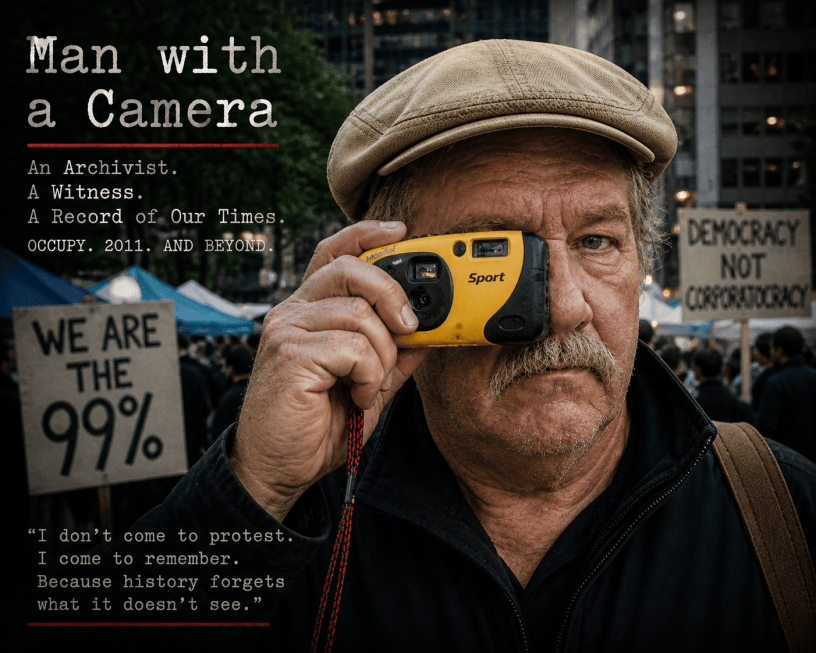
From the edge, with a camera in hand, it was impossible not to notice the shift. The crowd was not just listening. It was participating in the delivery of the message itself.
Friction in the Process
Consensus is not harmony. It is negotiation.
Disagreements surfaced quickly. Some were ideological. Some were personal. Some were rooted in frustration with how slow the process could be. A single objection could halt momentum. A single voice could reshape an entire proposal.
From the outside, it sometimes looked like dysfunction. From the inside, it was the cost of trying to build agreement without hierarchy (Tarrow, 2011).
Not everyone had the patience for it.
Small Assemblies, Clearer Voices
By the time winter set in, the crowds thinned. The large circles became smaller gatherings.
Something changed in that transition.
With fewer people, voices carried more clearly. Discussions became more direct. The process, while still slow, felt more grounded. It was no longer a spectacle. It was a working group trying to hold onto something that was slipping.
Those smaller Assemblies revealed what had always been there beneath the larger movement: individuals trying to make sense of a system they believed was failing them.
Watching the Process
From where I stood, just outside the circle, the Assembly was less about outcomes and more about observation.
Who spoke. Who hesitated. Who repeated. Who stepped back.
The camera recorded the visible process. It did not capture everything—the tension, the uncertainty, the quiet calculations people made before raising a hand—but it preserved enough to show that this was not chaos.
It was an attempt.
What Remains
Looking back now, the General Assembly is one of the most misunderstood parts of Occupy.
It is often remembered as inefficient, unfocused, or naïve. There is truth in that. But it was also one of the few spaces where people attempted to practice direct participation in real time, without intermediaries.
It did not scale well. It did not last.
But for a time, it worked well enough to bring people together and give them a voice.
That is what the record shows.
For more from Cliff Potts, see https://cliffpotts.org
If this work helps you understand what’s happening, help me keep it going: https://www.patreon.com/cw/WPSNews
References
Graeber, D. (2013). The democracy project: A history, a crisis, a movement. Spiegel & Grau.
Gitlin, T. (2012). Occupy nation: The roots, the spirit, and the promise of Occupy Wall Street. HarperCollins.
Tarrow, S. (2011). Power in movement: Social movements and contentious politics (3rd ed.). Cambridge University Press.
Discover more from WPS News
Subscribe to get the latest posts sent to your email.

