By Cliff Potts, CSO, and Editor-in-Chief of WPS News
Baybay City, Leyte, Philippines — September 18, 2026 — 12:30 p.m.
Last week we examined the vacuum tube diode.
It was an elegant device.
Simple.
Reliable.
Useful.
But it could only do one thing.
It allowed current to flow in one direction.
Engineers soon asked an obvious question.
What if we could control that current?
The answer became one of the greatest inventions in the history of electronics.
The triode.
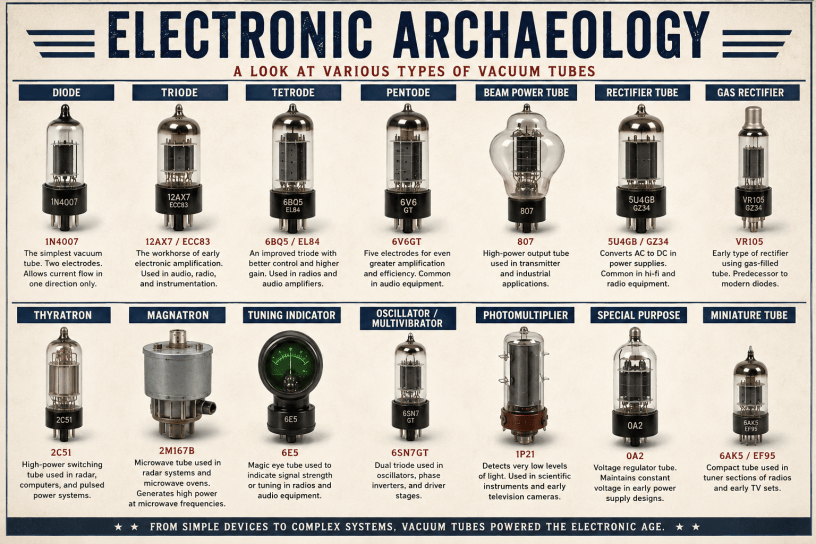
The triode takes the basic diode and adds one additional element between the cathode and the plate.
It is called the control grid.
That single piece of wire changed the world.
The heated cathode still releases electrons.
The positively charged plate still attracts them.
But now the electrons must pass through the control grid on their journey.
Apply a small negative voltage to the grid and fewer electrons reach the plate.
Reduce that negative voltage and more electrons pass through.
A very small change on the control grid can produce a much larger change in the plate current.
That is amplification.
For the first time, a weak electrical signal could control a much stronger one.
This breakthrough transformed communications.
Early radio receivers suddenly became practical because weak signals arriving at the antenna could be amplified.
Telephone systems could carry conversations over much greater distances.
Public-address systems became possible.
Radio broadcasting exploded.
Electronic music, radar, television, and the first digital computers all owe part of their existence to the triode.
It is difficult to overstate its importance.
Electronic Archaeology Note
One of the things I always appreciated about vacuum tubes was that you could actually see the device you were studying.
Inside the glass envelope you could identify the cathode, the control grid, and the plate.
The parts were not hidden inside a tiny black package.
They were right there in front of you.
As a student, that made the electronics feel real.
You could point to the grid and say, “That’s the part controlling the current.”
It was an excellent teaching tool.
The triode also introduced engineers to the idea of gain.
Gain simply describes how much a device increases the strength of a signal.
A tiny microphone signal could become powerful enough to drive a loudspeaker.
A weak radio transmission from hundreds of kilometers away could become loud enough to fill a room.
Without amplification, long-distance electronic communication would have remained extremely limited.
Of course, triodes were not perfect.
They could become unstable.
At high frequencies, unwanted electrical effects between the internal elements reduced performance.
Engineers responded by developing new tube designs.
The tetrode added another grid.
The pentode added yet another.
Each generation improved performance for specific applications.
We will meet those tubes in the coming weeks.
Even today, the triode remains respected.
Many high-end audio amplifiers still use triodes because listeners appreciate their distinctive sound characteristics.
Whether one prefers tube sound or solid-state sound is largely a matter of personal taste, but there is no question that the triode occupies a special place in the history of electronics.
Electronic Archaeology is about more than collecting old equipment.
It is about understanding the ideas that shaped the modern world.
The triode represents one of those ideas.
Three electrodes.
One control grid.
An invention that allowed tiny electrical signals to become powerful enough to carry voices, music, and information around the world.
Next week we will examine the next step in the evolution of vacuum tubes.
The tetrode.
By adding a second grid, engineers solved several important problems and pushed electronic performance to new levels.
If this work helps you understand what’s happening, help me keep it going: https://www.patreon.com/cw/WPSNews
For more from Cliff Potts, see https://cliffpotts.org
References
Horowitz, P., & Hill, W. (2015). The Art of Electronics (3rd ed.). Cambridge University Press.
Tyne, G. F. J. (1977). Saga of the Vacuum Tube. Howard W. Sams & Co.
Encyclopaedia Britannica. (2025). Triode. Encyclopaedia Britannica. https://www.britannica.com/technology/triode
Discover more from WPS News
Subscribe to get the latest posts sent to your email.
 WPS News