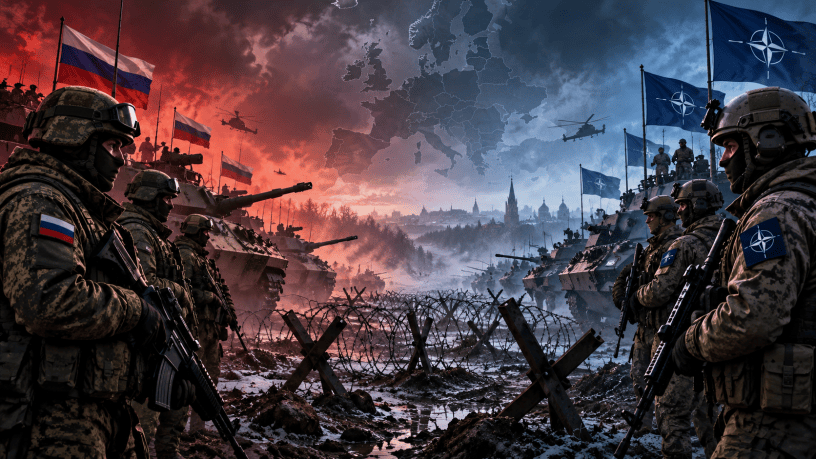
Rome Supports Ukraine, but NATO Treaty Obligations Create a Different Standard for an Attack on an Ally
By Cliff Potts, Editor-in-Chief, WPS News
BAYBAY CITY, LEYTE, Philippines — Thursday, October 1, 2026
Support WPS News — Patreon: https://www.patreon.com/cw/WPSNews
REPORTING: DOCUMENTED DEVELOPMENTS
ITALY IS ALREADY ON NATO’S EASTERN FLANK
Italy is responding to Russia’s war against Ukraine and mounting tension along NATO’s borders with forces already deployed from the Black Sea region to northern Europe.
Italy serves as the framework nation—the lead country—for NATO’s multinational battlegroup in Bulgaria.
In Finland, Sweden leads NATO’s Forward Land Forces formation, while Italy contributes forces alongside Denmark, France, Iceland, Norway and the United Kingdom. The formation strengthens NATO’s ability to reinforce Finland and defend the alliance’s northeastern and Arctic regions (NATO, 2026a).
Italian troops have already trained there. More than 170 personnel from the Taurinense Alpine Brigade participated in Cold Response 26, operating Arctic-capable vehicles, anti-tank weapons, mortars and reconnaissance drones in severe winter conditions (Italian Ministry of Defence, 2026a).
Italian aircraft also participate in NATO Baltic air-defense missions. In September, Italian Eurofighters operating under NATO command intercepted and destroyed a drone after it entered Lithuanian airspace (Italian Ministry of Defence, 2026b).
WHAT THE NATO TREATY LEGALLY REQUIRES
Article 5 of the North Atlantic Treaty says that an armed attack against one NATO member is considered an attack against all.
If a NATO ally suffers an armed attack covered by Article 5, Italy is obligated to assist that ally (NATO, 2025).
The treaty does not require every member to respond in exactly the same way.
Each government takes “such action as it deems necessary.” NATO states that assistance may or may not include armed force.
Italy could therefore fulfill its obligation through combat aircraft, air and missile defense, naval forces, ground troops, intelligence, logistics, cyber operations or another form of assistance.
There is no treaty rule automatically requiring Italy to send ground troops into Poland, Finland or another attacked NATO state.
There is also no rule stating that every missile, drone or border violation automatically qualifies as an Article 5 armed attack.
Article 4 is separate. It allows allies to consult whenever a member believes its territorial integrity, political independence or security is threatened. Article 4 consultations do not themselves activate collective defense.
Those are the legal requirements.
WHAT CANNOT BE ASSUMED IN ADVANCE
Several questions would depend upon the circumstances of an actual incident.
A Russian drone entering Polish airspace would not, by itself, tell NATO whether the event was deliberate, accidental, diverted by electronic warfare or part of a larger attack.
Likewise, no one can state beforehand exactly how Italy would respond to a hypothetical Russian strike against Poland.
The response would depend on factors including the scale of the attack, casualties, evidence of intent, Poland’s position, NATO consultations and the broader military situation.
It would therefore be speculation to say today that Italy would automatically send ground troops, conduct strikes inside Russia or take any other specific military action.
What can be stated confidently is narrower: if NATO determines that an ally has suffered an Article 5 armed attack, Italy has an obligation to assist.
The exact form of that assistance would remain a political and military decision for Rome within the alliance framework.
ITALY CONTINUES TO SUPPORT UKRAINE
Ukraine is not covered by NATO’s Article 5 guarantee.
Italy continues providing military, financial and diplomatic support to Kyiv while rejecting deployment of Italian ground forces into the current war.
That is a political choice concerning assistance to a non-NATO partner.
It should not be confused with Italy’s treaty commitments to fellow NATO members.
Foreign Minister Antonio Tajani has supported NATO collective defense while maintaining that Italy is not presently at war with Russia.
ITALY IS TAKING ON MORE NATO RESPONSIBILITY
Italy is also becoming more important inside NATO’s command structure.
Under changes agreed this year, Italy is scheduled to assume leadership of Joint Force Command Naples, one of NATO’s three four-star operational commands responsible for directing alliance forces during major crises and conflicts (NATO, 2026b).
That expands Italy’s role beyond simply contributing troops and aircraft. Rome will carry greater responsibility for planning and commanding multinational NATO operations.
ANALYSIS
ITALY’S STRATEGY IS NATO-CENTERED
The documented developments point toward a clear Italian strategy.
Germany is emphasizing large-scale conventional rearmament.
France combines conventional military power with an independent nuclear deterrent and a push for greater European strategic autonomy.
Italy is concentrating heavily on NATO integration: multinational battlegroups, eastern-flank deployments, air defense, Arctic training and alliance command responsibilities.
These are differences in emphasis, not evidence that the three governments disagree fundamentally about the need to strengthen European defense.
THE IMPORTANT DISTINCTION
The line Italy is drawing is not simply geographical.
It is institutional.
Rome has considerable freedom to decide how far it goes in supporting Ukraine because Ukraine is not protected by NATO’s collective-defense treaty.
Italy has less freedom to disengage politically if a NATO ally suffers an armed attack falling under Article 5.
That still does not tell us exactly what Italian forces would do.
It tells us that Italy would be inside the collective-defense decision rather than standing outside it.
That distinction becomes increasingly important as Russian missiles, drones and military operations continue approaching NATO territory.
READER TAKEAWAY
Readers should remember three separate facts.
First, Italy is not neutral in the NATO-Russia confrontation. Italian troops and aircraft are already helping defend NATO territory from Bulgaria to the Baltic and High North.
Second, Italy is not currently a direct combatant in the Ukraine war. Rome has chosen to support Kyiv without deploying Italian ground forces into Ukraine.
Third, if Russia deliberately carries the war into NATO territory and the alliance determines that an Article 5 armed attack has occurred, Italy cannot simply decide that the conflict has nothing to do with it. The treaty requires assistance.
What nobody can honestly tell readers in advance is exactly what that assistance would look like.
That would depend on the attack.
The important warning is therefore not that Italian troops are certain to march east if another drone crosses a border.
It is that the legal and strategic environment changes dramatically once a Russian action becomes a confirmed armed attack against NATO rather than another dangerous incident near NATO territory.
That is the threshold worth watching.
APA-Style Sources
Italian Ministry of Defence. (2026a, March 26). Conclusion of NATO exercise Cold Response 26.
Italian Ministry of Defence. (2026b, September 15). Minister Crosetto on mission to NATO’s eastern flank.
NATO. (2025). Collective defence and Article 5.
NATO. (2026a). Strengthening NATO’s eastern flank.
NATO. (2026b, February 6). European Allies to take on new leadership roles in NATO’s Command Structure.
Discover more from WPS News
Subscribe to get the latest posts sent to your email.

