By Cliff Potts, CSO, and Editor-in-Chief of WPS News
Baybay City, Leyte, Philippines — October 7, 2026
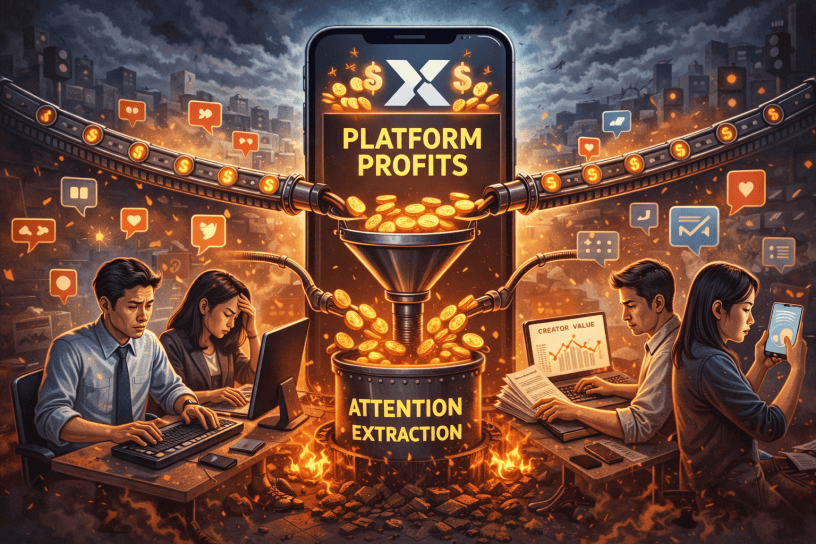
Social media platforms often describe attention as something users freely exchange. Post content, gain views, build an audience. On X, that framing hides a harder truth. Attention is not shared equally. It is extracted, concentrated, and monetized by the platform far more than by the people who create it.
This essay explains how attention extraction works and why it leaves Filipino users doing the work without receiving fair value in return.
Attention Is the Product
Every post, reply, and argument keeps users on the platform longer. Time spent scrolling creates data. Data creates ad inventory. Ad inventory creates revenue.
In this system, users are not customers. They are suppliers. Their attention fuels the platform, but ownership of that value remains centralized.
The more active the user base, the more profitable the platform becomes — even if users themselves earn nothing.
Creators Do the Labor, Platforms Capture the Value
Filipino creators invest time writing threads, responding to comments, and building communities. That labor increases engagement across the platform.
But income opportunities remain limited. Monetization tools are narrow, inconsistent, and often unavailable. The platform captures the majority of value generated by user activity, while creators compete for small and unreliable returns.
This imbalance is not accidental. It is structural.
Why Extraction Hits the Philippines Harder
In wealthier countries, unpaid attention may be an inconvenience. In the Philippines, it can be a burden. Many users rely on digital income to supplement low wages or unstable work.
When attention is extracted without fair return, opportunity costs rise. Hours spent posting replace hours that could be used for paid work elsewhere. The platform grows. The user does not.
That gap widens inequality instead of reducing it.
Engagement Metrics Hide the Problem
High engagement numbers are often used to prove success. Millions of posts. Billions of views. But these numbers do not show who benefits.
A post that reaches thousands of people may still produce zero income. A viral thread may raise the platform’s profile while leaving the creator unpaid. Engagement looks like opportunity, but often functions as unpaid labor.
Metrics reward noise, not sustainability.
Why This Model Is Unstable
Platforms built on extraction face long-term problems. As users realize their work produces little return, trust declines. Burnout rises. Quality drops.
Advertisers notice when audiences feel exploited. Creators leave when better options appear. What looks efficient in the short term becomes fragile over time.
Extraction without sharing eventually empties the system.
Looking Ahead
The next essay will assess the overall reliability of the platform and why many users and businesses conclude it is too powerful to trust.
When attention flows in only one direction, the relationship is not a partnership.
It is exploitation.
For more social commentary, please see Occupy 2.5 at https://Occupy25.com
This essay will be archived in the WPS News Archives at Amazon.
References (APA)
Fuchs, C. (2017). Social media: A critical introduction (2nd ed.). Sage Publications.
Reuters. (2024). X struggles to monetize despite high user activity. https://www.reuters.com
Zuboff, S. (2019). The age of surveillance capitalism. PublicAffairs.
Discover more from WPS News
Subscribe to get the latest posts sent to your email.

