By Cliff Potts, CSO, and Editor-in-Chief of WPS News
Baybay City, Leyte, Philippines — October 9, 2026 — 12:30 p.m.
During our last lesson we examined power tubes, the giants that drove radio transmitters, radar systems, and industrial equipment.
This week we turn our attention to another family of vacuum tubes that rarely received much attention from the public but quietly powered nearly every electronic device of the twentieth century.
The rectifier tube.
Unlike amplifier tubes, a rectifier had no interest in making signals larger.
Its job was much simpler.
Convert alternating current into direct current.
Without rectifiers, most vacuum-tube equipment would never have operated.
Every radio receiver.
Every television.
Every public-address amplifier.
Every early electronic computer.
They all depended upon a reliable source of direct current.
The wall outlet, however, supplied alternating current.
Something had to perform the conversion.
That something was the rectifier.
The simplest rectifier tube was nothing more than a vacuum tube diode.
A heated cathode released electrons.
A positively charged plate attracted them.
When the alternating current reversed direction, the electrons could no longer reach the plate.
Current stopped.
The tube allowed electricity to travel in only one direction.
Half of the alternating waveform passed through.
Half was blocked.
The result became known as half-wave rectification.
It worked.
But it wasted half of the available energy.
Engineers quickly improved the design.
By using two diodes with a center-tapped transformer, or later by using four rectifying elements in what became known as a bridge circuit, much more of the available energy could be converted into usable direct current.
The output still wasn’t perfectly smooth.
It resembled a series of rolling hills.
That is where the capacitors we studied earlier returned to the circuit.
They stored energy during the peaks.
They released energy during the valleys.
The result was smooth direct current suitable for powering electronic equipment.
Electronic Archaeology Note
One of the things I always appreciated about tube rectifiers was that they made the power supply feel like part of the electronics rather than just something hidden inside the cabinet.
Modern power supplies often disappear inside a small sealed module.
Tube equipment proudly displayed its power supply.
Large transformers.
Tall rectifier tubes.
Filter capacitors.
Everything was visible.
It gave you a much better appreciation for where the electricity actually came from.
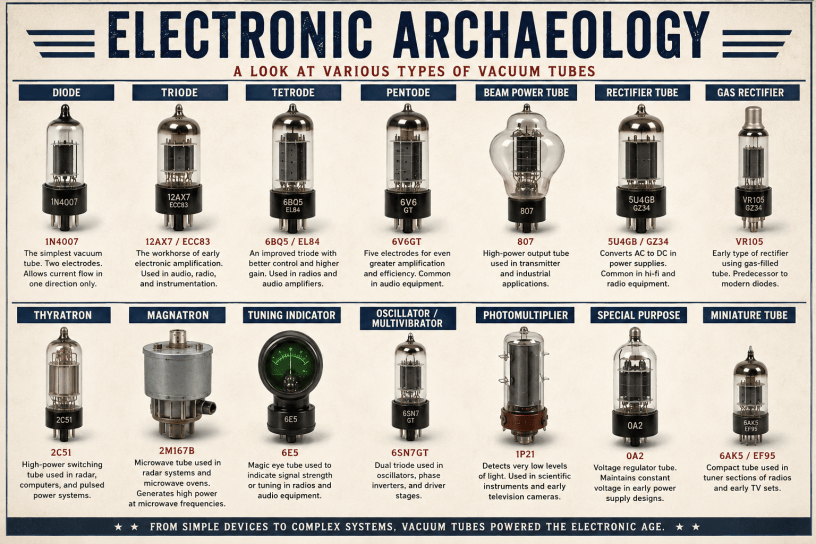
Some rectifier tubes became legendary.
The 5Y3.
The 5U4.
The 80.
The 83.
Collectors and restorers still recognize these tube numbers immediately.
Each represented a slightly different solution to the same engineering problem.
Convert AC into DC safely and reliably.
Rectifier tubes also had personalities.
Unlike semiconductor diodes, many tube rectifiers required time to warm up before they began conducting.
The heater warmed the cathode.
Only then did the electrons begin flowing.
As a result, many vintage radios and amplifiers came alive gradually.
The dial lamps would glow.
The filaments would brighten.
A few moments later, sound would emerge from the speaker.
Anyone who has restored vintage equipment knows the experience.
The machine seemed to wake up.
Solid-state electronics changed that.
Modern equipment often begins operating almost instantly.
Efficient?
Absolutely.
But many enthusiasts still miss the slow, deliberate warm-up of vacuum-tube equipment.
Rectifier tubes also introduced an important engineering consideration.
High voltage.
Many operated with several hundred volts present inside the power supply.
Large filter capacitors could retain that voltage long after the equipment had been unplugged.
Servicing tube equipment demanded caution.
The old saying among technicians was simple.
Always assume the capacitor is charged until you prove otherwise.
That advice has saved countless people from unpleasant surprises.
Electronic Archaeology is not about pretending old technology was perfect.
It certainly was not.
Tube rectifiers generated heat.
They consumed power.
They eventually wore out.
Silicon diodes perform the same job far more efficiently today.
Yet understanding the tube rectifier helps us understand how generations of engineers solved practical problems using the technology available to them.
Every great electronic system begins with one simple requirement.
Reliable power.
The rectifier tube quietly provided it for decades.
Next week we will meet one of the most unusual vacuum tubes ever created.
The “magic eye” tuning indicator.
Part instrument.
Part display.
Part work of art.
It helped listeners tune radio stations with remarkable accuracy while giving vintage radios one of their most recognizable visual features.
If this work helps you understand what’s happening, help me keep it going: https://www.patreon.com/cw/WPSNews
For more from Cliff Potts, see https://cliffpotts.org
References
Horowitz, P., & Hill, W. (2015). The Art of Electronics (3rd ed.). Cambridge University Press.
Tyne, G. F. J. (1977). Saga of the Vacuum Tube. Howard W. Sams & Co.
Encyclopaedia Britannica. (2025). Rectifier. Encyclopaedia Britannica. https://www.britannica.com/technology/rectifier
Discover more from WPS News
Subscribe to get the latest posts sent to your email.

