By Cliff Potts, CSO, and Editor-in-Chief of WPS News
Baybay City, Leyte, Philippines — October 17, 2026 — 21:05 PHST
The Intersection
If you want to understand where Occupy Chicago actually existed, you start here.
LaSalle and Jackson.
Not in theory. Not in slogans.
On that corner.
At street level, in front of the Federal Reserve Bank of Chicago, within sight of the Chicago Board of Trade Building.
That’s where it lived.
Why It Mattered
That location wasn’t accidental.
It put the movement directly in front of the institutions it was responding to—finance, currency, policy, power—all in one visual frame.
You didn’t have to explain the protest to anyone standing there.
They could see it.
Filling the Space
For most of the day, that intersection filled.
People gathered in numbers that made it impossible to ignore. Not always organized, not always coordinated, but present in a way that registered.
Late at night, it thinned.
Sometimes down to a handful.
But it didn’t disappear.
There were always people there.
That’s what made it an occupation.
The Shift System in Practice
After Camp Downpour, the presence became structured.
Not formally, not with schedules posted on a wall, but in practice.
Day. Afternoon. Overnight.
People rotated in and out, holding the space as best they could. Some stayed longer than others. Some came for a few hours and left.
But the effect was continuity.
Even when the crowd dropped, the occupation remained.
The Lines on the Ground
The boundaries were simple, and they were enforced.
The sidewalk was public.
The building was not.
Federal security made that distinction clear. You could stand in front of the building, protest in front of it, exist in that space.
But you couldn’t lean against it.
So people adapted.
They leaned against the planters.
Same corner. Same presence. Slight shift to stay within the line.
Watching the Flow
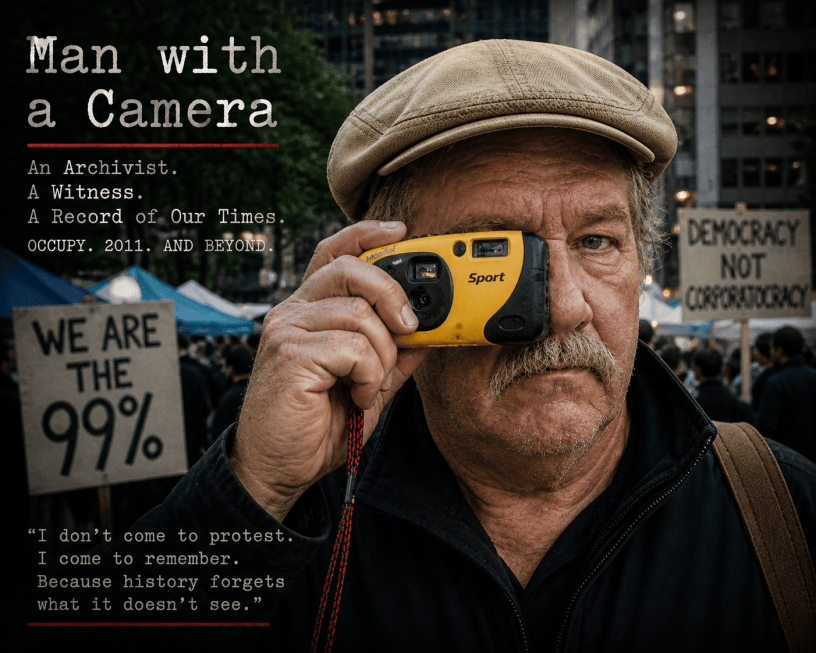
From where I stood—with a camera, not a sign—the intersection had a rhythm.
Morning arrivals. Midday growth. Afternoon conversations. Evening tension. Late-night thinning.
It wasn’t static.
It moved like a tide.
And like a tide, it never fully went out.
What Held It Together
There was no single person holding that corner.
No central authority keeping it intact.
What held it together was repetition.
People showing up.
Again and again.
That’s what made it real.
What It Was
LaSalle and Jackson wasn’t just a protest site.
It was a point of contact between a movement and a system.
Concrete, visible, and impossible to abstract away.
You could argue about Occupy anywhere else.
At that intersection, you couldn’t ignore it.
For more from Cliff Potts, see https://cliffpotts.org
If this work helps you understand what’s happening, help me keep it going: https://www.patreon.com/cw/WPSNews
References
Potts, C. (2011, November 3). For the sake of the record. WPS News. https://wps.news/2011/11/03/for-the-sake-of-the-record/
City of Chicago. (n.d.). Chicago municipal code. American Legal Publishing. https://codelibrary.amlegal.com/codes/chicago/latest/chicago_il/0-0-0-2485380
Gitlin, T. (2012). Occupy nation: The roots, the spirit, and the promise of Occupy Wall Street. HarperCollins.
Discover more from WPS News
Subscribe to get the latest posts sent to your email.

