WPS News | International Affairs
October 21, 2026 | 14:35 Philippine Standard Time (PHST)
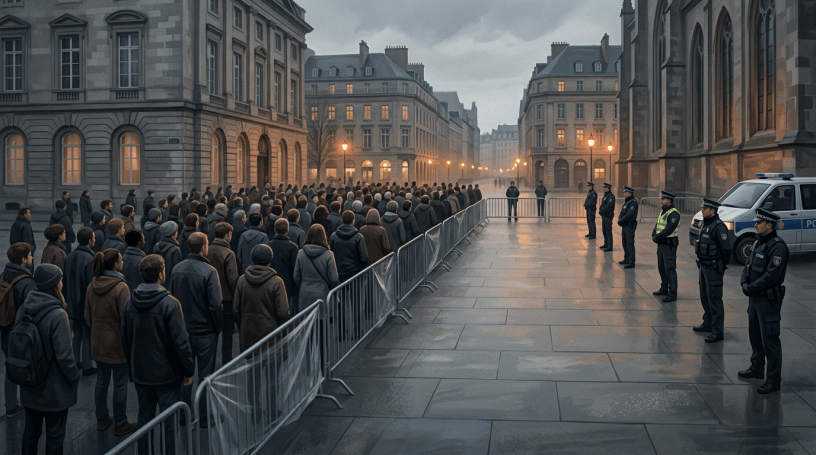
Violent demonstrations in Milan and other Italian cities have left businesses damaged, police officers injured, and hundreds detained. Behind the disorder lies a familiar European problem: rising living costs, dissatisfaction with public services, and growing frustration with political leadership.
Italy has joined France in experiencing a wave of street violence that raises troubling questions about public security, economic dissatisfaction, and the ability of European governments to maintain public confidence.
Over the weekend of October 17–18, 2026, demonstrations against rising living costs and deteriorating public services erupted into violent confrontations in Milan, Bologna, Turin, and several other northern Italian cities.
Masked individuals smashed storefronts, looted businesses, erected burning barricades, and attacked police officers with stones, bottles, and other projectiles.
Italian police responded with tear gas, water cannons, and arrests.
By Monday, October 19, Prime Minister Giorgia Meloni had convened senior security officials to discuss the disturbances and the government’s response.
The violence was genuine, extensively documented, and serious.
But understanding what happened requires distinguishing the thousands of Italians frustrated with economic conditions from the smaller groups responsible for criminal destruction.
Those are not necessarily the same people.
Milan: Two Days of Disorder
The worst violence occurred in Milan, Italy’s financial and commercial center.
On Saturday, October 17, demonstrators gathered to protest rising household expenses, low wages, inadequate public services, and government policies.
The demonstrations initially included peaceful participants exercising their right to political expression.
But as the day progressed, groups of masked individuals broke away from the larger gatherings and confronted police near Piazza del Duomo, the historic square surrounding Milan’s famous Gothic cathedral.
The violence spread into surrounding streets and the Galleria Vittorio Emanuele II, one of Italy’s best-known shopping arcades.
Storefronts were damaged, businesses closed their shutters, tourists fled, and the central Duomo metro station was temporarily shut down.
Police used tear gas to disperse people throwing stones and other objects.
The violence continued Sunday.
Groups smashed windows, looted shops and supermarkets, overturned rubbish containers, and built makeshift barricades from restaurant furniture.
Police deployed water cannons and riot-control units.
Among the businesses reported damaged or looted were Decathlon, Arc’teryx, and Vodafone outlets.
According to Reuters, authorities took 271 people to police headquarters during Sunday’s disturbances. Of those, 32 were formally arrested, while another 28 were referred to judicial authorities.
The distinction matters. Being taken to police headquarters for identification or questioning is not the same as being arrested, charged, or convicted.
Italian news agency ANSA reported that 14 law-enforcement officers were injured in Sunday’s clashes.
By Monday, workers were cleaning debris from Milan’s streets while businesses assessed the damage.
The Violence Was Not Limited to Milan
Although Milan received the greatest international attention, disturbances occurred elsewhere in northern Italy.
Bologna, Turin, Brescia, and Bergamo also experienced confrontations connected with demonstrations.
Authorities reported 28 arrests following Saturday’s unrest across the affected cities.
These incidents shared important characteristics with the disorder in France: protests over economic conditions, confrontations involving masked groups, and attacks on police or property.
But similarity does not establish coordination.
There is insufficient evidence to conclude that a single organization directed the violence in France and Italy.
The protests may reflect common economic grievances across Europe without representing one centrally organized movement.
Why Are Italians Angry?
Italy’s economic problems did not begin in October 2026.
For years, the country has struggled with sluggish productivity growth, regional economic inequality, employment insecurity, and wages that have failed to keep pace with many household expenses.
Young Italians face particular difficulties.
Finding stable employment, securing affordable housing, and establishing financial independence can be challenging, especially in expensive urban areas.
Milan illustrates the contradiction.
It is one of Europe’s important centers of fashion, finance, commerce, and tourism. Luxury boutiques and expensive apartments coexist with workers and students struggling to afford ordinary city life.
The contrast between wealth and economic insecurity is visible in the very neighborhoods where the violence occurred.
Demonstrators also criticized the quality of public services and government spending priorities.
Some protests included opposition to wars abroad.
These grievances do not explain every act of violence. They do, however, provide context for why demonstrations attracted public participation.
A person protesting unaffordable housing is not automatically responsible for a masked individual smashing a store window.
Nor does economic hardship excuse assault, arson, or theft.
Both realities deserve recognition.
The Question of Young People
One particularly troubling aspect of the Milan disturbances was the involvement of minors.
According to ANSA’s October 19 reporting, 220 of the 271 people taken to police headquarters during Sunday’s disturbances were under 18.
Of the 32 people arrested, 23 were minors.
Those numbers demand attention, but they also require careful interpretation.
Being stopped or detained does not establish criminal guilt. Investigators and courts must determine individual responsibility.
Nevertheless, the scale of youth involvement raises difficult questions about how young people become participants in violent confrontations.
Some may have arrived because of political convictions. Others may have joined crowds through social networks, peer influence, or the attraction of confrontation.
Authorities must establish motivations through evidence rather than assumptions.
The presence of minors also creates a difficult problem for police and prosecutors.
They must protect the public while respecting legal protections for children and adolescents.
The fact that a suspect is young does not eliminate responsibility for criminal behavior. It does require appropriate legal procedures and consideration of age.
And if young people are increasingly willing to participate in destructive public disorder, Italy must examine more than its policing tactics.
It must also ask what is happening in its schools, communities, employment opportunities, and political culture.
Meloni’s Response
Prime Minister Giorgia Meloni condemned the violence and distinguished lawful protest from attacks on businesses, public property, and police officers.
Her government convened a security meeting on October 19 to consider how to prevent further disturbances.
Deputy Prime Minister Matteo Salvini subsequently announced plans to deploy 500 soldiers to Milan to reinforce public security.
The response reflects an immediate political challenge.
Meloni leads a right-wing government that has emphasized public order, border security, and the authority of the state.
Images of masked individuals looting businesses in Milan therefore raise questions about the effectiveness of the government’s security policies.
But assigning responsibility requires more than political slogans.
National authorities, local police, municipal governments, and prosecutors all have different responsibilities.
The causes of the unrest also extend beyond decisions made by any single administration.
Italy’s economic difficulties have accumulated under governments representing several political traditions.
Meloni’s government is responsible for its current policies and responses, but it did not create every structural problem facing Italian society.
The immediate task is protecting the public and investigating crimes.
The longer-term task is determining whether economic and social policies are adequately addressing the grievances that brought people into the streets.
The Difference Between Protest and Criminal Violence
Democratic societies depend upon the right to assemble, criticize governments, and demand political change.
That right does not extend to destroying businesses or assaulting people.
A shopkeeper in Milan should not lose a livelihood because someone else is angry about the economy.
A police officer should not be attacked for performing lawful duties.
And a peaceful demonstrator should not be treated as a criminal because violence occurred elsewhere in the same crowd.
These principles are compatible.
The danger arises when governments, political movements, or commentators deliberately blur the distinctions.
Describing everyone in the streets as a rioter delegitimizes peaceful dissent.
Describing every act of looting as political resistance excuses criminal conduct.
Neither approach provides an accurate account of what happened.
Milan Mayor Giuseppe Sala acknowledged the legitimacy of the protesters’ concerns while condemning the destruction and fear inflicted upon residents and visitors.
That distinction is essential to understanding the weekend’s events.
Italy and France: A Warning for Europe?
The timing of the disturbances is significant.
France and Italy experienced major unrest during the same weekend, with demonstrators expressing overlapping frustrations concerning household expenses, public services, and government responsiveness.
Other European countries have also experienced demonstrations and clashes, although the causes and circumstances vary.
The similarities suggest broader economic and political pressures across Europe.
They do not prove that Europe is collapsing, that the violence is coordinated internationally, or that democratic institutions are incapable of responding.
Those conclusions would require substantially more evidence.
What the disturbances demonstrate is that economic frustration can create conditions in which peaceful demonstrations and destructive violence occur simultaneously.
Governments must respond to both without confusing them.
The danger is not simply that police may be overwhelmed during a weekend of demonstrations.
It is that recurring confrontations can gradually erode public confidence in political institutions, particularly when citizens believe their economic grievances are being ignored.
What Comes Next?
By Monday, October 19, businesses in Milan’s luxury shopping district were boarding windows and removing merchandise from displays as a precaution against further unrest.
Police patrols remained visible.
The immediate concern was whether the disturbances would continue and whether authorities could prevent additional attacks.
Italy now faces a familiar dilemma.
It must maintain public security while addressing the economic conditions contributing to public anger.
More police officers may prevent additional looting.
Criminal investigations may identify those responsible for assaults and destruction.
But neither measure, by itself, will improve wages, make housing more affordable, or repair public services.
Those require economic policy, political compromise, and sustained attention.
Italy is not descending into civil war. Its government has not collapsed, and its democratic institutions continue to function.
But the weekend’s events exposed genuine public disorder and underlying dissatisfaction.
The challenge facing Meloni’s government is not merely to restore calm to Milan’s shopping streets.
It is to demonstrate that the Italian state can protect its citizens while responding to their legitimate concerns.
Broken windows can be replaced. Destroyed merchandise can be restocked. Rebuilding public trust is considerably more difficult.
APA-Style Source List
Agenzia Nazionale Stampa Associata. (2026, October 18). Scontri a Milano, 28 arresti e 197 identificati, diversi minori e stranieri. https://www.ansa.it/sito/notizie/cronaca/2026/10/18/scontri-a-milano-28-arresti-e-197-identificati-diversi-minori-e-stranieri.-meloni-siamo_397d8359-98ac-4ba2-840f-a55dcb988745.html
Agenzia Nazionale Stampa Associata. (2026, October 19). 14 police officers injured in clashes with rioting youths in Milan. https://www.ansa.it/english/newswire/english_service/2026/10/19/14-police-officers-injured-in-clashes-with-rioting-youths-in-milan_96103500-c1b4-46cd-9e59-793efb89a785.html
Associated Press. (2026, October 17). Rioters loot stores, set fires in central Milan during cost-of-living protest. https://apnews.com/article/aada57790a8d2d3c02ab55911b9ecead
Reuters. (2026, October 17). Italian police clash with protesters in the centre of Milan. Internazionale. https://www.internazionale.it/ultime-notizie-reuters/2026/10/17/italian-police-clash-with-protesters-in-the-centre-of-milan
Reuters. (2026, October 19). Italian police detain hundreds as stores looted in weekend unrest in Milan. Internazionale. https://www.internazionale.it/ultime-notizie-reuters/2026/10/19/italian-police-detain-hundreds-as-stores-looted-in-weekend-unrest-in-milan
Reuters. (2026, October 19). Milan luxury shops close for fear of new unrest as government prepares to deploy troops. https://www.reuters.com/world/italian-police-detain-hundreds-stores-looted-weekend-unrest-milan-2026-10-19/
Discover more from WPS News
Subscribe to get the latest posts sent to your email.

