By Cliff Potts, CSO, and Editor-in-Chief of WPS News
Baybay City, Leyte, Philippines — October 24, 2026
There was a time when the sky was not the limit—it was the challenge.
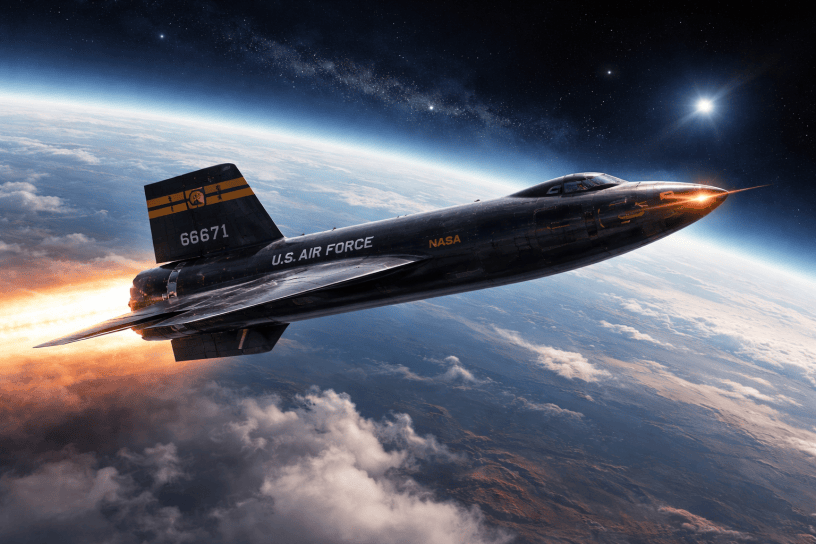
In the early 1960s, before the Moon landings, before the Space Shuttle, before space became routine, there was the NASA / U.S. Air Force partnership that built something audacious, something dangerous, something that felt like it came straight out of science fiction: the North American X-15.
It wasn’t a plane. It wasn’t a spacecraft.
It was both—and neither.
It was a black dart of raw ambition.
What the X-15 Was
The X-15 was a rocket-powered aircraft designed to fly faster and higher than anything that had ever existed. Dropped from the wing of a modified B-52 bomber, it ignited its engine midair and climbed like a bullet fired at the edge of space.
And “edge” is not poetic language here.
The X-15 routinely flew above 50 miles (80 km), and on multiple flights, it exceeded 62 miles (100 km)—the internationally recognized boundary of space. Its fastest recorded speed? Mach 6.7—over 4,500 miles per hour.
That’s not fast.
That’s unforgiving.
At those speeds, the air itself becomes a weapon. The aircraft skin glows. Control surfaces barely behave like control surfaces anymore. You’re not flying through the atmosphere—you’re negotiating with it.
And sometimes, you’re losing.
What They Did With It
The X-15 program wasn’t about spectacle. It was about survival—how to survive the future.
Pilots—men who would later become legends like Neil Armstrong—used the X-15 to answer questions no one had answers to yet:
- What happens to a human body at the edge of space?
- How do you control a vehicle when the air is too thin for wings to matter?
- What does reentry feel like at hypersonic speed?
- How do you keep a craft from burning up before it ever reaches orbit?
Every flight was an experiment. Every mission pushed the envelope a little further.
They tested reaction control systems—tiny rocket thrusters that would later be used on spacecraft.
They tested heat-resistant materials that could survive reentry.
They tested the limits of human reaction time when things go wrong at Mach 5… and faster.
And things did go wrong.
This was not a safe program.
It was a necessary one.
What It Taught Us
Without the X-15, there is no Apollo.
Without the X-15, there is no Space Shuttle.
Without the X-15, modern aerospace engineering is guessing in the dark.
The program gave us:
- Real data on hypersonic flight
- The first practical experience with spaceflight controls
- Understanding of reentry physics and thermal protection
- Proof that humans could operate vehicles at the edge of space and return alive
It bridged the impossible gap between airplanes and spacecraft.
It turned theory into reality.
And it did it in less than a decade.
The Thrill of It — “Go Fever”
You have to understand the moment.
This was the 1960s.
The Cold War was real. The stakes were existential. The future wasn’t guaranteed—it was contested.
And suddenly, on black-and-white televisions across America, people were watching something incredible:
A plane dropped from the sky… then igniting like a missile.
Climbing straight up.
Faster than bullets. Faster than sound. Faster than anything people could comprehend.
Kids watched it and saw the future.
Adults watched it and felt something they hadn’t felt in years—possibility.
They called it “go fever.”
Because everything was moving.
Everything was accelerating.
The world wasn’t standing still anymore—it was launching.
And the X-15 was right at the center of it.
The Final Flight — October 24, 1968
By the time the last X-15 flew in 1968, the world had already begun to shift toward Apollo. The Moon was now within reach. The X-15 had done its job.
No ceremony. No grand finale.
Just another flight.
That was the nature of the program—quietly rewriting the rules of physics and then stepping aside.
But make no mistake:
By the time that last flight ended, humanity had already crossed a line it could never uncross.
We had learned how to leave Earth.
And more importantly—
We had learned how to come back.
Why It Still Matters
Today, hypersonic flight is back in the headlines. Nations compete again. Speeds once considered impossible are being pursued once more.
But the truth is simple:
We’ve been here before.
In the 1960s, a handful of pilots climbed into a black rocket plane, strapped themselves to an explosion, and pointed it straight up.
No guarantees.
No safety net.
Just data to gather and a future to build.
That’s the essence of the X-15.
Not just speed.
Not just altitude.
But courage—measured in Mach numbers.
Discover more from WPS News
Subscribe to get the latest posts sent to your email.

