Baybay City, Leyte, Philippines — October 24, 2026
By Cliff Potts | WPS News
There is something particularly irritating about identifying a genuine problem, spending nineteen months exploring possible solutions, and discovering that nobody is particularly interested in finding out whether those solutions might work.
But an idea that was never built is not necessarily an idea that could never work.
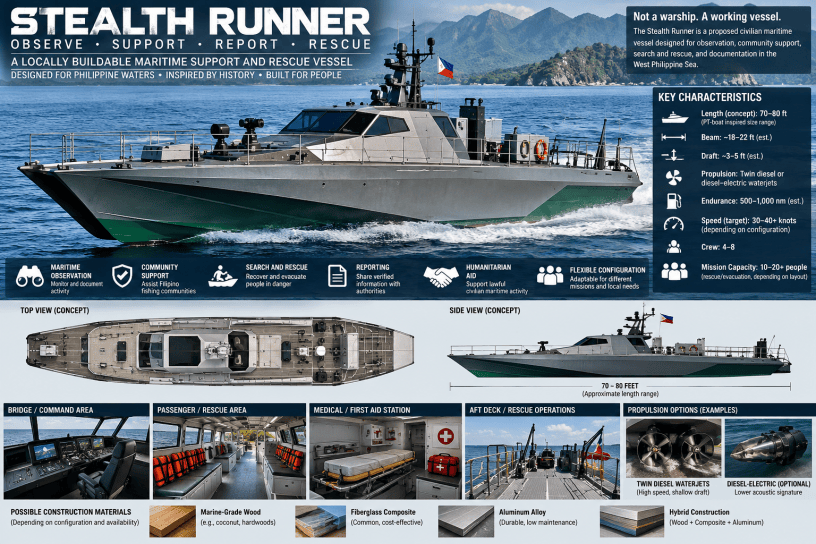
In May 2024, WPS News introduced the Stealth Runner, a proposed civilian maritime observation and support vessel intended to help address the Philippines’ limited maritime resources.
The concept eventually expanded into a collection of proposals involving locally constructed boats, alternative propulsion systems, communications equipment, rescue capabilities, and a possible network of vessels supporting Filipino fishing communities.
We called one proposed development Kraken’s Kiss. Another became the Seahawk.
We investigated coconut timber, fiberglass, conventional engines, electric propulsion, historical American PT boats, and the advantages and disadvantages of operating relatively small craft in difficult maritime environments.
Some ideas were practical possibilities. Others were speculative. A few claims published during the project’s development were too confident and now deserve correction.
No operational vessel was ever built.
The project was retired in December 2025.
Now, as WPS News prepares to introduce the original articles to new readers through WTFM.LOL beginning November 11, 2026, we are revisiting the complete idea one final time this year.
This is not an appeal for funding. It is not an announcement of a new construction program. Nor is it an attempt to persuade anyone to send privately operated boats into confrontations with foreign government vessels.
It is an examination of what we proposed, why we proposed it, what the evidence actually supports, and whether the central idea retains value.
One point needs to be established immediately.
Stealth Runner was never supposed to be a warship.
It was conceived as a civilian observation vessel, a maritime-security support vessel, a reporting platform, and a means of assisting people in trouble at sea.
That distinction is fundamental to everything that follows.
The Question That Started Everything
I moved to the Philippines in September 2023.
Not long afterward, I remember reading a news report discussing the Philippine Coast Guard’s shortage of vessels available to monitor activity in the West Philippine Sea.
I believe the article may have appeared in The Manila Times. I have not recovered the original report, however, so I cannot verify that attribution.
What I remember clearly is my reaction.
Why couldn’t the Philippines build more boats?
Not necessarily enormous government ships carrying sophisticated military equipment. Smaller vessels. Boats that could be constructed locally, maintained by Filipino workers, and deployed where additional maritime observation or emergency assistance might be useful.
My friend Eric and I had already entertained some humorous conversations about Miami-style cigarette boats and the possibility of maneuvering around much larger Chinese Coast Guard vessels.
The image was amusing.
A comparatively tiny speedboat operating near a massive government ship certainly invites comparisons with David and Goliath.
But there was a serious question underneath the humor.
What could a small, fast, relatively inexpensive maritime vessel actually accomplish?
Could it observe activity?
Could it document dangerous encounters?
Could it assist fishermen experiencing mechanical trouble?
Could it recover people from the water?
Could several such vessels provide useful coverage that one large ship could not?
Those questions gradually developed into the Stealth Runner project.
A Small Fishing Boat and a Very Large Government Vessel
Another influence was a video showing a Filipino fisherman maneuvering an outrigger near a considerably larger Chinese government vessel.
The contrast was remarkable.
The fisherman possessed a small boat and considerable experience operating it.
The larger vessel possessed greater mass, machinery, communications equipment, and institutional authority.
The encounter did not prove that a small boat could defeat a larger one.
It demonstrated something more modest: different vessels possess different operational characteristics, and size alone does not determine every aspect of maritime usefulness.
A small craft can sometimes operate in shallow areas or confined spaces that are unsuitable for much larger vessels.
It may be relatively inexpensive to acquire and maintain.
It may also be severely limited by weather, fuel capacity, endurance, crew accommodation, and the ability to recover survivors.
Those advantages and disadvantages became recurring themes throughout the project.
The original proposal appeared in May 2024.
The archive contains inconsistent references to May 22, May 23, and May 24 as the project’s beginning. These appear to reflect differences between proposal preparation, publication, and subsequent retrospective descriptions.
The important historical point is that the project entered the published WPS News record in May 2024.
What began as an unconventional discussion had become an editorial and technical investigation.
What Stealth Runner Was Actually Supposed to Do
The original concept had four closely related purposes.
Observation. A vessel could monitor maritime activity and provide additional information about conditions affecting fishing communities.
Reporting. Equipped with suitable communications and recording equipment, it could document incidents and relay information to competent Philippine authorities.
Civilian maritime-security support. A properly authorized and coordinated vessel might contribute to situational awareness and support lawful maritime activities without attempting to exercise government law-enforcement powers.
Rescue and emergency assistance. A vessel could potentially help fishermen experiencing mechanical failures, injuries, collisions, or other emergencies.
These were not interchangeable missions.
Observation requires reliable sensors, communications, navigation, and sufficient operating endurance.
Rescue requires safe passenger recovery, flotation equipment, medical supplies, and appropriate space for survivors.
Security support requires particularly careful attention to legal authority, identification, and coordination with government agencies.
Combining all these functions in one small vessel presents engineering compromises.
A boat designed for speed may not provide adequate passenger capacity.
A vessel optimized for long observation missions may require more fuel, larger batteries, or additional crew accommodation.
A craft that performs well in protected coastal waters may be unsuitable for prolonged operations in rough offshore conditions.
The Stealth Runner concept attempted to reconcile these requirements.
It never demonstrated that a single design had successfully done so.
That is an important distinction.
Why Rescue Was So Important
The West Philippine Sea is not merely a geopolitical abstraction.
It is a working environment.
People fish there.
They earn their living there.
They depend upon the sea to support their families.
And maritime emergencies occur whether or not foreign governments are arguing about territorial claims.
An engine can fail.
A boat can take on water.
A fisherman can become injured.
Weather can deteriorate.
A vessel can run aground.
A collision can leave people needing immediate assistance.
In September 2026, a Bureau of Fisheries and Aquatic Resources vessel, BRP Datu Magat Salamat, ran aground near Hasa-Hasa Shoal while approaching fishing boats to distribute fuel.
Nearby fishermen initially attempted to assist.
Their efforts were unsuccessful, and the Philippine Coast Guard subsequently dispatched BRP Malabrigo to help refloat the vessel.
This incident illustrates the practical importance of maritime response capability.
It also illustrates why good intentions are not enough.
The fishing boats could attempt assistance, but they lacked the capacity to complete the recovery.
Different emergencies require different equipment and operational capabilities.
A Stealth Runner-inspired rescue vessel would need to be designed around realistic scenarios, not merely the assumption that any additional boat would be useful.
The objective would be to improve the chances that appropriate help could reach people who needed it.
The Philippine Coast Guard’s Continuing Resource Problem
The concern that inspired the project has not disappeared.
In August 2026, the Philippine Information Agency reported that the Coast Guard continued emphasizing the need for additional maritime assets, modern equipment, and improved logistics facilities.
Coast Guard spokesperson Rear Admiral Jay Tristan Tarriela explained that expanding personnel numbers alone was insufficient.
The service also needed the vessels and supporting infrastructure necessary to carry out its responsibilities.
The Department of Agriculture reported in July 2026 that 453,246 registered fisherfolk lived in provinces and cities bordering the West Philippine Sea.
That is a substantial population whose livelihoods are connected to the maritime environment.
Meanwhile, the Philippine Coast Guard and BFAR continue supporting fishing communities through patrols, fuel assistance, food supplies, and other programs.
In January 2026, the Coast Guard reported deploying vessels and aircraft to support dozens of Filipino fishing boats near Bajo de Masinloc.
The operation involved maritime observation, protection, and assistance.
These are government operations conducted under established authority.
They are not evidence that private citizens should independently undertake similar confrontations.
But they demonstrate the range of tasks involved in supporting fishing communities.
The original Stealth Runner question therefore remains relevant.
Could additional civilian maritime support capacity complement these government operations?
Possibly.
But the answer depends on proper organization, engineering, funding, training, and lawful coordination.
The World War II PT Boat Inspiration
American patrol torpedo boats were among the project’s earliest historical reference points.
During World War II, the United States operated hundreds of these fast wooden craft, particularly in the Pacific.
Many measured approximately 70 to 80 feet long.
The famous 80-foot Elco PT boats used three powerful Packard gasoline engines and were designed for speeds exceeding 40 knots under suitable conditions.
They carried crews, weapons, fuel, communications equipment, and supplies.
They were genuine military vessels.
Their history includes combat operations, reconnaissance, personnel transport, and rescue.
Their limitations were equally real.
High-powered gasoline engines consumed considerable fuel.
Maintenance requirements were substantial.
Small warships could be uncomfortable and dangerous in difficult sea conditions.
And speed did not make them invulnerable.
Nevertheless, their versatility raised an interesting possibility.
What if the general size and useful characteristics of a PT boat were reconsidered for civilian purposes?
What if the space originally occupied by military equipment were dedicated to medical supplies, rescue equipment, passenger accommodation, and communications?
Could a vessel approaching that size provide useful humanitarian capabilities?
Certainly, a properly engineered vessel of that general size could accommodate such functions.
But it would not automatically be economical or appropriate for the intended mission.
A modern rescue vessel should be designed from its own requirements.
A World War II PT boat provides historical inspiration, not a ready-made modern blueprint.
From the Original Stealth Runner to Kraken’s Kiss
The first Stealth Runner concepts were considerably smaller than historical American PT boats.
Early proposals explored wooden construction, small crews, conventional engines, and relatively simple observation equipment.
As the project continued, the design changed.
Some articles investigated electric propulsion and alternative energy sources.
Others examined hull forms, composite construction, communications equipment, and different approaches to crew accommodation.
In November 2024, the project developed the Kraken’s Kiss concept.
A contemporary proposal discussed adapting an existing Glen-L Marine design, subject to review and modification by a qualified Filipino marine engineer.
It also explored hybrid propulsion, batteries, solar charging, and conventional backup power.
These ideas were not necessarily compatible without substantial engineering.
For example, electric propulsion requires an energy-storage system appropriate to the vessel’s power demands.
Solar generation can support onboard electrical loads, but available deck area limits how much power can be collected.
A hybrid system introduces additional machinery, controls, electrical protection, and maintenance requirements.
The project’s evolution reflected genuine curiosity about possible solutions.
It also revealed how quickly a seemingly simple boatbuilding idea can become technically complicated.
The December 2025 Design
On December 25, 2025, WPS News published a technical retrospective describing a proposed 24–28-foot vessel.
The article identified a beam of approximately 7.0–8.2 feet, a shallow draft, and a proposed 60–90-horsepower four-stroke outboard engine.
It also described a small crew, basic observation equipment, communications systems, and possible shelter arrangements.
The proposed cruising speed was approximately 10–14 knots, with a higher estimated maximum speed.
The article suggested that a small crew could complete construction within several weeks.
These specifications should be understood as preliminary design targets.
They were not validated through completed engineering calculations, supplier quotations, or sea trials.
The article’s claim that the vessel was feasible went beyond what had been independently established.
There was no completed prototype.
There were no verified stability tests.
There were no demonstrated offshore endurance figures.
There was no certified construction package.
The document preserved the design philosophy and preliminary technical assumptions.
That is valuable archival material.
It is not the same thing as a construction-ready engineering design.
The Seahawk: Another Direction
On December 30, 2025, WPS News introduced the Stealth Runner Model II, called the Seahawk.
This proposed development included twin outboard propulsion, expanded communications equipment, and sleeping accommodation for three.
Its publication created an apparent contradiction.
Earlier December articles had described the project as retired, yet the Seahawk announcement discussed another design and possible future capabilities.
The distinction is between publishing a concept and operating an active construction program.
The Seahawk was another conceptual proposal.
It was not evidence that construction had resumed.
Nor was it an operational successor to an existing Stealth Runner vessel.
The larger lesson is that the project did not progress toward one stable, independently validated design.
It produced several evolving possibilities.
That makes the archive interesting.
It also means that any future organization examining the idea would need to begin with a fresh engineering assessment rather than assume the last published version was necessarily the best.
Baybay City Was Already Building Boats
Perhaps the most important discovery in this retrospective concerns Baybay City itself.
While WPS News was investigating whether Filipinos could produce relatively affordable maritime vessels, the local government had already established a fiberglass boatbuilding initiative.
According to BFAR Region VIII, Baybay fabricated and distributed 50 fiberglass motorboats in 2021.
It produced another 75 in 2022.
And another 75 in 2023.
That is 200 boats over three years.
The boats were approximately 26 feet long.
The program included a fiberglass boatmaking facility in Barangay Candadam.
Local fisherfolk participated in fabrication and received compensation for their work.
The facility also supported repair activities.
This is substantial evidence.
It demonstrates an existing local combination of construction skills, community participation, public-sector involvement, and maintenance capability.
The program did not produce Stealth Runners.
Nor does it prove that Baybay’s fishing boats could safely conduct extended offshore rescue operations.
A 26-foot fishing boat and a purpose-built maritime observation-and-rescue vessel have different requirements.
But the existence of the program changes the feasibility discussion.
The question is no longer whether Filipinos can learn to build useful fiberglass boats.
They already do.
The remaining questions concern the type of vessel, its intended operating environment, required equipment, engineering standards, and total operating cost.
That is a considerably more concrete starting point than we had when the project began.
Coconut Wood: What We Got Right and Wrong
One of the original Stealth Runner arguments concerned coconut timber.
The reasoning was straightforward.
Coconut palms are common throughout the Philippines.
When aging palms are responsibly replaced, their trunks can provide useful timber.
If a locally constructed boat could use appropriate domestic materials, it might reduce dependence on imported supplies.
That was a reasonable hypothesis.
Unfortunately, the archive also made claims about coconut timber’s natural resistance to marine borers that were not adequately substantiated.
The Food and Agriculture Organization classifies coconut timber as non-durable without suitable protection.
Its properties also vary significantly depending on the portion of the trunk from which material is obtained.
That variability matters.
A structural component must possess predictable strength and durability.
Marine environments expose materials to moisture, biological deterioration, mechanical loading, and repeated changes in temperature and humidity.
The claim that coconut timber would naturally resist marine organisms because of its silica content should not be accepted without specific evidence.
The earlier articles cited a purported study concerning coconut timber durability that could not be independently verified during this review.
It should not be treated as established scientific authority.
Does that mean coconut wood has no possible place in marine construction?
Not necessarily.
Appropriately processed and tested coconut timber might be suitable for selected components.
But its use would require professional evaluation.
The fact that a material is locally available does not automatically make it appropriate for a boat’s hull.
A failed structural component at sea can cost lives.
The original project’s emphasis on local resources remains reasonable.
Its confidence in coconut timber’s marine durability requires revision.
Fiberglass May Be the More Practical Starting Point
The strongest locally documented construction evidence favors fiberglass-reinforced plastic.
That does not make fiberglass universally superior.
But it is already used extensively in Philippine fishing vessels.
It can be molded into different hull forms, does not rust like conventional steel, and benefits from established repair techniques.
Properly engineered marine composites can provide useful structural performance.
Poorly manufactured composites can also fail.
Laminate quality, reinforcement selection, resin application, bonding, and long-term inspection are important.
Wood remains useful in many marine applications, particularly where skilled workers and appropriate materials are available.
Aluminum offers another established option for professional vessels.
Steel is valuable for many larger craft.
Each material carries different costs, fabrication requirements, maintenance demands, and environmental consequences.
A future Stealth Runner-inspired project should compare them using a defined mission and realistic lifetime costs.
It should not begin by insisting that the original material choice must be preserved.
If fiberglass offers better performance and local maintainability, use fiberglass.
If another material proves superior for a particular vessel, use that instead.
The goal was never to build a monument to coconut lumber.
The goal was to produce useful maritime capability.
The Problem With Calling Something Stealthy
The project’s name reflected an interest in reducing vulnerability during dangerous encounters.
Early articles sometimes suggested that wooden construction could make the vessel difficult to detect by radar.
There is a legitimate technical basis for recognizing that different materials interact differently with radar.
But material selection alone does not determine whether a complete vessel can be detected.
Modern maritime surveillance may involve radar, visual observation, thermal imaging, aircraft, and other technologies.
There is no evidence that the proposed Stealth Runner would have been invisible to these systems.
There is also no evidence that its design could prevent radar-guided weapons from identifying or attacking it.
Those claims would require extensive independent testing and cannot be inferred from ordinary wooden construction.
There is an additional problem.
The U.S. National Transportation Safety Board has warned that small wooden and fiberglass boats can be difficult for conventional marine radar to detect.
The agency considers this a collision hazard.
It recommends appropriate radar reflectors and identification systems to improve visibility.
That is an important contradiction.
A civilian rescue vessel must avoid unnecessary danger, but it must also be visible to friendly vessels and maritime authorities.
A boat that cannot be detected by nearby ships may be less safe, not more.
The original interest in low visibility therefore needs to be reconsidered in light of the actual mission.
The most important safety measures are reliable communications, identification, emergency signaling, weather information, competent navigation, and coordination with authorities.
A civilian observation-and-rescue vessel should not depend on unproven claims of immunity from military surveillance or attack.
Quiet Running and Reduced Pollution
Another original objective involved operating quietly and reducing unnecessary environmental damage.
That remains a legitimate engineering goal.
Electric propulsion can eliminate direct engine exhaust during battery-powered operation.
It may reduce some forms of machinery noise.
But it does not automatically make a vessel silent.
Underwater noise can arise from propulsion systems, water movement, and other mechanical sources.
The International Maritime Organization has recognized the environmental effects of underwater radiated noise and adopted guidance intended to reduce its impact on marine life.
A quieter vessel may improve crew comfort and reduce disturbance to surrounding marine environments.
But the benefits must be measured.
A hybrid propulsion system might be appropriate for some missions.
A conventional four-stroke outboard might be more practical for others.
The correct choice depends on operating distance, energy demand, reliability, available fuel or charging facilities, maintenance capability, and cost.
Solar panels could contribute electricity for communications and onboard equipment.
They would not automatically provide sufficient energy for sustained high-speed propulsion.
The project originally entertained several combinations of power systems.
None was validated through construction and operational testing.
The environmental objective remains worthwhile.
The particular engineering solution remains open.
The Real Cost Is Not Just the Boat
The original archive discussed several cost estimates.
Some concerned small experimental concepts.
Others involved more developed patrol craft.
These figures cannot be compared directly because they described different vessels, equipment packages, and assumptions.
Some estimates excluded major construction materials or other essential components.
The project never obtained a complete independently verified construction and operating budget.
That matters because the purchase price is only the beginning.
A functioning maritime support organization would require trained crews, insurance, maintenance, fuel or electricity, communications subscriptions, safety equipment, inspections, replacement parts, and shore facilities.
Personnel must be paid or otherwise supported.
Equipment must be maintained.
Engines eventually require overhaul or replacement.
Storm damage and ordinary wear cannot be ignored.
A vessel that appears inexpensive to build may become expensive to operate.
Likewise, a somewhat more expensive vessel may provide better value if it is more reliable and requires less maintenance.
A future feasibility study would need to compare total lifetime costs.
Without those figures, the original claim of affordability remains plausible but unproven.
Why Numbers Mattered
The Stealth Runner project eventually considered producing several vessels.
The argument was not that six small boats could defeat a major foreign navy.
The more defensible argument concerned coverage.
One boat can occupy only one location at a time.
When it requires maintenance, its contribution disappears.
A network of appropriately equipped vessels could potentially provide observation and emergency assistance from several locations.
But a distributed fleet creates additional obligations.
More vessels require more crews.
More crews require more training.
More equipment requires more maintenance.
And more people operating in dangerous waters can mean more people exposed to serious risks.
A larger civilian fleet would not automatically deter Chinese government vessels.
Its value would have to be measured through rescue availability, response capability, documented observations, and support for maritime communities.
That is a different proposition from military deterrence.
It is also more consistent with the project’s original civilian mission.
Civilian Security Is Not Private Warfare
The West Philippine Sea involves international legal disputes and significant questions of maritime jurisdiction.
The 2016 South China Sea arbitration rejected the legal basis for China’s extensive historic-rights claims insofar as they exceeded the maritime entitlements recognized by the United Nations Convention on the Law of the Sea.
China rejected the arbitration.
The Philippines continues to assert its maritime rights under international law.
These disputes do not automatically authorize private citizens to undertake military or law-enforcement operations.
A privately operated observation vessel would need to comply with applicable Philippine maritime requirements.
Its operators would require appropriate qualifications, registration, safety equipment, and lawful procedures.
Coordination with the Philippine Coast Guard and other relevant authorities would be essential.
The project’s historical discussions occasionally included weapons.
A vessel may physically accommodate defensive equipment, but the legality of any armament depends on the circumstances and applicable law.
It is not something a private organization can simply decide for itself.
The distinction between observation and confrontation must remain clear.
A rescue vessel should not deliberately create the emergency it is supposedly equipped to resolve.
Nor should a civilian organization expose fishermen to unnecessary danger in the name of protecting them.
The Destroyer Escort That Was Never Going to Be a Navy
Not every maritime conversation connected to the project was entirely serious.
At one point, we entertained the possibility of acquiring a retired American destroyer escort and converting it into an entertainment vessel for Cliff Potts & the AI Rebellion.
Yes, a floating entertainment venue.
It was an amusing idea.
But the discussion led to legitimate questions about civilian maritime law.
A retired military vessel does not retain the legal authority of a commissioned warship simply because somebody purchases it.
Civilian ownership introduces registration requirements, inspection obligations, crew qualifications, insurance, environmental rules, and restrictions concerning weapons.
That conversation reinforced something important.
A civilian vessel can be large, impressive, and historically associated with military service without becoming a lawful instrument of private naval power.
The Stealth Runner was never supposed to create a private navy.
It was supposed to provide useful civilian maritime services.
The Outreach That Went Nowhere
As the project developed, I explored possible outside interest.
I remember considering organizations whose environmental or humanitarian missions might overlap with aspects of the proposal.
Greenpeace was among them.
I recall investigating its regional organization and possibly identifying an Australian office as an appropriate contact.
I do not have a complete verified correspondence record.
Nor can I establish that Greenpeace formally evaluated or rejected the project.
I do not remember receiving a substantive response.
That is different from proving that no response ever arrived.
The published archive also discusses outreach through an industry contact associated with GoDaddy.
No substantial institutional partnership resulted.
That much is clear.
Why?
There are several plausible explanations.
The proposal may not have aligned with the organizations’ missions.
The absence of independently validated engineering may have made it difficult to evaluate.
Funding and insurance requirements could have been substantial.
Civilian operations in contested waters would raise complicated legal and safety concerns.
Or the proposal simply may not have reached the right people.
We do not know.
What we do know is that no partner emerged prepared to undertake the engineering, funding, construction, and operation of the proposed vessels.
A newsroom can ask difficult questions.
It cannot automatically become a shipyard.
Billy Mitchell and Jimmy Doolittle
During our retrospective discussions, I recalled an American aviation advocate who faced resistance from established military authorities.
I initially associated the story with Jimmy Doolittle.
The historical figure I was more likely remembering was Billy Mitchell.
Mitchell argued during the 1920s that aircraft would fundamentally alter military operations, including naval warfare.
He demonstrated the vulnerability of warships to aerial attack and became increasingly critical of military leadership.
His public statements contributed to a 1925 court-martial.
Jimmy Doolittle was another important aviation pioneer, best known for leading the American air raid on Japan in April 1942.
The comparison deserves care.
An unconventional proposal is not correct simply because established institutions fail to embrace it.
Mitchell possessed evidence from aviation experiments.
Stealth Runner never produced a tested vessel.
Those are different situations.
But the broader principle remains valid.
An idea should be evaluated according to its evidence, practicality, and limitations.
Not merely dismissed because it originated outside established institutions.
And its supporters must be willing to accept criticism.
If the engineering is wrong, correct it.
If the costs are unrealistic, recalculate them.
If the mission is unsafe, redesign it.
That is how useful ideas improve.
Why Stealth Runner Was Retired
By late 2025, the project had produced extensive research and several conceptual designs.
It had not produced an operational boat.
No institution had accepted responsibility for developing the concept into a functioning maritime service.
There was no completed engineering package, construction financing, or established operating organization.
My personal circumstances also changed profoundly.
My wife, Luz, died in September 2025.
Her death altered my priorities and made continuing a major undertaking of this kind increasingly unrealistic.
The December 2025 archive documents the project’s reassessment and retirement.
The Seahawk announcement later that month represented another conceptual presentation, not a reversal of the decision to stop active development.
An August 2026 article revisited aspects of the broader distributed-maritime-capability argument.
That discussion did not restart the original construction program.
As of October 2026, I do not intend to personally build, finance, or operate a Stealth Runner fleet.
The project is retired.
The questions remain.
What Would Make a Modern Version Viable?
The strongest possible successor to the original idea would not begin with the name Stealth Runner.
It would begin with an identified maritime need.
A qualified organization would consult fishing communities, maritime authorities, rescue specialists, and naval architects.
It would determine what kinds of incidents occur, where assistance is needed, and what existing resources are available.
Only then would it select an appropriate vessel.
Perhaps a proven fiberglass design could be adapted.
Perhaps a larger purpose-built rescue vessel would be necessary.
Perhaps several smaller coastal support craft would provide better coverage than one larger vessel.
Perhaps the most economical solution would involve improving existing fishing-community equipment rather than building an entirely new class of boat.
Those possibilities should be evaluated without prejudice.
A serious project would require independently reviewed engineering, realistic cost estimates, qualified operators, proper legal authority, and controlled sea trials.
It would also require long-term maintenance and financial planning.
That is what separates an interesting proposal from a sustainable maritime service.
Could such an organization develop useful vessels in the Philippines?
There is no obvious reason to dismiss the possibility.
The country’s existing boatbuilding industry and documented local programs provide a credible foundation for investigation.
But the original Stealth Runner specifications do not establish that a particular design would be safe, affordable, or suitable for offshore service.
Those questions would have to be answered through professional engineering and testing.
Why WPS News Is Bringing the Archive Back
Beginning November 11, 2026, WTFM.LOL will introduce the original Stealth Runner and Kraken’s Kiss articles to new readers through weekday Bluesky posts.
The scheduled posting time is 3:30 a.m. U.S. Eastern Time.
The campaign will revisit the published record in historical sequence.
Readers will encounter the project’s origins, changing designs, technical arguments, humanitarian objectives, outreach efforts, and eventual retirement.
Some articles contain useful observations.
Others contain assumptions that deserve correction.
A few made claims more confidently than the evidence justified.
That is part of the record too.
Preserving an archive does not require pretending that every original statement was correct.
It requires showing how an idea developed and what can be learned from examining it.
The campaign does not mean construction has resumed.
It means the research remains available for readers who wish to consider the questions for themselves.
The Final Assessment
After reviewing the project’s history and the available independent evidence, several conclusions are defensible.
The original maritime problem was real.
Philippine authorities continue to require substantial maritime resources, and fishing communities continue to depend on effective observation, assistance, and rescue services.
The Philippines possesses genuine boatbuilding capabilities.
Baybay City’s fiberglass construction program demonstrates that local workers can participate in organized vessel production and maintenance.
The historical PT-boat comparison provided useful inspiration, but those military designs cannot simply be converted into modern civilian rescue vessels without substantial engineering.
Coconut timber’s proposed marine durability was overstated.
Fiberglass and other established marine materials deserve serious consideration.
The original radar-stealth claims were not demonstrated.
A civilian rescue vessel must balance survivability with the need to remain identifiable and detectable to friendly maritime traffic.
Quiet propulsion and reduced environmental damage remain worthwhile objectives, but their benefits must be measured rather than assumed.
The project’s cost estimates were never independently validated.
And a network of civilian support craft would require professional coordination, lawful authority, sustainable funding, and trained personnel.
None of this proves that the original Stealth Runner was ready to build.
It was not.
But neither does it establish that locally produced civilian maritime observation and rescue vessels are impractical.
The central idea remains a legitimate subject for engineering and public-policy investigation.
One Last Question
Suppose an independent Philippine maritime organization examined the Stealth Runner archive.
Suppose it consulted professional naval architects, rescue specialists, and local boatbuilders.
Suppose it discovered that a modified fiberglass vessel could provide reliable observation, communications, and emergency assistance at a sustainable cost.
Suppose the Philippine Coast Guard and other relevant authorities determined that such vessels could safely complement existing services.
Would that be worth pursuing?
Of course.
Not because WPS News proposed it.
Not because I happen to like boats.
And certainly not because we gave the concept a dramatic name.
It would be worth pursuing because the evidence demonstrated that it could help people.
And if professional evaluation concluded that an entirely different vessel would work better, then that alternative should prevail.
The objective was never to defend every original technical decision.
The objective was to ask whether Filipinos could use their own resources, experience, and craftsmanship to improve maritime observation, security support, and rescue availability.
The Stealth Runner was never built.
Its proposed solutions were never comprehensively tested.
Institutional support never materialized.
Those are facts.
But another fact deserves equal attention.
The problem that inspired the project has not disappeared.
The Philippines still needs maritime capability.
Its fishing communities still need support.
And its boatbuilders still possess skills that deserve serious consideration.
Stealth Runner was never supposed to be a warship. It was supposed to observe, report, assist, and rescue.
That was the idea.
The project is retired.
The archive remains.
And the question is still worth asking.
For 2026, that is where we leave it.
Tomorrow?
Who the hell knows?
APA-Style References
Bureau of Fisheries and Aquatic Resources, Region VIII. (n.d.). Navigating transformation: LGU Baybay paving the seas of change for its fisherfolk communities through effective adaptation of BFAR’s Bangka Ko, Gawa Ko Project. https://region8.bfar.da.gov.ph/navigating-transformation-lgu-baybay-paving-the-seas-of-change-for-its-fisherfolk-communities-through-effective-adaptation-of-bfars-bangka-ko-gawa-ko-project/
Department of Agriculture. (2026, July 19). West Philippine Sea livelihoods rest on protecting fisherfolk—DA Usec. https://www.da.gov.ph/west-philippine-sea-livelihoods-rest-on-protecting-fisherfolk-da-usec/
Food and Agriculture Organization of the United Nations. (n.d.). Coconut palm stem processing: Technical handbook—Timber protection. https://www.fao.org/4/ag335e/ag335e08.htm
National Transportation Safety Board. (2023). Reducing collision risk by improving small vessel detectability (Safety Alert SA-087). https://www.ntsb.gov/Advocacy/safety-alerts/Pages/SA-087.aspx
Permanent Court of Arbitration. (2016, July 12). The South China Sea arbitration: Award. https://pca-cpa.org/
Philippine Information Agency. (2026, August 12). PCG sees modernization, additional assets as key to stronger WPS patrols. https://pia.gov.ph/news/pcg-sees-modernization-additional-assets-as-key-to-stronger-wps-patrols
Philippine News Agency. (2026, July 23). CCG harassment fails to stop PCG, BFAR fuel mission in WPS. https://www.pna.gov.ph/articles/1280134
Potts, C. (2025, December 21). A final look at the Stealth Runner: The rise and retirement of a citizen-born defense concept. WPS News. https://wps.news/2025/12/21/stealthrunner3/
Potts, C. (2025, December 25). The Stealth Runner technical blueprint & design brief: A closing record of what might have been. WPS News. https://wps.news/2025/12/25/stealthrunner4/
Potts, C. (2025, December 30). Introducing the Stealth Runner Model II: A maritime security innovation. WPS News. https://wps.news/2025/12/30/introducing-the-stealth-runner-model-ii-a-maritime-security-innovation/
West Philippine Sea Transparency Office. (2026, January 30). PCG deploys vessels and aircraft to safeguard Filipino fishermen in BDM. https://wpstransparency.ph/pcg-deploys-vessels-and-aircraft-to-safeguard-filipino-fishermen-in-bdm/
Discover more from WPS News
Subscribe to get the latest posts sent to your email.

