By Cliff Potts, CSO, and Editor-in-Chief of WPS News
Baybay City, Leyte, Philippines — October 27, 2026
For ten weeks, WPS News has examined whether the constitutional case exists for impeaching Donald J. Trump for a third time.
We examined the meaning of “high Crimes and Misdemeanors.”
We returned to January 6—not to prosecute the same impeachment again, but because history matters when evaluating presidential power.
We examined the rule of law, confrontations with federal courts, Congress’s power of the purse, presidential war powers, private financial interests and foreign-connected benefits, and allegations that federal authority has been used against political and personal adversaries.
Last week, we brought those strands together.
The evidence does not establish every allegation made against Trump. Some matters remain disputed. Some involve unresolved litigation. Some involve executive powers claimed by presidents of both parties. Some allegations would require evidence of intent or direct presidential involvement that is not publicly established.
That distinction has mattered throughout this series.
Evidence is evidence.
Allegation is allegation.
Analysis is analysis.
But there is another constitutional question that remains even when those distinctions are maintained:
What happens when nobody decides where the boundaries are?
THE CONSTITUTION DOES NOT ENFORCE ITSELF
The American constitutional system divides power deliberately.
Congress writes laws and controls appropriations.
The president executes those laws and commands the executive branch.
Courts decide cases and interpret the law.
Each branch possesses mechanisms capable of restraining the others.
Impeachment is one of those mechanisms.
The Constitution gives the House the sole power of impeachment and the Senate the sole authority to conduct impeachment trials. Conviction requires two-thirds of senators present (U.S. Const. art. I, §§ 2–3).
The Congressional Research Service’s Constitution Annotated describes impeachment as an important congressional check upon executive and judicial power and traces “high Crimes and Misdemeanors” to abuses of office and public trust rather than merely violations of ordinary criminal statutes (Constitution Annotated, 2026a, 2026b).
But possessing a constitutional power and exercising it are different things.
Congress can investigate.
Congress can subpoena.
Congress can legislate.
Congress can control money.
Congress can impeach.
Congress can also choose to do none of those things.
And repeated congressional inaction can have consequences far beyond a single presidency.
PRECEDENT IS NOT ONLY CREATED BY COURTS
Americans often think of constitutional precedent as something produced by the Supreme Court.
That is only part of the story.
Constitutional practice develops through the actions of Congress and presidents as well.
Constitution Annotated notes that institutional practices and political norms help shape the understood meaning of constitutional provisions over time. James Madison described constitutional meaning as something that could become settled through a regular course of governmental practice (Constitution Annotated, 2026c).
That means precedent can develop quietly.
A president claims authority.
Congress objects but does nothing.
Another president makes the same claim.
Congress again does nothing.
Eventually the argument changes.
The question is no longer, “Where does the president get this power?”
It becomes, “Presidents have been doing this for years. Why can’t this president do it too?”
That is how extraordinary power can become ordinary power.
THE POWER OF THE PURSE IS A CURRENT EXAMPLE
The dispute over congressional spending authority provides an unusually clear illustration.
On September 25, 2026, Trump transmitted a special message to Congress proposing rescissions from 11 appropriations accounts. The Office of Management and Budget simultaneously withheld the affected money.
Four days later, the Government Accountability Office responded.
GAO concluded that the Impoundment Control Act does not permit the president to withhold money beyond its expiration date while waiting for Congress to act upon a rescission proposal. GAO said the statute’s language, legislative history, Supreme Court precedent and broader constitutional structure supported that conclusion (Government Accountability Office [GAO], 2026).
On October 1, California and six other states sued the administration over approximately $810 million in withheld federal funds, arguing that the administration’s “pocket rescission” violated Congress’s constitutional spending authority. The administration has argued that the targeted programs conflict with its policy priorities and that its rescission approach is lawful.
Those are the facts currently available.
Whether Trump’s conduct ultimately constitutes an impeachable abuse is a conclusion for Congress.
But something else is equally important.
If Congress repeatedly appropriates money and presidents increasingly acquire the practical ability to decide afterward whether that money will actually be spent, Article I has changed without anybody amending the Constitution.
The words remain.
The distribution of power does not.
COURTS CAN STOP SOME THINGS, NOT EVERYTHING
Federal courts have repeatedly become involved in disputes over Trump administration policies.
Sometimes the administration has lost.
Sometimes it has won.
Sometimes injunctions have been narrowed or reversed on appeal.
That is how judicial review works.
Recent litigation over White House press access demonstrates both the power and limitations of judicial intervention. In September, a federal judge concluded that the administration likely violated constitutional protections when it excluded CNN, MS NOW and Politico from White House access. The administration subsequently restored access following the court’s order while continuing to contest aspects of the dispute.
That is evidence that courts can constrain presidential action.
But courts cannot substitute for Congress.
Judges resolve cases and controversies brought before them.
They do not conduct general supervision of the presidency.
They do not decide whether a pattern of otherwise separate presidential actions collectively constitutes an abuse of public trust.
And they do not impeach presidents.
The Constitution assigned that responsibility elsewhere.
CRIMINAL LAW CANNOT DO THE ENTIRE JOB EITHER
This series began with a distinction that deserves repeating at the end.
Impeachment is not simply another criminal prosecution.
Alexander Hamilton described impeachable offenses as arising from misconduct involving public trust and injuries to society. American impeachment practice has consequently included conduct that does not necessarily correspond to an ordinary criminal offense (Constitution Annotated, 2026b).
That distinction is critical.
If Congress decides that presidential misconduct matters only when prosecutors can prove a statutory crime beyond a reasonable doubt, Congress has effectively rewritten the impeachment standard.
The Constitution does not say:
“Treason, Bribery, or whatever a federal prosecutor can indict.”
It says:
“Treason, Bribery, or other high Crimes and Misdemeanors” (U.S. Const. art. II, § 4).
The impeachment mechanism exists partly because abuse of governmental power can injure the constitutional system even when ordinary criminal prosecution is unavailable, inappropriate or insufficient.
THE OTHER DANGER: IMPEACHMENT CANNOT BECOME ROUTINE
There is an opposite danger too.
If Congress treats every aggressive presidential action, policy disagreement or disputed constitutional interpretation as an impeachable offense, impeachment becomes another instrument of ordinary partisan warfare.
That would weaken the mechanism just as surely as never using it.
Presidents must be able to govern.
They must be able to make controversial decisions.
They must be able to challenge statutes in court.
They must be able to advance disputed constitutional interpretations.
They must be able to lose lawsuits without automatically facing removal from office.
The relevant distinction is abuse of office.
That requires evidence.
It requires context.
It requires congressional judgment.
And because impeachment is inherently political in the constitutional sense, reasonable legislators can examine the same record and disagree about whether the threshold has been crossed.
That disagreement is not constitutional failure.
Refusing to examine the evidence at all may be.
THE TRUMP QUESTION WILL EVENTUALLY END
Donald Trump’s presidency will end.
Whether through the expiration of his term or some other lawful constitutional mechanism, there will eventually be another president.
That person may be a Republican.
That person may be a Democrat.
That person may be someone whose political movement does not yet exist.
The important question is what powers that president inherits.
Will that president inherit broader authority to withhold money Congress appropriated?
Greater freedom to initiate military operations without congressional authorization?
Greater ability to pressure institutions through grants, contracts and regulatory authority?
Greater freedom to maintain private financial relationships that overlap with official decisions?
Greater ability to use federal investigative machinery in ways that appear connected to personal or political grievances?
Greater authority to decide which news organizations receive governmental access based upon their coverage?
None of those questions depends upon whether someone likes Donald Trump.
The next president inherits presidential power, not presidential personality.
THE REVERSE-PARTY TEST
There is a useful way to evaluate almost every constitutional question discussed in this series.
Reverse the political party.
If a Republican believes Donald Trump should possess a particular power, would that Republican be comfortable giving exactly the same power to a Democratic president?
If a Democrat believes Trump’s exercise of a particular authority is intolerable, would that Democrat object just as strongly when a Democratic president exercises it?
That test does not answer every constitutional question.
But it removes a great deal of political camouflage.
Constitutional rules that work only when your party controls the White House are not constitutional principles.
They are temporary political preferences.
A functioning constitutional system requires rules capable of surviving changes in power.
THE EVIDENCE DOES NOT REQUIRE A PREDETERMINED VERDICT
After ten installments, WPS News is not going to manufacture certainty that the evidence does not provide.
There are documented actions by the Trump administration that courts, GAO, members of Congress and other governmental institutions have challenged as unlawful or unconstitutional.
There are documented judicial decisions limiting administration actions.
There are documented congressional disputes concerning appropriations and war powers.
There are documented financial relationships that raise conflict-of-interest questions.
There are documented governmental actions affecting individuals and institutions Trump has publicly criticized.
There are also legitimate counterarguments.
Presidents possess substantial Article II authority.
The executive branch must make enforcement decisions.
Presidents can challenge congressional restrictions.
They can appeal court rulings.
They can conduct foreign policy.
They can direct executive agencies.
Private businesses associated with presidential families do not automatically become illegal because a relative occupies the White House.
Political opponents are not immune from legitimate investigation.
None of those defenses can simply be discarded because Trump is Trump.
Neither can the evidence be discarded because Trump is president.
The proper constitutional response is investigation, documentation, adversarial examination and judgment.
Congress has the tools to perform that work.
THE COST OF NO ACCOUNTABILITY
Accountability does not necessarily mean impeachment.
That may be the most important conclusion of this series.
Accountability can mean congressional investigation.
Public testimony.
Inspector-general review.
Judicial enforcement.
Appropriations restrictions.
Legislation.
Elections.
Disclosure.
Ethics rules.
Criminal prosecution when actual crimes can be proved.
And, when the constitutional standard is satisfied, impeachment.
The danger comes when none of those mechanisms functions effectively.
Because then the lesson learned by future presidents is not complicated.
Push harder.
The courts may eventually stop you.
Congress may complain.
The press may investigate.
Opponents may sue.
Government watchdogs may issue reports.
But if the disputed action produces its intended result before accountability arrives, presidential power still expands.
And the next president begins from there.
THE CONSTITUTIONAL QUESTION AFTER TRUMP
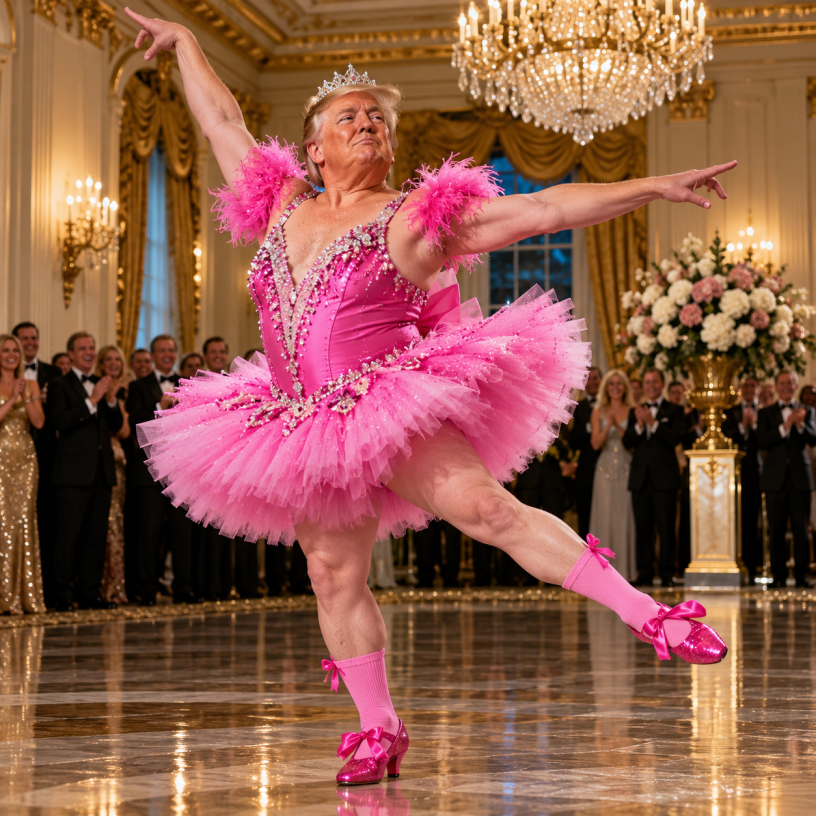
The image accompanying this final installment is deliberately ridiculous.
Donald Trump, in a tutu, dancing in celebration.
It is satire.
The underlying question is not.
What exactly would a president be celebrating?
Vindication?
Victory?
Political survival?
Or the discovery that the constitutional system contains enormous restraints on paper but sometimes remarkably few consequences in practice?
That question extends far beyond Donald Trump.
The Framers did not design a government that depended upon finding permanently virtuous presidents.
They divided power because they assumed power would sometimes be abused.
They created Congress.
They created courts.
They created elections.
They created impeachment.
They created a presidential oath requiring the president to “preserve, protect and defend the Constitution of the United States” (U.S. Const. art. II, § 1).
None of those mechanisms guarantees accountability.
People have to use them.
Institutions have to defend their authority.
Congress has to protect congressional power even when the president belongs to the congressional majority’s own party.
Courts have to enforce lawful orders.
Presidents have to accept constitutional limits.
Citizens have to decide what conduct they will tolerate from the people they elect.
That is where this ten-part investigation ends.
Not with a declaration that every allegation against Donald Trump has been proved.
It has not.
Not with a declaration that every disputed presidential action is unconstitutional.
That has not been established either.
It ends with something less satisfying but considerably more important:
The American constitutional system only works when the institutions entrusted with power are willing to enforce its boundaries.
If evidence establishes misconduct, investigate it.
If an allegation fails, say so.
If presidential conduct is lawful, defend that conclusion.
If it is unlawful, enforce the law.
And if Congress concludes after examining the evidence that presidential conduct constitutes the abuse or violation of public trust contemplated by the constitutional impeachment standard, the Constitution already tells Congress what mechanism exists.
The unanswered question is whether Congress will use it.
Because Donald Trump will eventually leave the White House.
The precedents established while he occupies it may remain for generations.
And whatever comes next will inherit them.
REFERENCES
Constitution Annotated. (2026a). Overview of Impeachment Clause. Congress.gov, Library of Congress.
Constitution Annotated. (2026b). Historical Background on Impeachable Offenses. Congress.gov, Library of Congress.
Constitution Annotated. (2026c). Impeachment Doctrine. Congress.gov, Library of Congress.
Government Accountability Office. (2026, September 29). Impoundment Control Act of 1974: Review of the President’s Special Message of September 25, 2026 (B-338788).
Reuters. (2026, September 24). White House reinstates access to CNN, MS NOW and Politico following judge’s order.
Reuters. (2026, October 1). California, six other states sue Trump administration over federal funds.
U.S. Constitution, art. I, §§ 2–3; art. II, §§ 1, 4.
Discover more from WPS News
Subscribe to get the latest posts sent to your email.

