By Cliff Potts, CSO, and Editor-in-Chief of WPS News
Baybay City, Leyte, Philippines — October 30, 2026 — 12:30 p.m.
For weeks we have been building toward this moment.
We learned what electricity is.
We explored resistors, capacitors, transformers, relays, power supplies, and vacuum tubes.
Last week we discovered the oscillator, the circuit that creates the steady electrical signal every transmitter needs.
Now it is time to put those pieces together.
The radio transmitter.
A radio transmitter performs one remarkable task.
It converts sound into radio waves that travel through space.
That statement sounds almost magical.
In reality, it is the result of several electronic systems working together.
Every transmitter begins with a stable oscillator.
The oscillator generates a carrier wave.
By itself, the carrier contains no information.
It is simply a precisely controlled radio-frequency signal.
Think of it as a blank sheet of paper.
The next step is modulation.
The information we wish to send—our voice, music, or digital data—is impressed onto the carrier wave.
The carrier now has something to say.
Depending on the design, the transmitter may use amplitude modulation, or AM, frequency modulation, or FM, or one of many digital modulation techniques developed in recent decades.
The earliest commercial broadcast stations relied almost entirely on AM.
For generations, families gathered around AM radios to hear news, sports, music, and emergency information.
Electronic Archaeology Note
When I first began learning about communications, one of the things that fascinated me was the idea that a human voice could become electricity, then a radio wave, then electricity again, and finally sound coming from a loudspeaker somewhere else.
The process sounded almost impossible.
Yet every stage followed understandable physical principles.
That realization helped me appreciate that electronics is not magic.
It is simply physics organized into useful machines.
After modulation, the signal is still relatively weak.
It must be amplified.
This is where the power tubes we discussed earlier enter the story.
They increase the strength of the radio-frequency signal until it is powerful enough to be radiated efficiently by an antenna.
The antenna becomes the final stage of the transmitter.
It converts the electrical signal into electromagnetic waves that travel outward at the speed of light.
Once released, those waves continue across the landscape.
Some follow the Earth’s surface.
Others reflect from layers of the ionosphere, allowing signals to travel hundreds or even thousands of kilometers.
Still others escape into space.
Every radio transmission becomes part of the universe.
One of the remarkable things about radio is that the antenna does not “throw” electricity through the air.
Instead, it produces changing electric and magnetic fields.
Those fields support one another as they travel outward as an electromagnetic wave.
James Clerk Maxwell predicted this behavior mathematically during the nineteenth century.
Later, Heinrich Hertz demonstrated that those waves actually existed.
The radio transmitter transformed those scientific discoveries into practical communication.
Early transmitters were surprisingly simple by today’s standards.
Spark-gap transmitters generated bursts of radio energy but occupied wide portions of the radio spectrum.
They were eventually replaced by continuous-wave vacuum-tube transmitters, which produced much cleaner and more stable signals.
That improvement allowed many more stations to share the airwaves.
Modern transmitters are vastly more sophisticated.
Computers control frequencies.
Digital circuits process signals.
Solid-state power amplifiers have replaced most vacuum tubes.
Yet the overall architecture remains familiar.
Oscillator.
Modulator.
Amplifier.
Antenna.
Technology evolves.
The basic flow remains remarkably consistent.
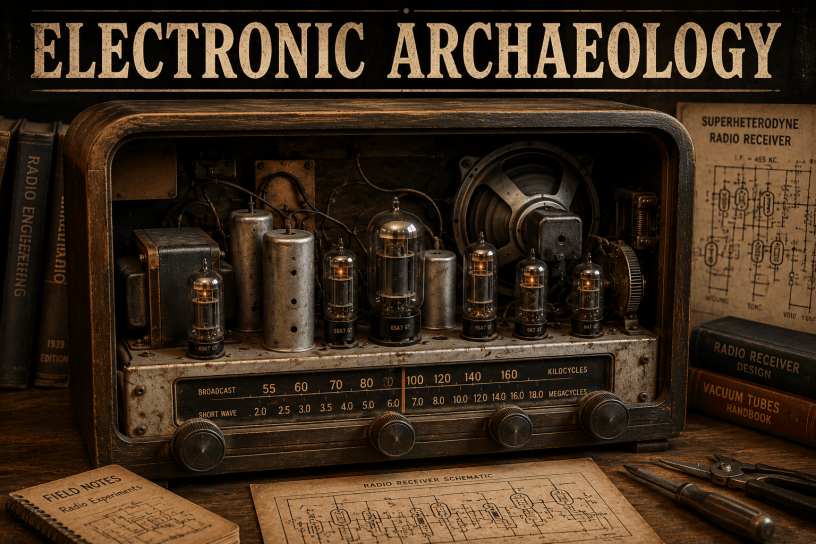
Electronic Archaeology reminds us that radio was one of humanity’s greatest achievements.
For the first time in history, information could travel instantly without a physical wire connecting two locations.
Ships communicated across oceans.
Aircraft navigated safely.
Emergency responders coordinated rescues.
Families listened to voices from distant cities.
Entire nations shared important events as they happened.
The radio transmitter made all of that possible.
Every broadcast begins the same way.
A stable electrical signal.
A carefully designed circuit.
An antenna reaching toward the sky.
And someone with something worth saying.
Next week we will stand at the other end of that invisible journey.
We will examine the radio receiver and discover how it captures tiny signals from the air and turns them back into voices, music, and information.
If this work helps you understand what’s happening, help me keep it going: https://www.patreon.com/cw/WPSNews
For more from Cliff Potts, see https://cliffpotts.org
References
Hayward, W. M. (2001). Experimental Methods in RF Design. American Radio Relay League.
Horowitz, P., & Hill, W. (2015). The Art of Electronics (3rd ed.). Cambridge University Press.
Encyclopaedia Britannica. (2025). Radio transmitter. Encyclopaedia Britannica. https://www.britannica.com/technology/radio-transmitter
Discover more from WPS News
Subscribe to get the latest posts sent to your email.

