Why Survival Depends on Cooperation, Not Individualism
By Cliff Potts, CSO, and Editor-in-Chief of WPS News
Baybay City, Leyte, Philippines — November 2, 2026
The Value of “Useless” People
In many survival narratives, people are quickly sorted into two categories: useful and useless.
The useful are those who can fight, build, hunt, or provide immediate physical labor. The “useless” are those without obvious survival skills—office workers, administrators, managers, and others whose experience does not appear directly applicable to off-grid conditions.
In these stories, the distinction is often treated as a matter of life and death.
It is also fundamentally flawed.
The Myth
The myth assumes that only physically practical skills matter in crisis.
In this model:
- Value is tied to immediate, visible output
- Physical labor is prioritized
- Abstract or organizational skills are dismissed
The conclusion is simple: if a person cannot directly produce or defend, they are expendable.
This is not how real systems function.
Why People Believe It
The belief comes from visibility.
Physical work is easy to recognize. It produces immediate, tangible results—food gathered, structures built, threats addressed.
Organizational work is less visible. Planning, coordination, and management often happen in the background. Their impact is indirect, making them easier to overlook.
There is also a cultural bias toward self-sufficiency and physical competence. Skills associated with offices, administration, or management are often undervalued outside their normal context.
But removing those skills creates problems that are not immediately obvious—until they become critical.
Why It Fails in Reality
Survival requires more than production. It requires coordination.
Without coordination:
- Resources are misallocated
- Effort is duplicated or wasted
- Critical tasks are missed
- Conflicts increase
Roles often labeled as “non-essential” are the ones that prevent these failures.
- Accounting tracks resources
- Planning organizes labor
- Communication aligns efforts
- Record-keeping preserves knowledge
These functions are not optional. They are structural.
History reinforces this point.
During World War II, victory depended not only on soldiers and factories, but on planners, logisticians, administrators, and analysts. The system worked because it was organized.
Without organization, production alone would have failed.
What Actually Works
Effective groups recognize different types of value.
Instead of asking, “What can this person do immediately?” they ask:
- What role can this person fill?
- What skills can be adapted?
- How can this person support the system?
A person who cannot build may be able to coordinate those who can.
A person who cannot hunt may be able to track supplies and ensure distribution.
A person without technical skills may still provide communication, planning, or stability within the group.
These contributions are not secondary. They are necessary.
The Risk of Narrow Thinking
Treating people as expendable based on limited criteria creates multiple risks:
- Loss of potentially critical skills
- Reduced group size and capability
- Increased burden on remaining members
- Lower morale and cohesion
It also encourages short-term thinking. Immediate utility is prioritized over long-term function.
Survival is a long-term problem.
A Broader Definition of Utility
Utility in survival is not limited to physical output.
It includes:
- Organization
- Adaptability
- Communication
- Decision support
- Emotional stability
These factors influence how well a group can respond to changing conditions.
A group that recognizes multiple forms of value is more flexible and more resilient.
Practical Takeaway
If you are preparing for disruption, avoid narrow definitions of usefulness.
- Identify a wide range of skills
- Consider how those skills can be applied under new conditions
- Integrate people into roles, rather than excluding them
- Recognize that coordination is as important as production
The goal is not to build a group of identical capabilities.
The goal is to build a system.
Conclusion
The idea that some people are “useless” in survival situations is based on a limited view of what survival requires.
Real-world survival depends on more than physical labor.
It depends on organization, coordination, and the ability to function as a group.
People who appear less useful at first may provide the structure that allows everything else to work.
Collapse does not reward narrow thinking.
It rewards systems that make use of all available capabilities.
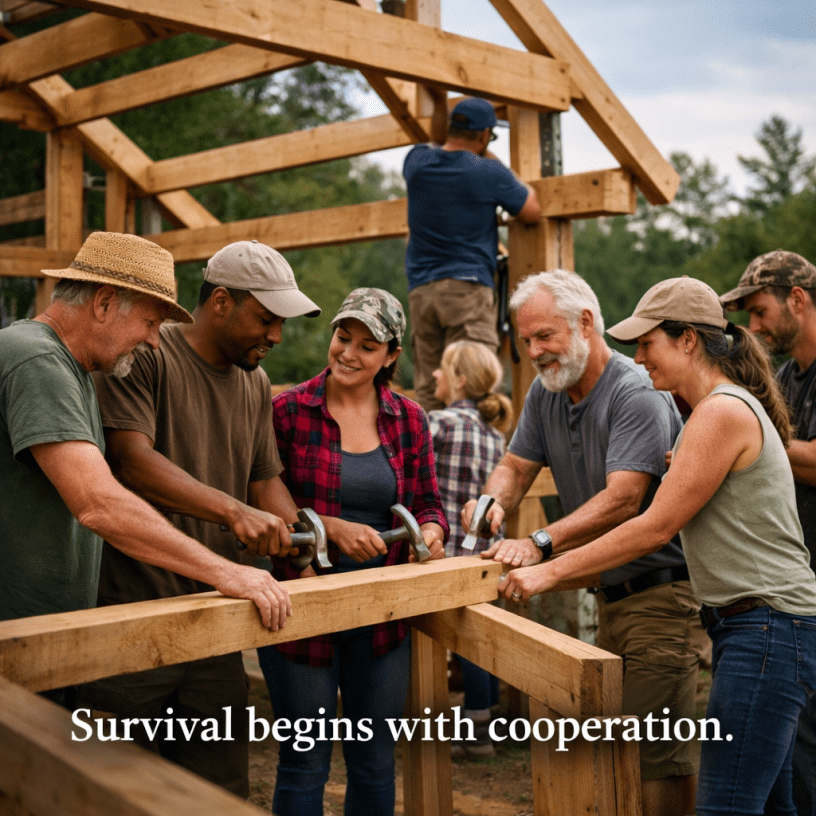
Survival begins with cooperation.
For more social commentary, please see Occupy 2.5 at https://Occupy25.com
If you read this and it matters, help me keep it going: https://www.patreon.com/cw/WPSNews
References
Keegan, J. (1989). The Second World War. Viking.
Mintzberg, H. (2009). Managing. Berrett-Koehler.
Simon, H. A. (1997). Administrative Behavior. Free Press.
Discover more from WPS News
Subscribe to get the latest posts sent to your email.

