By Cliff Potts, CSO, and Editor-in-Chief of WPS News
Baybay City, Leyte, Philippines — November 3, 2026
A Quiet Anniversary With Lasting Consequences
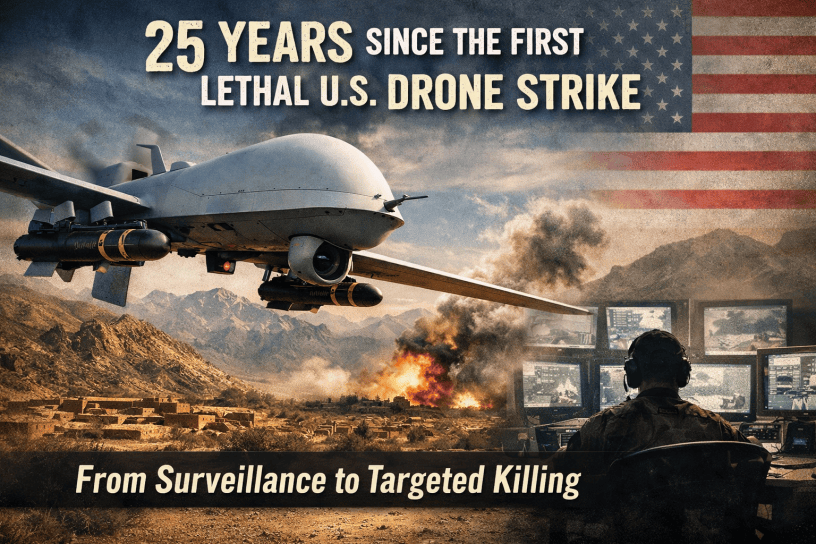
November 2026 marks twenty-five years since the United States carried out its first lethal drone strike in Afghanistan in early November 2001. The operation attracted little public attention at the time, overshadowed by the opening phase of the post-September 11 war. Yet that strike marked a turning point that reshaped modern warfare, executive authority, and the meaning of accountability in the use of lethal force.
What began as an experiment in surveillance had, in less than a decade, become a normalized system of remote killing—one that operates largely outside public view.
Drones Were Not Designed to Kill
Unmanned aerial vehicles entered U.S. service in the 1990s as intelligence tools. Early systems were explicitly unarmed and promoted as a safer way to observe conflicts without risking pilots. Their mission was persistent surveillance: watch, record, and report.
During operations in the Balkans and later in Afghanistan, these aircraft demonstrated a new capability—continuous presence over suspected targets. What they could not do was act on that information. Targets identified from the air often escaped before manned aircraft or ground forces could respond.
That operational gap set the stage for a profound shift.
Why Arming Drones Suddenly Seemed “Necessary”
By the late 1990s and early 2000s, U.S. intelligence agencies faced a recurring dilemma. High-value targets were intermittently visible but difficult to capture. Diplomatic constraints, legal limits, and the risks of deploying troops repeatedly blocked action.
After September 11, 2001, those constraints collapsed. Speed replaced deliberation as the primary value. Arming drones appeared to solve several problems at once: no pilot risk, rapid response, and the ability to strike without deploying large forces or declaring new wars.
From an institutional perspective, it looked efficient. From a political perspective, it looked quiet. Both mattered.
Authority Without Visibility
The decision to authorize lethal drone strikes did not come through a single public vote or statute. Instead, authority emerged from overlapping executive powers, classified legal interpretations, and counterterrorism directives issued in the early days of the post-9/11 response.
Critically, the program blurred traditional distinctions between military operations and intelligence activities. That shift reduced transparency and moved life-and-death decisions further from judicial or legislative oversight. Targeting became an administrative process rather than a battlefield judgment.
Once established, the system proved difficult to question, let alone reverse.
Institutional Momentum Takes Over
By the mid-2000s, armed drones were no longer experimental. New platforms were designed from inception to carry weapons. Training pipelines, contractor relationships, and budget lines followed. What had begun as an exception hardened into doctrine.
At that point, the program no longer depended on a single president or crisis. It became part of the permanent national security apparatus, operating across administrations with limited public scrutiny.
What This Anniversary Represents
The significance of the first lethal drone strike lies not only in the act itself, but in what it normalized. It established a precedent for remote, individualized killing conducted far from declared battlefields and largely shielded from public accountability.
Twenty-five years later, armed drones are commonplace, used by many states and non-state actors alike. The early assumption that such weapons would remain rare or tightly constrained has proven incorrect.
This anniversary is a reminder that major changes in law and practice often arrive quietly—and that their consequences endure long after the headlines fade.
This article will be added to the ongoing WPS News Monthly Brief Series, archived and available through Amazon.
For more social commentary, please see Occupy 2.5 at https://Occupy25.com
References (APA)
Boyle, M. J. (2015). The legal and ethical implications of drone warfare. International Journal of Human Rights, 19(2), 105–126.
Chamayou, G. (2015). A theory of the drone. New York: The New Press.
U.S. Department of Defense. (2001–2006). Unmanned aerial vehicle operational reports.
Zenko, M. (2013). Reforming U.S. drone strike policies. Council on Foreign Relations Special Report No. 65.
Discover more from WPS News
Subscribe to get the latest posts sent to your email.

