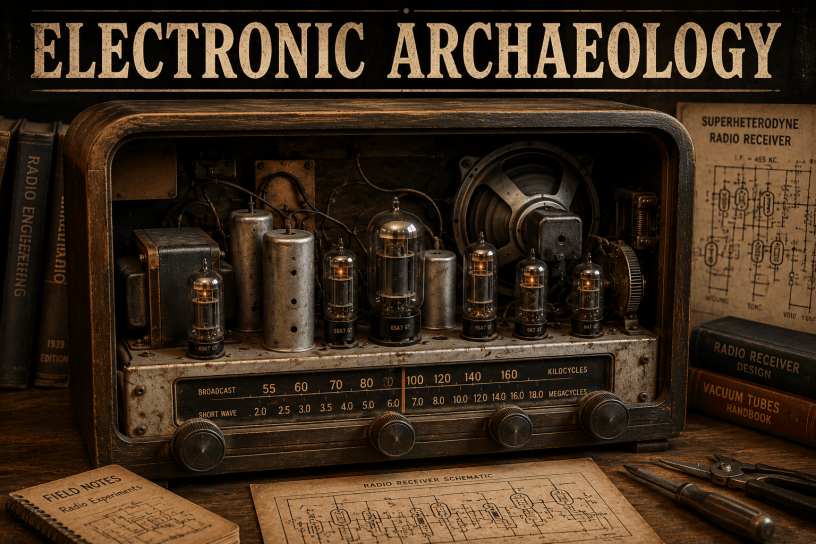
By Cliff Potts, CSO, and Editor-in-Chief of WPS News
Baybay City, Leyte, Philippines — November 6, 2026 — 12:30 p.m.
Last week we followed a radio signal from the microphone to the antenna.
The transmitter converted sound into electromagnetic waves and launched them into the sky.
This week we stand at the other end of that invisible journey.
The radio receiver.
At first glance, a receiver seems almost magical.
Somehow it reaches into empty space, captures an invisible signal traveling at the speed of light, separates one station from thousands of others, and reproduces a human voice through a loudspeaker.
In reality, it performs that task one carefully engineered step at a time.
The journey begins with the antenna.
Unlike a transmitting antenna, which sends electromagnetic energy outward, a receiving antenna intercepts tiny amounts of that energy as the radio wave passes by.
The signal produced at the antenna is incredibly small.
In many cases it measures only millionths of a volt.
By itself, it is far too weak to drive a speaker.
The receiver must strengthen it.
The first stage is usually radio-frequency amplification.
This amplifier increases the strength of the incoming signal while adding as little unwanted noise as possible.
Once the signal has been amplified, it must be separated from all the other radio stations sharing the airwaves.
That is the job of the tuning circuit.
Using carefully selected combinations of inductors and capacitors, the receiver responds strongly to one frequency while rejecting most of the others.
Turn the tuning knob.
The electrical characteristics of the circuit change.
A different station becomes the strongest signal.
One station fades away.
Another comes to life.
Electronic Archaeology Note
This was one of the parts of electronics I understood fairly well in school.
What fascinated me wasn’t simply that radios worked.
It was that they could ignore thousands of signals all around them and focus on just one.
As I learned more, I realized that wasn’t magic at all.
It was careful engineering, with every component doing one very specific job.
That idea has stayed with me ever since.
Once the desired station has been selected, another circuit must recover the information carried by the radio wave.
For an AM broadcast, this process is called detection or demodulation.
The receiver removes the radio-frequency carrier, leaving only the original audio signal.
What began as a voice in front of a microphone has completed nearly its entire journey.
One step remains.
The recovered audio signal is still extremely weak.
Audio amplifiers increase its strength until it is powerful enough to drive headphones or a loudspeaker.
The loudspeaker converts the electrical signal back into moving air.
Moving air becomes sound.
The listener hears the original voice.
The entire journey has been completed.
Voice.
Electricity.
Radio wave.
Electricity again.
Sound.
All in a fraction of a second.
The remarkable thing is that every stage depends upon principles we have already studied.
The power supply energizes the receiver.
Resistors establish operating conditions.
Capacitors filter unwanted signals.
Transformers may match circuits together.
Vacuum tubes—or today, transistors—provide amplification.
Oscillators help tune the desired station.
Nothing appears by magic.
Every component contributes.
Early receivers were relatively simple.
Crystal radios required no external power source at all, relying entirely on the energy captured by the antenna.
Later receivers added amplification.
Vacuum tubes dramatically improved sensitivity and audio quality.
Eventually engineers developed the superheterodyne receiver, one of the greatest advances in radio history.
That remarkable design remains the foundation of many radio receivers today.
We will examine it next week.
Electronic Archaeology reminds us that a radio receiver is one of the finest examples of systems engineering ever developed.
No single component performs the miracle.
The miracle occurs because dozens of carefully designed components cooperate with one another.
Each performs one task.
Together they accomplish something extraordinary.
Every time you hear a voice emerge from a radio, remember what is actually happening.
Invisible electromagnetic waves are arriving from the atmosphere.
Tiny electrical currents are flowing through carefully designed circuits.
Electrons are doing their work silently inside the receiver.
And somewhere, perhaps hundreds or thousands of kilometers away, another person spoke into a microphone.
That voice has just crossed the sky.
Next week we will examine the invention that transformed radio forever.
The superheterodyne receiver.
More than a century after its invention, it remains one of the most elegant and influential electronic circuits ever designed.
If this work helps you understand what’s happening, help me keep it going: https://www.patreon.com/cw/WPSNews
For more from Cliff Potts, see https://cliffpotts.org
References
Horowitz, P., & Hill, W. (2015). The Art of Electronics (3rd ed.). Cambridge University Press.
Hayward, W. M. (2001). Experimental Methods in RF Design. American Radio Relay League.
Encyclopaedia Britannica. (2025). Radio receiver. Encyclopaedia Britannica. https://www.britannica.com/technology/radio-receiver
Discover more from WPS News
Subscribe to get the latest posts sent to your email.

