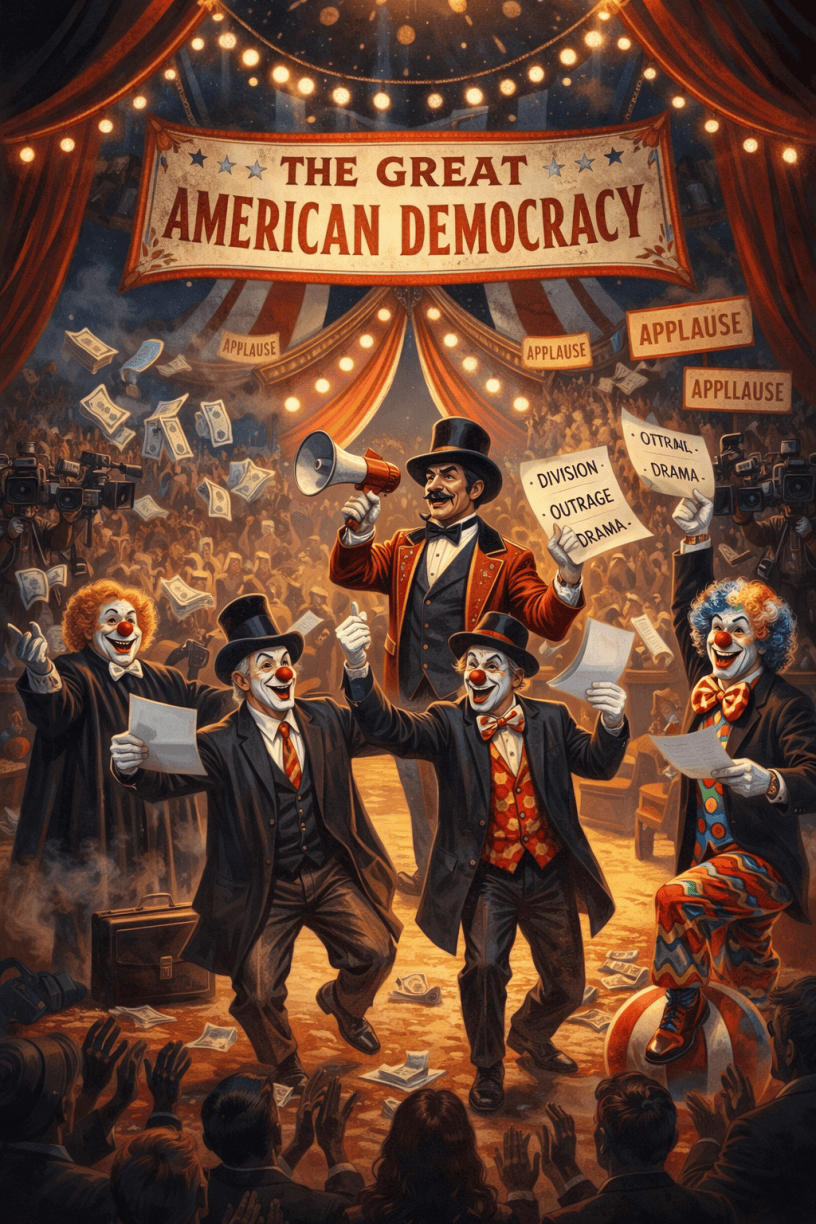
How Political Theater Replaces Accountability—and Why It Keeps Working
By Cliff Potts
Editor-in-Chief, WPS News
The Show Is the Point
Modern American politics is not governed primarily through policy outcomes. It is governed through performance. The conflict voters see is not incidental to the system—it is the system. The shouting, the outrage, the ritualized scandal, and the carefully staged confrontations are not signs of collapse. They are signs of professional execution.
This is not dysfunction. It is choreography.
Like any successful show, it depends on distraction, timing, and misdirection. The audience must believe the drama is real, even as the structure beneath it remains largely unchanged.
Lawyers as Performers
The overwhelming presence of lawyers in Congress is not a coincidence. Legal training emphasizes adversarial performance, command of language, and strategic escalation without irreversible commitment. Lawyers are trained to argue forcefully while preserving optionality. They know how to press right up to the line without crossing it.
This makes them ideal performers in a political system that requires visible conflict without systemic disruption.
They argue loudly.
They threaten symbolically.
They retreat procedurally.
The audience mistakes intensity for consequence.
Spectacle as Substitution
Political theater fills a critical vacuum: it substitutes spectacle for accountability. While voters are focused on personalities, insults, and performative outrage, core policy structures persist with minimal scrutiny. Economic frameworks, donor influence, regulatory continuity, and institutional priorities remain remarkably stable beneath the noise.
The conflict is real in tone, but limited in scope.
This substitution is effective because it satisfies emotional demand without requiring structural change. Voters feel represented because they see “their side” fighting—even when nothing materially shifts.
The Illusion of Choice
Elections reinforce this dynamic. Voters are presented with stark rhetorical contrasts that imply transformative difference, while the boundaries of acceptable policy remain tightly constrained. The spectacle resets every cycle, but the architecture of power rarely does.
This is why disappointment follows victory so reliably. The show promised catharsis. The structure never intended to deliver it.
Why the Performance Persists
Political theater persists because it works—for donors, institutions, and the political class itself. It channels public anger into symbolic conflict, preventing that anger from consolidating around structural critique. It keeps the audience divided, invested, and emotionally engaged without threatening the underlying system.
As long as the performance holds, the institution remains stable—even if public trust erodes.
Stability is maintained not by consensus, but by distraction.
When the Curtain Fails
The danger is not that the performance continues. The danger is that it eventually fails.
When spectacle can no longer absorb pressure—when words stop working, when performance no longer satisfies—the system loses its primary containment mechanism. That is when instability moves from symbolic to structural.
Until then, the show will go on.
Not because it is honest.
But because it is effective.
For more social commentary, please see Occupy 2.5 at https://Occupy25.com
References (APA)
Debord, G. (1967). The society of the spectacle. Buchet-Chastel.
Goffman, E. (1959). The presentation of self in everyday life. Anchor Books.
Mann, T. E., & Ornstein, N. J. (2012). It’s even worse than it looks: How the American constitutional system collided with the new politics of extremism. Basic Books.
Discover more from WPS News
Subscribe to get the latest posts sent to your email.

