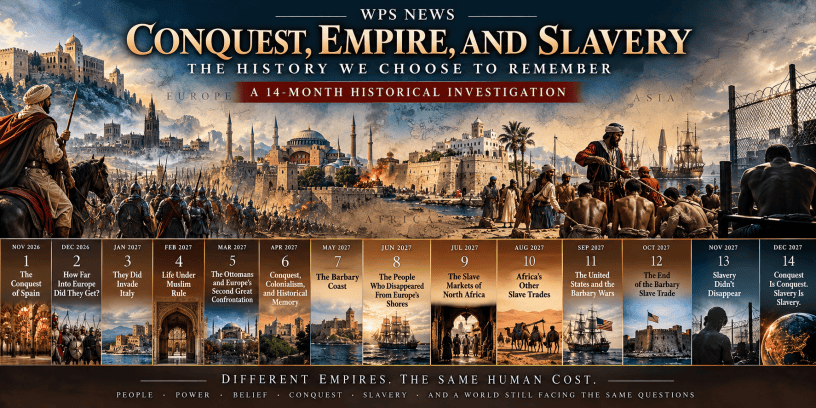
Conquest, Empire, and Slavery — Part 1 of 14
By Cliff Potts | WPS News
BAYBAY CITY, Philippines — November 15, 2026 | 21:05 PHT
In the year 711, an army crossed the Strait of Gibraltar from North Africa into what is now Spain. Within a few years, much of the Iberian Peninsula had fallen under the control of a rapidly expanding Islamic empire.
This was not a peaceful migration. It was a military conquest.
The invading forces defeated an existing government, occupied territory, established new political authorities, and incorporated much of the peninsula into the Umayyad Caliphate.
Yet the story is more complicated than an invading Muslim army overthrowing Christian Europe. It involves political instability, competing aristocrats, religious persecution, military ambition, negotiated surrender, and centuries of cultural transformation.
It also raises a question that will guide this fourteen-part WPS News investigation:
Why do we remember some imperial conquests as colonialism while treating others as ordinary chapters of history?
An Empire Already on the Move
By 711, the Umayyad Caliphate, governed from Damascus, had expanded across the Middle East and North Africa.
Its armies had defeated powerful opponents, including forces of the Byzantine and Sasanian empires. Its territories stretched across enormous distances, encompassing populations with different languages, religions, and political traditions.
North Africa had not simply welcomed every new ruler. Indigenous Amazigh, commonly called Berber, communities had resisted successive imperial authorities, including Muslim conquerors.
Nevertheless, by the early eighth century, North Africa had become a launching point for further Umayyad expansion.
Across the narrow Strait of Gibraltar stood the Visigothic kingdom of Hispania.
And that kingdom was experiencing serious internal problems.
Spain Was Already Divided
The Visigoths had ruled much of the Iberian Peninsula for centuries. Their kingdom was Christian, but its political leadership was divided by disputes over succession and aristocratic power.
King Roderic, who ruled during the invasion, faced opposition from rival factions.
The kingdom also had a history of persecuting Jewish communities through discriminatory legislation and coercive religious policies.
These divisions mattered.
An invading army does not always need overwhelming numbers when the government it confronts is already struggling to maintain authority.
Some later accounts describe rival Visigothic factions cooperating with the invaders. However, historians disagree about the details because surviving contemporary documentation is limited.
What is reasonably clear is that the Visigothic monarchy was vulnerable when the invasion began.
Tariq ibn Ziyad Crosses the Strait
The commander most closely associated with the invasion was Tariq ibn Ziyad, a military leader serving the Umayyad administration in North Africa.
His army consisted largely of North African Berber soldiers, alongside Arab forces.
In 711, Tariq crossed into southern Iberia.
The name Gibraltar itself derives from Jabal Tariq, meaning Tariq’s mountain.
Later that year, his forces defeated King Roderic’s army in the battle traditionally known as Guadalete. Roderic apparently died during the campaign.
The defeat was catastrophic for the Visigothic monarchy.
Without effective central leadership, resistance became fragmented. Some cities fought. Others negotiated surrender.
The following year, Musa ibn Nusayr, the Umayyad governor of North Africa, arrived with additional forces.
The conquest accelerated.
By approximately 718, Muslim-led armies controlled most of the Iberian Peninsula, although Christian-controlled territories survived in the north.
The conquered territories became known as al-Andalus.
What Conquest Actually Meant
It is important to distinguish military conquest from the immediate transformation of an entire population.
The inhabitants of Iberia did not suddenly become Muslims.
Large Christian and Jewish populations remained under the new government. Many continued practicing their religions, although their legal status and obligations differed from those of Muslims.
Some communities negotiated agreements preserving property, religious institutions, or limited local authority in exchange for submission and taxation.
Others experienced warfare, confiscation, displacement, or political upheaval.
The governing system changed, but daily life varied according to location, period, social standing, and the policies of individual rulers.
Over generations, conversion to Islam increased. Arabic became increasingly influential in administration, scholarship, and culture.
This transformation took centuries, not weeks.
Conquest and Civilization Are Not Opposites
One of the most misleading approaches to this history is to insist that al-Andalus must have been either an enlightened paradise or an oppressive nightmare.
It was neither uniformly.
Muslim-ruled Iberia eventually produced extraordinary achievements in architecture, agriculture, medicine, mathematics, philosophy, and literature.
Córdoba became a major intellectual and commercial center.
Muslims, Christians, and Jews sometimes collaborated in scholarship, trade, and cultural production.
But intellectual achievement does not erase the circumstances of conquest.
Nor does military conquest erase the achievements of people who lived under the resulting political order.
The Roman Empire produced roads, legal institutions, and remarkable engineering. It also conquered territories and enslaved human beings.
The British Empire developed extensive administrative, commercial, and transportation networks while simultaneously exercising colonial domination.
The same historical standard must apply to the Umayyads.
A civilization can contribute substantially to human knowledge while exercising coercive imperial power.
Both facts belong in the historical record.
Was This Colonialism?
The answer depends partly on how the term is defined.
The Umayyad expansion involved foreign military conquest, political subordination, imperial administration, and the movement of people, languages, and institutions across conquered territory.
Those characteristics overlap with processes historians associate with colonialism.
However, the early medieval Umayyad Empire was not organized identically to modern European overseas colonial systems.
Its political institutions, religious structures, economic relationships, and patterns of settlement differed.
Calling the conquest imperial expansion is historically straightforward. Whether particular phases of Umayyad rule should also be described as colonialism requires more careful comparison.
What should not be disputed is the basic event.
An army crossed into another kingdom, defeated its rulers, and established a new government.
That is conquest.
The History We Choose to Remember
Modern discussions of colonialism often concentrate on European expansion into the Americas, Africa, and Asia.
There are legitimate reasons for that attention. Those empires helped shape contemporary political borders, economic inequalities, racial hierarchies, and international relationships.
But European colonial history does not represent the entire history of imperial conquest.
Muslim-ruled empires expanded through military force. So did Christian kingdoms, Mongol rulers, Roman emperors, and numerous other political powers.
None deserves exemption from historical examination.
And none of those histories justifies blaming people living today for the actions of rulers centuries ago.
The conquest of Iberia in 711 began a political and cultural transformation that would influence European history for nearly eight centuries.
It also began a long struggle over territory, sovereignty, religion, and identity.
Our next installment will follow the expansion northward, across the Pyrenees, and examine the famous Battle of Tours in 732.
Was that battle really the moment Europe was saved from conquest?
Or has later mythology exaggerated what actually happened?
That is where our investigation goes next.
Conquest is conquest. Empire is empire. And history should apply the same standards to everyone.
APA-Style Source List
Collins, R. (1989). The Arab conquest of Spain, 710–797. Basil Blackwell.
Dodds, J. D. (Ed.). (1992). Al-Andalus: The art of Islamic Spain. Metropolitan Museum of Art. https://www.metmuseum.org/es/met-publications/al-andalus-the-art-of-islamic-spain
Kennedy, H. (1996). Muslim Spain and Portugal: A political history of al-Andalus. Longman.
The Metropolitan Museum of Art. (2001). The art of the Umayyad period in Spain (711–1031). https://www.metmuseum.org/essays/the-art-of-the-umayyad-period-in-spain-711-1031
The Metropolitan Museum of Art. (n.d.). The Spanish Umayyads (711–1031). https://www.metmuseum.org/learn/educators/curriculum-resources/art-of-the-islamic-world/unit-five/chapter-one/the-spanish-umayyads
The Metropolitan Museum of Art. (2016). Artistic interaction among cultures in medieval Iberia. https://www.metmuseum.org/essays/artistic-interaction-among-cultures-in-medieval-iberia
Discover more from WPS News
Subscribe to get the latest posts sent to your email.

