The American Civil War: Civic Life Series (Part 11 of 18)
By Cliff Potts, CSO, and Editor-in-Chief of WPS News
Baybay City, Leyte, Philippines
November 17, 2026
The Civil War was fought with muskets and artillery—but it was also fought with ink.
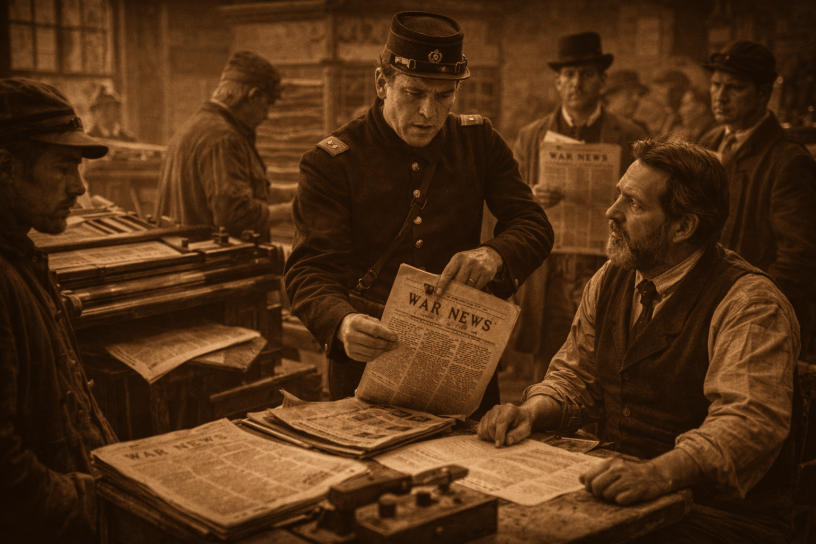
For civilians, newspapers were the primary lens through which the war was understood. They explained victories and defeats, named heroes and traitors, and offered a sense of coherence to events unfolding far away. As the conflict deepened, control over information became a form of power as consequential as control over troops.
The war for legitimacy was also a war for narrative.
Newspapers as Civic Infrastructure
Before radio or mass telegraph networks reached into every home, newspapers were civic infrastructure. They connected towns to the wider world, shaped political identity, and provided a shared account of reality. Reading the paper was not passive consumption; it was participation in public life.
That made newspapers dangerous.
Editors were not neutral observers. Many were openly partisan, framing events to support the Union or the Confederacy, criticize opponents, and rally morale. This partisanship had long existed, but wartime pressure sharpened it into something more brittle and more consequential.
Words could mobilize—or destabilize.
The Rise of Wartime Censorship
As the stakes rose, tolerance narrowed. Governments on both sides moved to suppress reporting deemed harmful to the war effort. Newspapers were shut down, editors arrested, presses destroyed, and distribution routes disrupted.
Official justification was straightforward: information could aid the enemy, undermine morale, or incite resistance. In practice, censorship often extended beyond military necessity into political convenience.
Criticism of leadership became suspect. Calls for negotiation were reframed as disloyalty. Dissent blurred into treason.
Self-Censorship Takes Hold
Formal censorship was only part of the story. Equally powerful was self-censorship.
Editors learned quickly what would bring retaliation. Writers softened language, avoided certain topics, or echoed official statements without verification. Newspapers survived by adapting—not always by telling the full truth.
Readers, too, adjusted expectations. Contradictions between lived experience and printed accounts were noticed but rarely resolved. When news conflicted with rumor, people learned to read between the lines.
Truth became negotiated rather than asserted.
Competing Realities
With information constrained, multiple realities emerged. Different regions—and even neighboring towns—received different versions of events. Losses were minimized. Victories exaggerated. Atrocities ignored or justified.
This fragmentation weakened shared understanding. Civilians no longer argued from common facts, but from competing narratives. Trust in the press eroded alongside trust in institutions.
The war did not only divide territory. It divided perception.
The Cost to Civic Trust
When newspapers ceased to function as credible intermediaries, rumor and speculation filled the void. Informal networks gained influence. Fear spread faster than correction. Confidence in public statements declined.
The long-term cost was severe. Postwar journalism struggled to reclaim authority. Skepticism hardened into cynicism. People remembered being misled—even if they could not always prove it.
Censorship protected short-term stability at the expense of long-term trust.
Looking Back
The Civil War demonstrated that controlling information can sustain a war—but it can also corrode the civic foundations needed to survive it. When truth is constrained, legitimacy weakens. When newspapers become instruments rather than witnesses, citizens lose a shared reality.
This is the eleventh truth of civic breakdown: when information is managed rather than trusted, societies fracture quietly.
The war was fought on battlefields.
But it was also fought in headlines—and the damage there lasted far longer.
McPherson, J. M. (1988). Battle cry of freedom: The Civil War era. Oxford University Press.
Neely, M. E. (1991). The fate of liberty: Abraham Lincoln and civil liberties. Oxford University Press.
Blight, D. W. (2001). Race and reunion: The Civil War in American memory. Harvard University Press.
McCurry, S. (2010). Confederate reckoning: Power and politics in the Civil War South. Harvard University Press.
Library of Congress. (n.d.). Civil War newspapers. https://www.loc.gov/collections/civil-war-newspapers/
Library of Congress. (n.d.). Chronicling America: Historic American newspapers. https://chroniclingamerica.loc.gov
Discover more from WPS News
Subscribe to get the latest posts sent to your email.

