By Cliff Potts, CSO, and Editor-in-Chief of WPS News
Baybay City, Leyte, Philippines — November 27, 2026 — 12:30 p.m.
For nearly six months we have traveled back through the history of electronics.
We began with electricity itself.
We learned about resistors, capacitors, switches, transformers, power supplies, vacuum tubes, oscillators, transmitters, and receivers.
Now it is time for the payoff.
Today we build the simplest practical radio receiver ever invented.
The crystal radio.
What makes a crystal radio remarkable is what it does not require.
No batteries.
No power cord.
No vacuum tubes.
No transistors.
No integrated circuits.
Everything needed to operate the radio comes from the energy carried by the radio station itself.
That idea still amazes people more than a century after crystal radios first appeared.
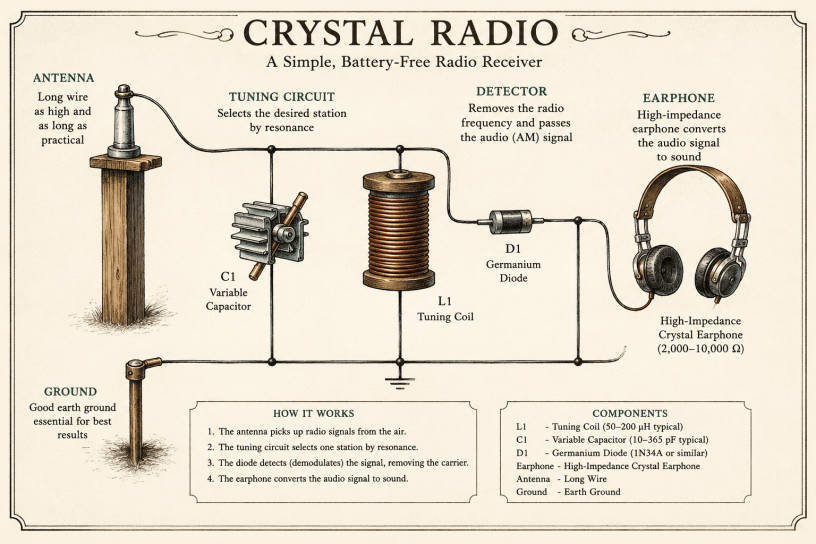
A basic crystal radio contains only a handful of parts.
A long-wire antenna collects the radio signal.
A good earth ground completes the circuit.
A tuning coil and variable capacitor select one station while rejecting others.
A germanium diode detects the AM audio signal.
A high-impedance crystal earphone converts the tiny electrical signal into sound.
That is all.
Each of those components should sound familiar.
We have spent the entire season learning exactly what each one does.
Now they finally work together.
Electronic Archaeology Note
One of the goals I had for this series was to reach a point where the theory stopped being theory.
I wanted us to arrive at something you could actually build.
Not because the crystal radio is the most advanced receiver ever designed.
It certainly isn’t.
But because it demonstrates almost every principle we’ve studied without hiding anything behind complicated circuitry.
If you understand how a crystal radio works, you’ve taken an important step toward understanding every radio that followed.
The antenna gathers a tiny amount of energy from the passing radio wave.
The tuning circuit chooses the station.
The diode removes the radio-frequency carrier and leaves only the audio.
The crystal earphone turns that electrical signal into sound.
There are no amplifiers.
The energy reaching your ear comes directly from the radio station’s transmitter.
That is one of the reasons crystal radios require a long outdoor antenna and a good ground connection.
The available energy is extremely small.
Every bit of signal matters.
Building one today is slightly different than it was a hundred years ago.
Some components are no longer common.
Variable tuning capacitors are usually salvaged from older radios or purchased from specialty electronics suppliers.
High-impedance crystal earphones are less common than modern headphones and may require a little searching.
Germanium diodes remain available from electronics distributors and hobby suppliers because of their excellent performance in crystal radio receivers.
Fortunately, the Internet has made locating these parts much easier than it was only a few decades ago.
The goal is not to build the world’s most powerful receiver.
The goal is to hear your first station.
The moment voices or music emerge from a receiver that has no batteries and no external power supply is unforgettable.
Suddenly everything we’ve studied becomes real.
The invisible radio waves surrounding us every day are no longer an abstract concept.
They become something you can hear.
Electronic Archaeology is about rediscovering the technologies that built our modern world.
The crystal radio represents one of the purest examples of elegant engineering ever created.
With only a handful of components, it demonstrates resonance, tuning, detection, antennas, grounding, and radio propagation.
Few electronic projects teach so much with so little.
Next week we will conclude Season One by looking back over everything we have learned.
From a simple electrical current to a working radio receiver, we have rediscovered the foundations of the Electronic Age.
And this is only the beginning.
Season Two will take us from understanding classic electronics to designing, building, testing, restoring, and safely working with the equipment that defined the twentieth century.
If this work helps you understand what’s happening, help me keep it going: https://www.patreon.com/cw/WPSNews
For more from Cliff Potts, see https://cliffpotts.org
References
ARRL. (2024). The ARRL Handbook for Radio Communications. American Radio Relay League.
Marcus, A., & Marcus, B. (1966). Elements of Radio Servicing. McGraw-Hill.
Encyclopaedia Britannica. (2025). Crystal detector. Encyclopaedia Britannica. https://www.britannica.com/technology/crystal-detector
Discover more from WPS News
Subscribe to get the latest posts sent to your email.

