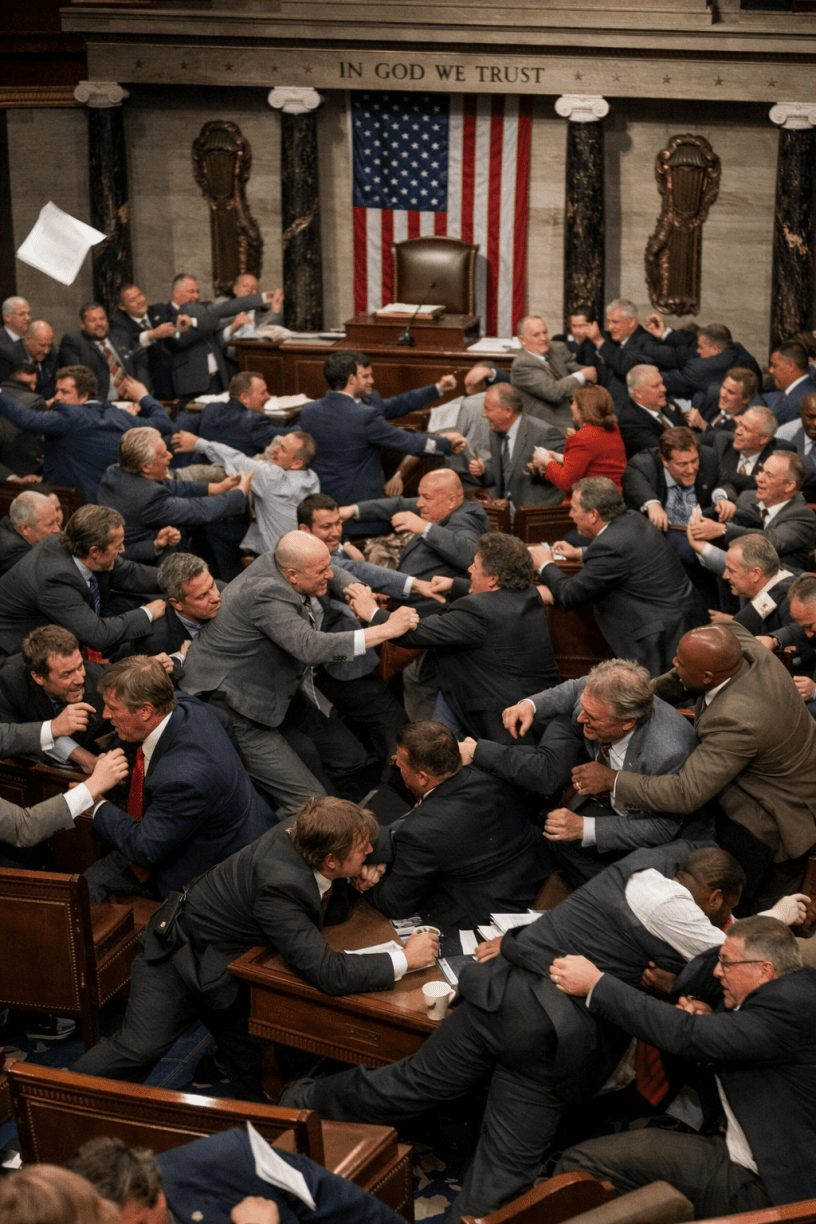
What the Absence of Violence in Congress Tells Us—and What Its Arrival Would Mean
By Cliff Potts
Editor-in-Chief, WPS News
Rhetoric Without Rupture
Since 2020, the U.S. House of Representatives has operated in a state of sustained rhetorical escalation. Members routinely engage in aggressive verbal confrontations, staged outrage, and performative conflict designed for media amplification rather than legislative deliberation. Yet one fact remains decisive: there has been no confirmed physical violence between sitting members on the House floor during this period.
That absence is not trivial. It is predictive.
In unstable legislatures, sustained verbal escalation eventually crosses into physical confrontation. Historically, this has been true both internationally and within the United States prior to the Civil War. The fact that it has not occurred in the modern House indicates that institutional restraint remains intact.
Political Theater as Containment
The highly visible framing of American politics as “Red MAGA versus Blue Resistance” functions primarily as political theater. It reinforces partisan identity, sustains donor engagement, and drives media attention. At the same time, it masks a quieter continuity: broad bipartisan alignment around neoliberal economic structures and the influence of corporate and financial actors within governance.
The conflict is loud. The underlying policy consensus is not.
This does not indicate institutional health. It indicates managed conflict. Members perform anger, but they respect boundaries that protect donor confidence, institutional legitimacy, and personal political survival. The restraint is strategic, not ethical.
Historical Precedent: When Words Turned Physical
There is historical precedent for what happens when rhetorical escalation escapes institutional restraint. In the years immediately preceding the Civil War, congressional debate became increasingly incendiary, personal, and absolutist. The turning point was not merely harsh language, but the moment when political disagreement became physically violent on the Senate floor, signaling that the norms governing conflict had collapsed.
That incident did not cause the Civil War. It revealed that the governing system could no longer contain it.
Violence inside the legislature marked the transition from symbolic polarization to open sectional rupture. Once that line was crossed, compromise was no longer credible, and institutional stability rapidly deteriorated.
Why the Line Has Not Been Crossed—Yet
Physical violence between representatives today would immediately destabilize the institution itself. It would signal loss of control, threaten capital confidence, and undermine the legitimacy of governance. As long as elite political and financial actors maintain leverage through party structures, fundraising mechanisms, and political action committees, internal violence remains unacceptable.
The system tolerates shouting.
It does not tolerate disruption of order.
That distinction is intentional.
January 6 as an Externalized Event
The events of January 6, 2021 do not contradict this analysis. That violence was external to Congress, carried out by non-members, and ultimately absorbed by the system without full accountability for key instigators and enablers. Many retained positions of influence, funding, and institutional support.
The lesson internalized by the political class was not deterrence, but containment.
As long as violence remains externalized—directed outward rather than inward—the institution can continue to function without confronting its own structural fragility.
The Predictor to Watch
The critical indicator of future instability is not rhetoric, polarization, or media outrage. It is loss of restraint among lawmakers themselves.
If physical violence were to occur between representatives—actual assault, not symbolic gesture—it would mark a transition from performative polarization to institutional breakdown. At that point, political theater would no longer be sufficient to manage factional pressure.
Such an event would not be a momentary scandal. It would be an early signal of civil upheaval moving from the public sphere into the governing core.
The Directional Warning
For now, the absence of violence indicates that the system remains controlled, if brittle. The shouting serves a purpose. The restraint serves a higher one.
The danger is not that the performance will continue indefinitely.
The danger is that when it fails, it will fail suddenly—and without a script.
For more social commentary, please see Occupy 2.5 at https://Occupy25.com
References (APA)
Brennan Center for Justice. (2021). The January 6 insurrection and the future of American democracy. https://www.brennancenter.org
Mann, T. E., & Ornstein, N. J. (2012). It’s even worse than it looks: How the American constitutional system collided with the new politics of extremism. Basic Books.
U.S. Capitol Police. (2023). Threat assessment and security trends report. https://www.uscp.gov
Discover more from WPS News
Subscribe to get the latest posts sent to your email.

