Credential Creep, Stagnant Wages, and the Great Cost Transfer
By Cliff Potts
Editor-in-Chief, WPS News
There is a persistent lie in modern corporate America: that professional workers are expensive, privileged, and difficult to manage. The reality is almost the inverse. Today’s professional class is increasingly over-credentialed, under-empowered, and managed as if judgment itself were a liability.
This is not a labor shortage problem.
It is not a motivation problem.
It is a management failure.
And it is structural.
The Professional Class Is No Longer Salaried
One of the most outdated assumptions still circulating in business culture is that “professional” means salaried. That distinction has collapsed.
Across cubicle farms, call centers, compliance offices, operations hubs, and remote workforces, a large share of professional workers are now hourly:
- analysts
- specialists
- credentialed support staff
- escalation teams
- compliance reviewers
- technical coordinators
Many hold multiple degrees. Some carry graduate credentials. They perform white-collar work requiring judgment, discretion, and institutional knowledge — yet they are tracked, scheduled, and disciplined like shift labor.
This is not accidental. Hourly classification preserves control.
It allows organizations to extract professional judgment while denying professional authority.
Credential Creep Is Not About Quality — It Is About Control
Degrees and certifications were once investments made by employers. Companies paid to train workers on specific systems because doing so increased internal capability.
That model collapsed in the 1990s.
Credential management was pushed downward onto workers themselves. Certifications became prerequisites for entry rather than tools for development. Costs shifted from institutions to individuals.
The result was a zero-sum system:
- workers paid for credentials
- credentials expired
- new credentials were demanded
- none guaranteed access to available jobs
Even when certifications demonstrated general competence, workers were excluded for lacking familiarity with an exact proprietary system. Knowing how to run a PBX was no longer enough — it had to be their PBX, regardless of how minor the real differences were in practice.
Credential creep did not raise standards. It narrowed opportunity while preserving managerial discretion.
Productivity Rose. Wages Did Not. That Was a Choice
From the end of World War II through the late 1970s, worker productivity and wages rose together. That relationship broke around 1980.
Since then, U.S. worker productivity has increased dramatically — while real wages for most workers have not.
According to the Economic Policy Institute, between 1979 and 2024, U.S. labor productivity increased by approximately 87%, while typical workers’ real hourly compensation rose only about 33%. Productivity grew nearly three times faster than pay.
Other analyses reach the same conclusion. Adjusted for inflation, American workers today produce more than twice as much output per hour as they did in 1980, yet their real wages have increased by less than 20%. Had wages kept pace with productivity, the median U.S. worker would be earning roughly $8–$10 more per hour today.
This gap is not rhetorical. Inflation adjustment is not a trick. It is the only honest way to measure whether wages actually buy more life.
Productivity gains were captured upward.
Costs and risk were pushed downward.
That outcome was not inevitable. It was the result of deliberate policy and management choices.
Remote Work Was an Emergency Measure — Then It Became a Cost-Transfer System
Remote work did not begin as a benefit. It began as an emergency response.
In 2020, large segments of the professional workforce — particularly call centers and operations staff — were abruptly dispersed because physical workplaces were unsafe. Dense office environments shut down out of necessity, not generosity.
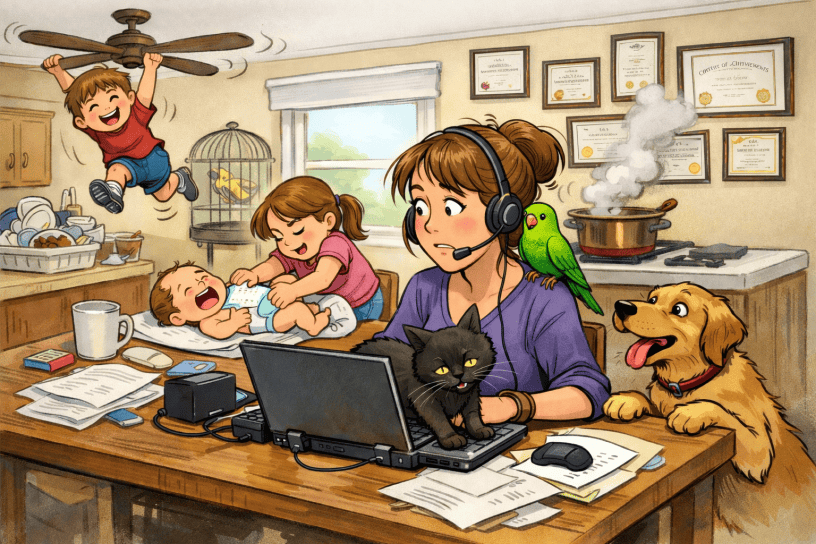
What followed was not a structured transition. Workers were displaced into private living spaces — often small apartments never designed to function as full-time workplaces. For many, this arrangement was psychologically and physically unsustainable. Some left the workforce entirely, not because they lacked skill, but because the conditions became untenable.
Institutional support largely failed to appear. Workers were expected to provide:
- their own desks and chairs
- their own ergonomic solutions
- their own internet connectivity
- their own utilities
Employers typically supplied only the computer and phone — not as a benefit, but because proprietary systems required it.
This was not flexibility.
It was cost transfer.
$700 Billion Went Upward — Workers Got the Bill
Between 2020 and 2025, U.S. companies saved or monetized an estimated $600–$800 billion in cumulative capital and operating costs by shifting large portions of their workforce to home-based and remote arrangements. A conservative midpoint estimate places the figure at roughly $700 billion.
Those savings came primarily from:
- eliminated or reduced office leases
- sale of owned office buildings
- subleasing excess space
- reduced utilities, maintenance, security, and facilities staffing
Across tech, finance, and customer-support sectors, employers saved an estimated $10,000–$11,000 per remote-capable employee per year in overhead alone. Over five years, this amounted to one of the largest upward cost transfers in modern corporate history.
Workers did not share in those gains.
No wage adjustment followed.
No productivity dividend was paid.
Claims that home-based agents were “more expensive” do not survive scrutiny. Productivity rose. Overhead dropped. Efficiency improved. Profit margins often expanded.
The narrative of loss was managerial, not financial.
Distributed Cubicle Farming
What replaced centralized offices was not autonomy. It was distributed cubicle farming.
Remote professional workers — many hourly, credentialed, and experienced — became:
- easier to monitor digitally
- easier to isolate socially
- easier to discipline procedurally
- easier to replace invisibly
Surveillance expanded. Productivity tracking intensified. Boundaries between work and personal life eroded. Advancement became less visible, not more.
Workers were told they were fortunate.
They were absorbing costs once borne by employers.
Authority Has Been Separated from Responsibility
Responsibility flows downward. Authority does not.
Professionals are expected to:
- solve problems
- absorb blame
- protect institutional outcomes
But are denied:
- decision rights
- policy influence
- structural protection
This separation guarantees burnout — and guarantees mediocrity.
Organizations cannot extract high-level thinking from people they refuse to trust.
Why This Is Mismanagement, Not Inevitability
None of this is forced by technology. None of it is required by markets. These are managerial choices reinforced by fear and habit.
Professional workers are not failing organizations.
Organizations are failing to understand the workers they already have.
The professional class has not been empowered by education — it has been pacified by it.
Until that changes, no amount of hiring, restructuring, or digital transformation will fix what is fundamentally a failure of trust.
For more social commentary, please see Occupy 2.5 at https://Occupy25.com
References (APA)
Economic Policy Institute. (2024). The productivity–pay gap. https://www.epi.org/productivity-pay-gap/
Economic Policy Institute. (2023). Wages for the top 1% soared, while wages for the bottom 90% stagnated. https://www.epi.org/publication/inequality-2023/
Mishel, L., & Bivens, J. (2021). Identifying the policy levers generating wage suppression. Economic Policy Institute. https://www.epi.org/publication/wage-suppression/
Global Workplace Analytics. (2023). Work-from-home cost savings estimates. https://globalworkplaceanalytics.com/
Barrero, J. M., Bloom, N., & Davis, S. J. (2021). Why working from home will stick. National Bureau of Economic Research. https://www.nber.org/papers/w28731
Discover more from WPS News
Subscribe to get the latest posts sent to your email.

