By Cliff Potts
June 4, 2026
A System Built to Limit Exposure
Workers’ compensation is often described as a safety net — a system designed to ensure that employees injured on the job receive prompt medical care and wage replacement without the need for litigation.
That description has not been accurate for a very long time.
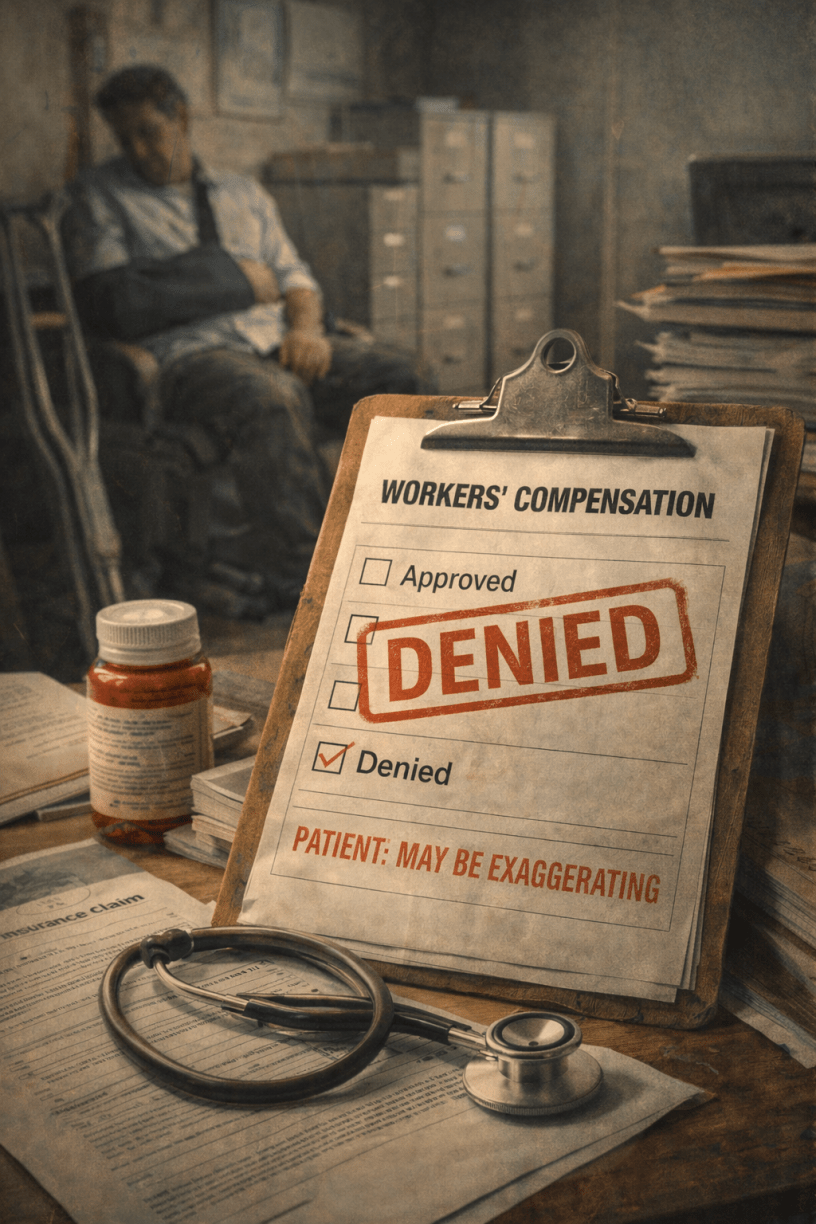
In practice, workers’ compensation in the United States functions less as a healthcare system and more as a liability-management framework. Its primary purpose is not healing. It is cost containment. Medical care exists within it only insofar as it limits long-term financial exposure for employers and insurers.
This distinction explains nearly every frustration injured workers encounter once they enter the system.
Care Begins With a Legal Question
In ordinary healthcare, the first question is clinical: What is wrong, and how do we treat it?
In workers’ compensation, the first question is legal: Is this compensable?
Before treatment decisions are made, causation must be established. Was the injury work-related? Was it preexisting? Was it aggravated by work or merely coincidental? Each of these questions delays care and reframes the body as evidence rather than a patient.
For acute injuries with clear mechanisms, this process can be relatively straightforward. For cumulative trauma — the kind associated with prolonged desk work, repetitive motion, and chronic strain — it becomes adversarial almost immediately.
Independent Medical Exams and Managed Doubt
One of the defining features of the workers’ compensation process is the independent medical examination. Despite the name, these exams are rarely neutral. They are commissioned to answer narrow legal questions, not to design treatment plans.
The injured worker may see multiple physicians, each tasked with assessing impairment, causation, or work capacity rather than recovery. Conflicting opinions are common. Treatment stalls while reports circulate. Time passes.
Delay is not a side effect of the system. It is one of its most effective tools.
As months stretch into years, symptoms may worsen or become permanent. At that point, responsibility can be deflected again — this time onto the passage of time itself.
Function Over Healing
Within workers’ compensation, the goal is rarely full recovery. The operative standard is “maximum medical improvement,” a term that often signals the end of care rather than its success.
Improvement does not mean restored health. It means no further treatment is deemed cost-effective. Workers may still be in pain, limited, or impaired, but the system considers them stabilized enough to be managed.
Return-to-work decisions frequently prioritize functional capacity over long-term wellbeing. If a worker can perform some job duties, even at reduced effectiveness or increased pain, the system has achieved its objective.
The question is never whether the body has healed. It is whether the claim has been contained.
Universal Healthcare as the Missing Release Valve
This structure persists because healthcare access in the United States is conditional. Treatment is tied to fault, coverage, and eligibility rather than need.
In a universal healthcare system, many of these conflicts would dissolve. Injured workers would receive care without first proving causation to an insurer. Treatment decisions would be medical, not legal. Recovery would not depend on navigating an adversarial process while injured.
The absence of such a system allows workers’ compensation to function as a gatekeeper rather than a caregiver.
The Human Cost of Cost Control
For injured workers, the experience is often demoralizing. Pain is acknowledged but questioned. Treatment is offered but delayed. Every interaction carries an implicit message: prove it, justify it, endure it.
Over time, many disengage. They accept partial recovery. They self-manage pain. They exit the workforce entirely. These outcomes are recorded as resolutions rather than failures.
From an accounting perspective, the system works.
From a human perspective, it does not.
Workers’ compensation was never designed to heal bodies. It was designed to manage risk. Understanding that reality does not make the injuries easier to live with, but it does make the process comprehensible.
The system behaves exactly as it was built to behave.
For more social commentary and science fiction works extraordinaire, see Occupy 2.5 at https://Occupy25.com
References (APA)
Boden, L. I., & Spieler, E. A. (2001). Social and economic impacts of workplace injury and illness. Journal of Occupational and Environmental Medicine, 43(6), 506–514.
Dembe, A. E. (2001). The social consequences of occupational injuries and illnesses. American Journal of Industrial Medicine, 40(4), 403–417. https://doi.org/10.1002/ajim.1111
Hadler, N. M. (1996). If you have to prove you are ill, you can’t get well. Carolina Academic Press.
Player, E. A., & Burton, J. F. (2012). The lack of correspondence between work-related disability and receipt of workers’ compensation benefits. Workers Compensation Research Institute.
Rosenman, K. D., Gardiner, J. C., Wang, J., Biddle, J., Hogan, A., Reilly, M. J., & Zhu, Z. (2000). Why most workers with occupational repetitive trauma do not file workers’ compensation claims. Journal of Occupational and Environmental Medicine, 42(1), 25–34.
Discover more from WPS News
Subscribe to get the latest posts sent to your email.

