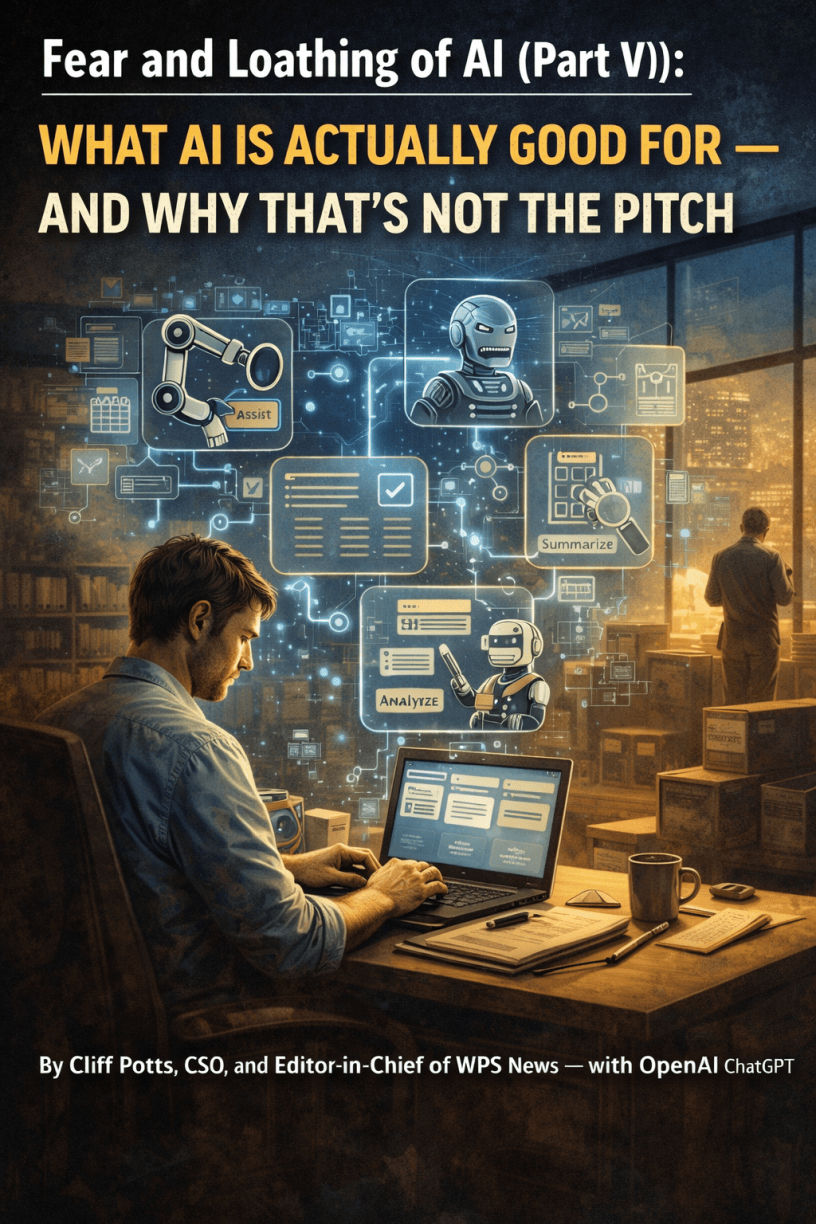
By Cliff Potts, CSO, and Editor-in-Chief of WPS News — with OpenAI ChatGPT
After all the noise, the hype, the fear, and the loathing, it’s worth ending with something unfashionable:
AI is useful.
Just not in the way it’s being sold.
The problem with artificial intelligence is not that it does nothing.
The problem is that what it does well is boring, unheroic, and unsuitable for grand promises.
Which is exactly why it’s rarely the pitch.
What AI is actually good at
AI excels at narrow, bounded tasks:
- summarizing large volumes of text,
- finding patterns in structured data,
- accelerating repetitive workflows,
- reducing clerical friction,
- assisting recall, drafting, and comparison.
It is good at support, not sovereignty.
It does not understand meaning.
It does not generate values.
It does not know what matters.
It rearranges, predicts, and optimizes based on what already exists.
That makes it a powerful assistant — and a terrible authority.
The quiet productivity gain
Used correctly, AI can:
- save time,
- reduce exhaustion,
- lower cognitive load,
- and free human attention for judgment, creativity, and care.
Those gains are real.
They are also modest, incremental, and highly context-dependent.
They do not justify:
- mass social disruption,
- collapsed wages,
- moral abdication,
- or the suspension of accountability.
Which brings us to the real reason this isn’t the pitch.
Why honesty doesn’t sell
“No miracles, but some efficiency gains” does not move venture capital.
“Helpful tool with limits” does not drive platform adoption.
“Assistive technology that requires regulation” does not excite markets.
So the story is inflated.
AI is framed as:
- inevitable,
- transformative,
- autonomous,
- and beyond human oversight.
Not because that is true — but because that framing extracts faster compliance.
The exaggeration is not accidental.
It is structural.
The human responsibility that never goes away
AI does not remove responsibility.
It concentrates it.
Every deployment still involves human choices:
- what to optimize,
- what to ignore,
- who absorbs the risk,
- who captures the gain.
Claiming “the system decided” is not neutrality.
It is abdication.
And abdication, dressed up as inevitability, is one of the oldest tricks in power.
The sane ending
The sane future with AI looks like this:
- Tools remain tools.
- Humans retain override authority.
- Productivity gains are shared, not hoarded.
- Surveillance is limited, not normalized.
- Institutions remain accountable for outcomes.
None of that is automatic.
All of it requires friction — political, legal, and social.
Which is why it is resisted.
Where this leaves us
AI will not save us.
AI will not doom us.
It will do what we allow it to do.
And right now, the loudest voices are not arguing for wisdom, restraint, or shared benefit. They are arguing for speed, dominance, and compliance.
That is not a technological destiny.
It is a choice.
And choices can be changed.
For more social commentary, please see Occupy 2.5 at https://Occupy25.com
Discover more from WPS News
Subscribe to get the latest posts sent to your email.

