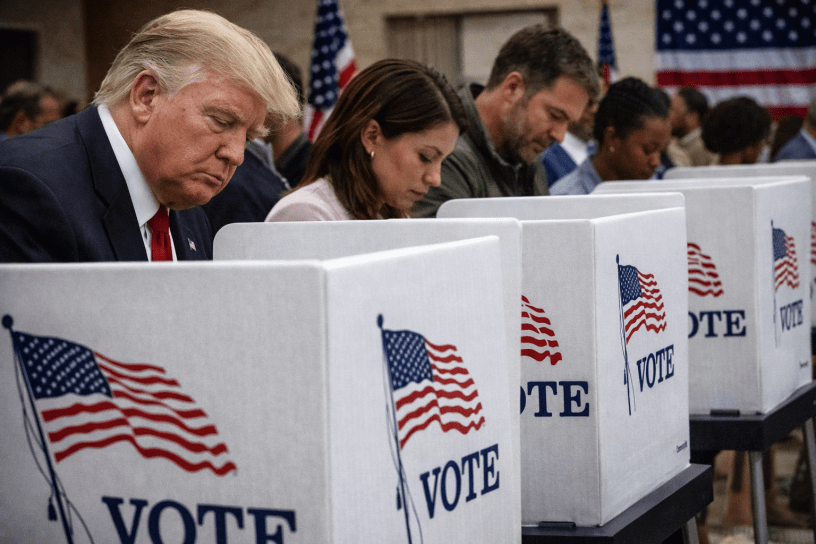
A Systemic Failure of the American Electorate
By Cliff Potts, CSO, and Editor-in-Chief of WPS News
Hiawatha, Iowa, USA
Published: June 1, 2026
The Fact That Should Have Ended the Question
On May 30, 2024, entity[“politician”,”Donald Trump”,”45th and 47th U.S. president”] was convicted by a unanimous jury on 34 felony counts in a New York criminal court.
That sentence should have ended his eligibility for national leadership in the eyes of any functioning democracy.
It did not.
Instead, less than six months later, the American electorate returned Trump to the White House. This was not a clerical error, a constitutional loophole, or a failure of the courts. It was a failure of the voting population itself — systemic, predictable, and deeply rooted in modern American political culture.
This article examines how that failure occurred, not to shame individual voters, but to document the conditions that made such an outcome possible.
Negative Partisanship: Voting Against, Not For
Political scientists have long documented the rise of negative partisanship — the tendency of voters to cast ballots primarily to oppose the other side rather than support their own candidate.
In such an environment, moral disqualifications lose force. A felony conviction does not end consideration if voters believe the alternative represents an existential threat to their identity, values, or social group.
For many Trump voters, the calculation was not whether he was fit to serve, but whether the opposing coalition — Democrats, liberals, elites, institutions — should be stopped at any cost.
In that framing, the law becomes secondary. Loyalty becomes primary.
Motivated Reasoning and the Rejection of Evidence
The conviction did not persuade many voters because persuasion was never possible.
Years of political polarization trained large segments of the electorate to treat unwelcome facts as hostile attacks rather than information. Psychologists refer to this as motivated reasoning: people accept or reject evidence based on whether it protects their existing beliefs and social identity.
Once Trump’s supporters accepted the narrative that he was a victim of political persecution, every legal setback reinforced that belief. The jury verdict was not processed as a legal outcome; it was reframed as proof of corruption.
This is not ignorance. It is identity defense.
Populist Victimhood as a Political Asset
In traditional democratic theory, conflict with the law is disqualifying. In modern populist movements, it can be an asset.
Trump’s political brand is built on confrontation — with courts, media, bureaucracies, and experts. To supporters who view these institutions as illegitimate or hostile, a criminal conviction signals strength, not failure.
The logic is perverse but internally consistent: If powerful institutions are attacking him, he must be fighting for us.
This dynamic turns accountability into martyrdom and collapses the boundary between justice and persecution.
Information Silos and Reality Fragmentation
A functioning electorate requires a shared baseline of facts. The United States no longer has one.
Large segments of the population consume media that minimized, distorted, or outright delegitimized Trump’s conviction. Others avoided the news entirely, overwhelmed by constant crisis.
When voters do not agree on what happened, they cannot agree on what matters.
This fragmentation is not accidental. It has been cultivated for profit, power, and political advantage — and it left millions of voters either misinformed or emotionally exhausted.
Corruption Without Consequence
Political science research consistently shows that voters are less likely to punish corruption when the accused candidate belongs to their partisan group.
Criminality becomes just another contested claim, stripped of its moral weight by team loyalty. Punishment, when it occurs, comes mostly from independents and weak partisans — groups that no longer dominate American elections.
In other words, the system worked exactly as designed.
Performance Politics and the Demand for Dominance
Trump does not campaign on governance. He campaigns on performance.
For voters who feel economically insecure, culturally displaced, or politically ignored, Trump’s belligerence reads as authenticity. His defiance of norms is interpreted as courage. His willingness to break rules is seen as proof he will fight.
In that emotional economy, a felony conviction is irrelevant. What matters is the display of dominance and the promise of retaliation.
The Electoral System Did Not Save Us
Some defenders of the outcome argue that the system worked because the election followed the rules. That is a procedural argument, not a democratic one.
Democracy depends not only on lawful processes but on civic judgment. The Constitution cannot compensate for a population that no longer treats criminality as disqualifying.
The electorate did not malfunction. It revealed its current values.
What This Failure Means
Electing a convicted felon to the presidency was not an accident of history. It was the predictable result of:
- extreme polarization
- identity-based voting
- media fragmentation
- erosion of institutional trust
- and the normalization of political nihilism
Until those conditions change, the outcome will repeat — with different names, different scandals, and the same result.
Conclusion: Naming the Failure
History will not be confused about what happened in 2024. The record is clear.
The American people were presented with a candidate who had been convicted of felony crimes by a jury of his peers — and enough of them decided it did not matter.
That decision belongs to the electorate.
Democracy does not fail only when ballots are stolen. It fails when voters abandon the idea that the law applies to those they admire.
For more social commentary, please see Occupy 2.5 at https://Occupy25.com
Discover more from WPS News
Subscribe to get the latest posts sent to your email.

